Bitcoin crashes to $53K, but analysts warn the worst isn’t over

Bitcoin crashed as low as $53,600 on Coinbase on July 5, the first time the asset has traded at this price since February, and analysts fear the worst is yet to come.
Bitcoin (BTC $54,154) has since leveled out to trade at $54,122 at the time of publication, according to TradingView data.
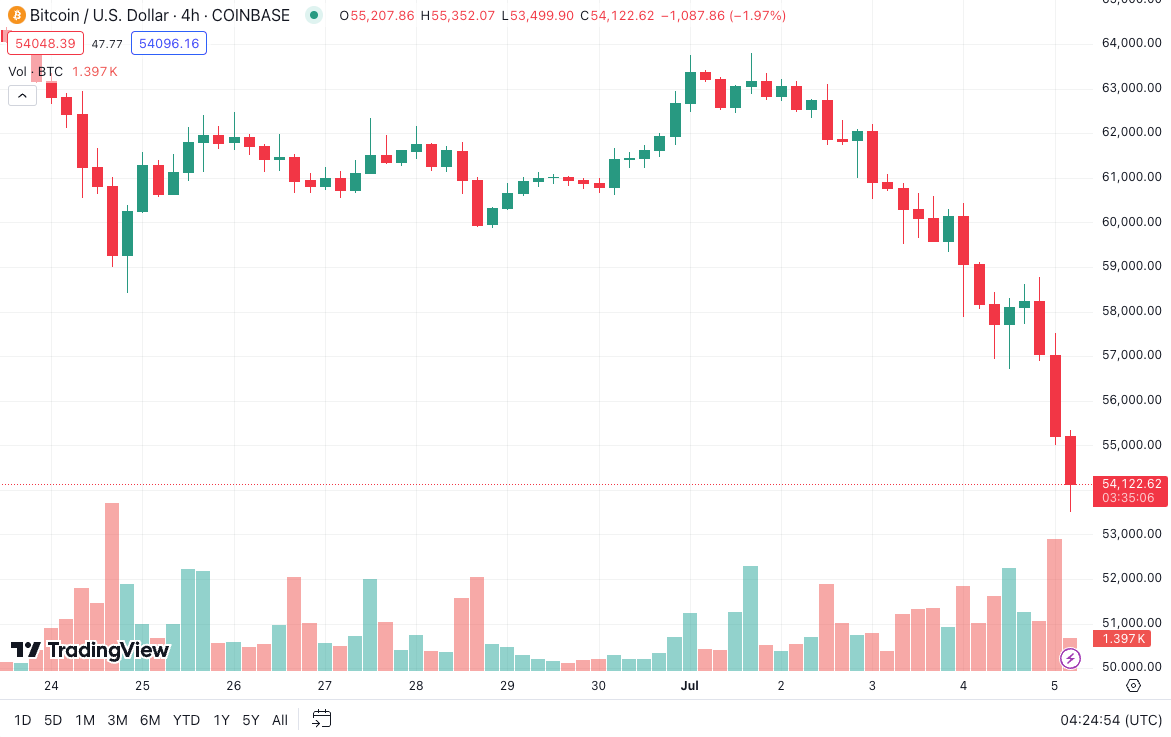
Bitcoin fell as low as $53,600 on Coinbase on July 5. Source: TradingView
Speaking to Cointelegraph, eToro market analyst Josh Gilbert said much of the sell-off could be traced back to fears stemming from Mt. Gox creditor repayments, which will see around $8 billion worth of BTC hit the market in July.
Following the sudden dip to $53,600, Gilbert said he expects to see worsening price action for Bitcoin in the coming days.
“The news flow is far more bearish than bullish right now, and the selling activity we’re seeing is quite clearly unsettling investors, which often drives more selling,” Gilbert said.
It wouldn’t surprise me to see the asset test $50,000 within the next week, but that will be a key physiological level.
“There will be weakness in the short term until we receive a catalyst to drive the price higher, and that might come in the form of investors ‘buying the dip’ or an ETH ETF approval to improve sentiment,” he added.
Similarly, Swyftx analyst Pav Hundal told Cointelegraph that the worst of Bitcoin’s price action could be yet to come.
“A vast wall of Bitcoin is about to meet a market that was already apathetic. The macro conditions long-term are still positive, but short term, we could test 50k and potentially lower. $52k is a key battleground for bears and bulls at the moment,” said Hundal.
Analysts from 10x Research also predicted a continued dip that could see the price of Bitcoin dip to as low as $50,000 in the coming weeks, warning that selling “could accelerate as support gets broken and sellers scramble to find liquidity.”
Reasons to be bullish about Bitcoin
Despite the short-term bearish outlook, Gilbert said there are also reasons for investors to remain bullish on a longer-term time horizon.
We look to catalysts such as the Federal Reserve cutting interest rates in September, with the potential for another cut in December to lift prices.
“On top of that, the full acceptance of an Ethereum ETF from the SEC, with a July launch date, would be a big boost for the crypto market,” he added.
Author

Cointelegraph Team
Cointelegraph
We are privileged enough to work with the best and brightest in Bitcoin.