Gold Price Forecast: XAU/USD yo-yos within $100 range, volatility set to extend
- Gold’s record rally stalls below $4,400; buyers seem to take a breather.
- US Dollar licks its wounds amid US-Sino trade tensions, dovish Fed remarks, extended government shutdown.
- Gold risks further correction on profit-taking, as the daily RSI remains extremely overbought.
Gold experiences intense volatility in the Asian trading hours on Friday, driven by a bout of profit-taking and risk-off flows, following the latest parabolic rise to new record highs near $4,380.
Gold weighs dovish Fedspeak against profit-taking
Gold yo-yos within a $100 range, eyeing a ninth consecutive weekly advance. Gold looks to book a whopping 8% gain this week, mainly driven by massive supply for the US Dollar amid renewed US-China trade tensions and dovish reinforcement surrounding US Federal Reserve (Fed) interest rate cuts.
In a latest spat between the US and China, the latter accused the US of exaggerating its rare earth export controls to stir panic, rejecting calls to roll them back.
Meanwhile, S&P Global estimated that US President Donald Trump’s tariffs will cost global firms $1.2 trillion in 2025, with about two-thirds of the burden falling on consumers.
Additionally, the latest round of Fedspeak helped double down on bets for two Fed rate cuts this year and weighed on the US Treasury bond yields, as investors remain wary of the impact of the tariffs and the ongoing government shutdown on the US economy.
Fed Governor Christopher Waller said on Thursday that a 25 bps rate cut is justified at the upcoming meeting, based on current data.
Minneapolis Fed President Neel Kashkari warned late Thursday, there is “more risk of labor market negative surprise than an uptick in inflation,” implying that there is scope for more rate cuts.
However, the correction in Gold seems to be sponsored by fresh optimism on a potential Russia-Ukraine peace deal as Trump and Ukrainian President Volodymyr Zelenskyy in Washington on Friday.
A Kremlin aide said recently that a Trump–Putin call lasted almost 2.5 hours and that the “call was substantive and open.” Both leaders discussed possible Tomahawk missile deliveries.
Separately, Zelenskyy said that he is “counting on the momentum that helped end terror and war in the Middle East to also help end the war with Russia.”
Further, markets resorted to taking profits off the table heading into the weekend, with the end-of-the-week flows likely in play going forward. All in all, another volatile session remains on the cards.
Gold price technical analysis: Daily chart
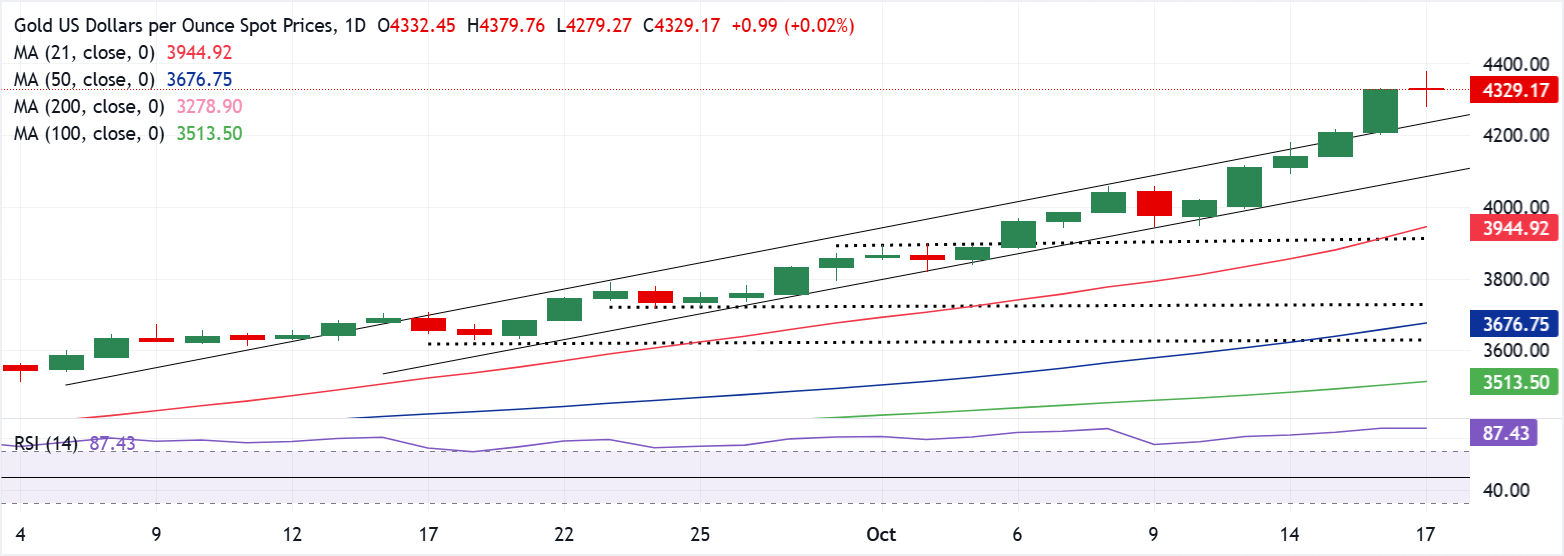
The short-term technical outlook for Gold remains more or less the same, with the ‘hot run’ triggering timely bouts of profit-taking, justified by the 14-day Relative Strength Index (RSI) stretching within the extreme overbought zone, currently near 87.50.
Risks are skewed more in favor of an extension to the latest steep corrective downside, with the immediate cushion seen at the rising channel resistance-turned-support at $4,243.
If that cap gives way, sellers could flex their muscle toward the actual channel support at $4,095.
The natural tendency of the rising channel formation is a break to the downside and hence, a daily candlestick close below the latter could confirm a bearish breakdown, initiating a fresh correction toward the $3,950-$3,900 demand area, where the 21-day Simple Moving Average (SMA) and the October 1 and 2 highs lie.
On the flip side, a retest of the lifetime highs at $4,379 will be inevitable if buyers fight back control. The $4,450 psychological level and the $4,500 round figure will be next on their radars.
Gold FAQs
Gold has played a key role in human’s history as it has been widely used as a store of value and medium of exchange. Currently, apart from its shine and usage for jewelry, the precious metal is widely seen as a safe-haven asset, meaning that it is considered a good investment during turbulent times. Gold is also widely seen as a hedge against inflation and against depreciating currencies as it doesn’t rely on any specific issuer or government.
Central banks are the biggest Gold holders. In their aim to support their currencies in turbulent times, central banks tend to diversify their reserves and buy Gold to improve the perceived strength of the economy and the currency. High Gold reserves can be a source of trust for a country’s solvency. Central banks added 1,136 tonnes of Gold worth around $70 billion to their reserves in 2022, according to data from the World Gold Council. This is the highest yearly purchase since records began. Central banks from emerging economies such as China, India and Turkey are quickly increasing their Gold reserves.
Gold has an inverse correlation with the US Dollar and US Treasuries, which are both major reserve and safe-haven assets. When the Dollar depreciates, Gold tends to rise, enabling investors and central banks to diversify their assets in turbulent times. Gold is also inversely correlated with risk assets. A rally in the stock market tends to weaken Gold price, while sell-offs in riskier markets tend to favor the precious metal.
The price can move due to a wide range of factors. Geopolitical instability or fears of a deep recession can quickly make Gold price escalate due to its safe-haven status. As a yield-less asset, Gold tends to rise with lower interest rates, while higher cost of money usually weighs down on the yellow metal. Still, most moves depend on how the US Dollar (USD) behaves as the asset is priced in dollars (XAU/USD). A strong Dollar tends to keep the price of Gold controlled, whereas a weaker Dollar is likely to push Gold prices up.
Author

Dhwani Mehta
FXStreet
Residing in Mumbai (India), Dhwani is a Senior Analyst and Manager of the Asian session at FXStreet. She has over 10 years of experience in analyzing and covering the global financial markets, with specialization in Forex and commodities markets.