GBP/USD Weekly Forecast: All eyes on Fed, BOE for a fresh direction
- GBP/USD broke below its range ahead of the critical Fed/ BOE decisions.
- Risk-off flows dominated amid resurfacing growth and inflation fears.
- Fed-BOE policy divergence to keep GBP/USD on the back foot.

After finishing the week in negative territory, GBP/USD is looking forward to the Fed and BOE monetary policy decisions in the week ahead for the next directional bias. Mounting tensions over a looming recession and higher inflation dominated financial markets and favored the safe-haven US dollar throughout the week. Meanwhile, UK political jitters and dire economic outlook weighed on the pound.
GBP/USD enjoyed good two-way business
GBP/USD opened the week a tad lower, and went on to fluctuate in a familiar range throughout the week. Bulls continued to reach for the 1.2600 level while their commitments were tested near the 1.2400 mark. Most traders remained on the sidelines and refrained from placing any fresh bets on cable amid UK political tensions and risks of a potential global recession.
The pair found support near the 1.2480 region on Monday and staged a modest rebound on the first trading day of the week. Bulls remained hopeful as the UK PM Boris Johnson braced for a confidence vote so that he can keep his position as the PM and the leader of the Conservative Party.
The dollar remained on the back foot, as risk flows returned at the start of the week, with thin trading conditions on account of the Whit Monday holiday in Europe. Investors mainly cheered the news of Beijing easing covid restrictions.
Cable capitalized on PM Johnson’s confidence vote win on Tuesday, as 211 lawmakers voted in his favor. Although UK political jitters remained in play and took the steam out the pair’s upturn. Sir Graham Brady, Chairman of the 1922 Committee said that it was technically possible to change the rule on the grace period which states that another confidence vote cannot take place for another year, reviving the spectre of a repeat vote on Johnson’s tenure.
Traders also remained unnerved ahead of PM Johnson’s rollout of new policy measures. The pair hit fresh two-week lows of 1.2430 on Tuesday after facing rejection at 1.2600.
The tide turned in favor of GBP/USD bears from Wednesday, as safe-haven demand for the dollar saw a revival on the return of concerns over a potential recession after the World Bank and the OECD slashed the world’s 2022 growth forecasts.
Surging oil prices exacerbated inflation concerns and added to the dour market mood, as it raised expectations of aggressive monetary policy tightening by the major central banks. The same fears turned into reality after the Reserve Bank of Australia (RBA) and the European Central Bank (ECB) gave more hawkish-than-expected assessments at the policy meetings in an effort to reign in the monster of inflation.
The spot headed towards the multi-week lows near 1.2400 once again. The pound traders also assessed PM Johnson’s policy speech, as he said that the United Kingdom is in a better position than in the past, adding that there is no quick fix to the situation in Ukraine, which has already fuelled raging inflationary pressures and is expected to continue to.
Risk-aversion remained at full steam, bolstering the dollar rally while the Treasury yields also touched monthly highs ahead of Friday’s critical US inflation data, further supporting the buck.
The US Bureau of Labor Statistics reported on Friday that annual inflation in the US, as measured by the Consumer Price Index (CPI), jumped to a fresh multi-decade high of 8.6% in May from 8.3% in April. The Core CPI, which excludes volatile food and energy prices, edged lower to 6% in the same period but came in above the market expectation of 5.9%. With safe-haven flows dominating the markets on hot US inflation data, the dollar continued to gather strength ahead of the weekend and GBP/USD plunged to fresh multi-week lows below 1.2350.
A busy week ahead
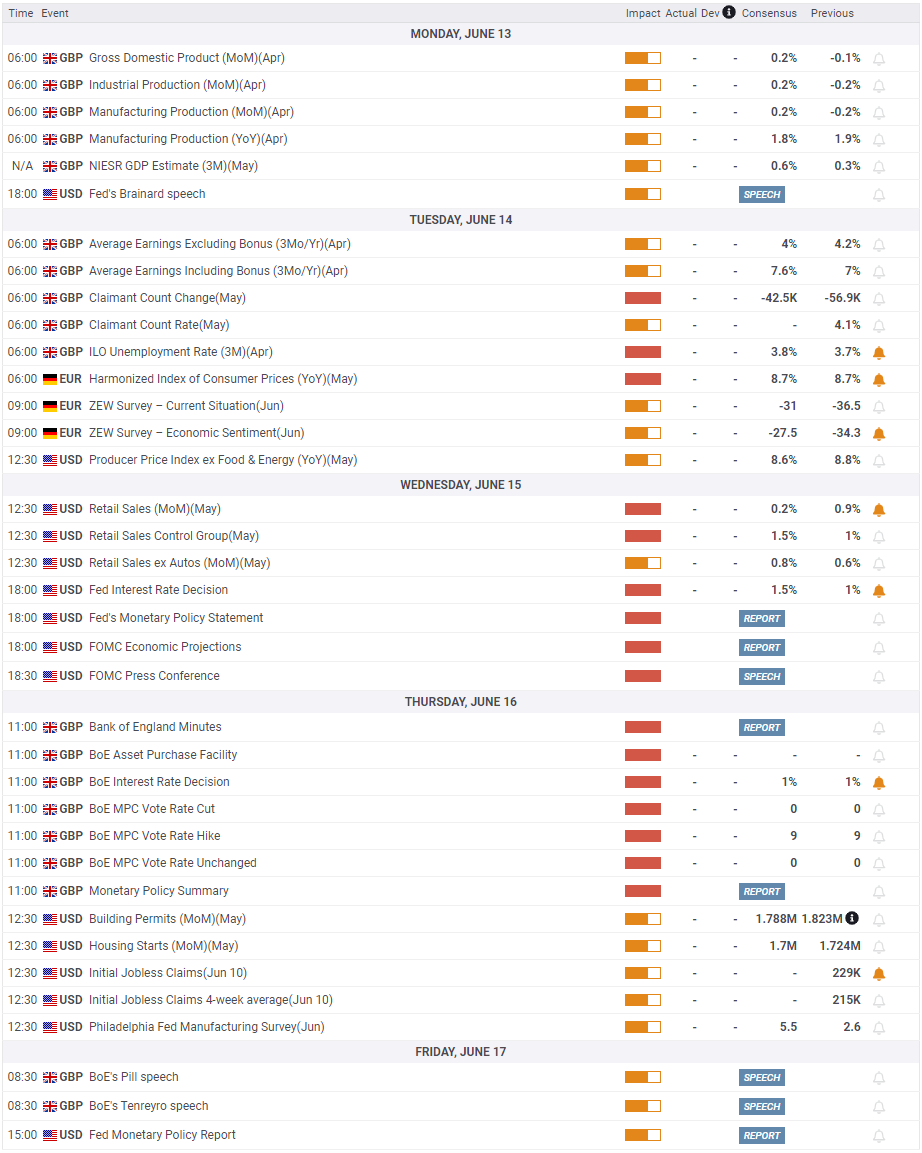
Cable traders are braced for a busy week ahead as from the word go, on Monday monthly UK GDP figures will be released alongside the country’s manufacturing and industrial figures.
Tuesday’s economic calendar is relatively busier, as it sees the UK Employment data dropping in, followed by the US Producer Price Index (PPI) release.
The US Retail Sales and the FOMC policy decision will emerge as the big market mover before Thursday’s Bank of England (BOE) interest rate announcement.
The Fed is likely to hike interest rates by 50 bps at its June policy meeting, as pre-committed. Hints on the scale of the September rate lift-off will be closely examined for the dollar valuations, which eventually impact GBP/USD.
The UK central bank is expected to leave key rates unchanged at 1%, as it looks to balance growth while fighting inflation. The BOE’s voting composition, rate hike guidance and the inflation outlook will hold the key to sterling’s next directional move.
The final trading day of the week will offer the UK Retail Sales, BOE-speak and Fed’s Monetary Policy report, to wrap up an eventful week.
GBP/USD: Technical outlook
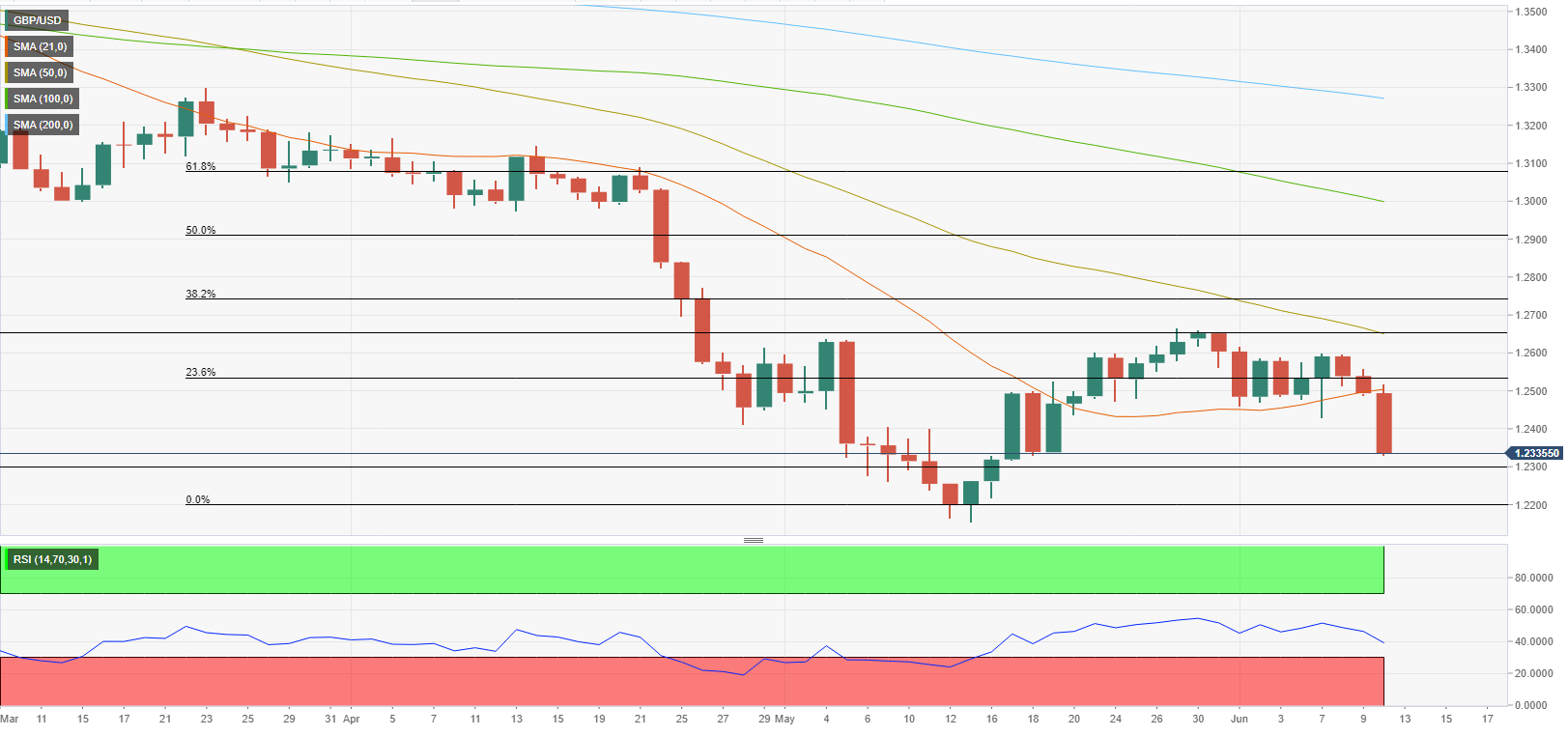
The Relative Strength Index (RSI) indicator declined to 40 ahead of the weekend, pointing to a buildup in bearish momentum. Additionally, GBP/USD closed below the 21-day SMA for the first time since mid-June, confirming that sellers are dominating the pair's action.
On the downside, 1.2300 (psychological level) aligns as initial support. With a daily close below that level, GBP/USD could extend its slide toward 1.2200 (static level, the end-point of the downtrend that started in late March) and touch a fresh two-year low at 1.2150.
In case the pair rises above 1.2500 (psychological level, 21-day SMA, Fibonacci 23.6% retracement) and starts using that level as support, it could extend its recovery toward 1.2600 (psychological level) and 1.2650 (50-day SMA).
GBP/USD: Forecast poll
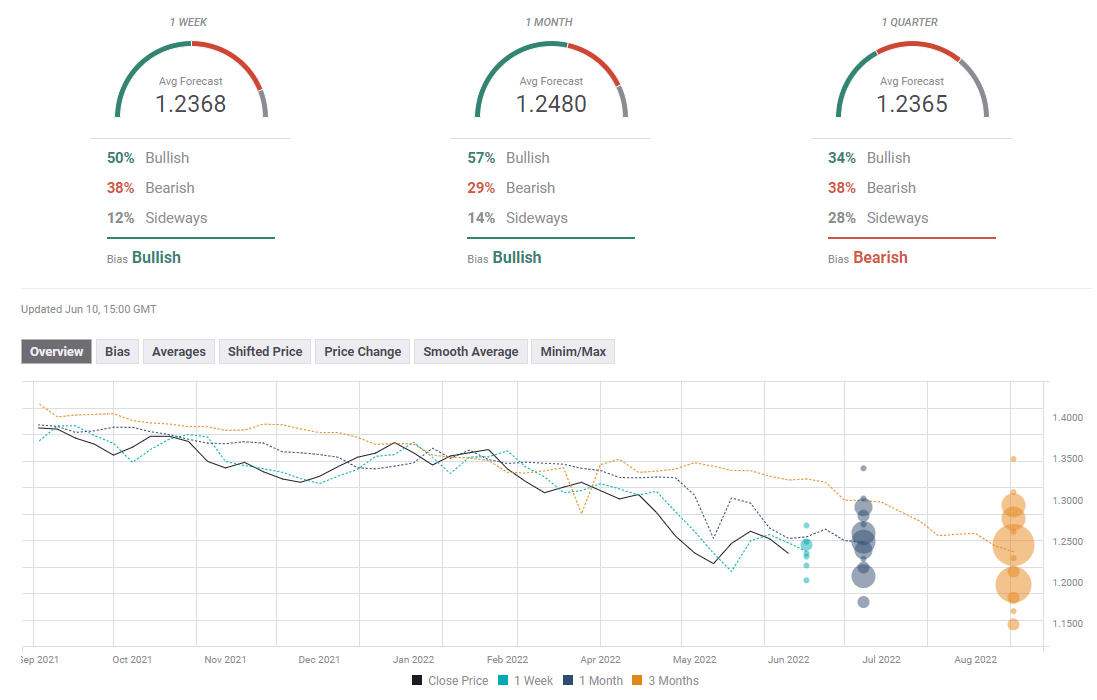
The FXStreet Forecast Poll paints a mixed picture for GBP/USD in the near term. The one-month outlook, however, shows that the majority of polled experts see the pair staging a rebound during that time frame with the average target sitting at 1.2480.
Author

Dhwani Mehta
FXStreet
Residing in Mumbai (India), Dhwani is a Senior Analyst and Manager of the Asian session at FXStreet. She has over 10 years of experience in analyzing and covering the global financial markets, with specialization in Forex and commodities markets.