EUR/USD Price Forecast: The breach of 1.0400 opens the door to extra losses
- EUR/USD extended further its weekly leg lower, revisiting the 1.0400 area.
- The US Dollar marched north amid tariff woes and geopolitical tension.
- The FOMC Minutes showed staff’s concerns over Trump policies.

EUR/USD flirted with the provisional support at the 55-day SMA near the 1.0400 neighbourhood in response to extra recovery in the Greenback.
That said, the US Dollar Index (DXY) rose further and surpassed the 107.00 hurdle with marked conviction against the backdrop of steady tariff jitters and geopolitical effervescence surrounding peace negotiations in the Russia-Ukraine crisis.
The pair’s marked pullback also came in tandem with the mixed performance in US yields across different maturity periods and the advance to monthly tops in Germany’s 10-year bund yields, which rose to the 2.55% zone.
Tariff tensions never left the building
Tariff tensions are keeping investors on edge, even without fresh headlines on US trade policy. While the White House postponed a 25% tariff on imports from Canada and Mexico, it held firm on a 10% duty on Chinese goods, leaving traders wary of what might come next.
Tensions escalated when President Trump announced a 25% tariff on steel and aluminium imports, sparking fears of further retaliation. Initially, this uncertainty weighed on the US Dollar, but the Greenback could bounce back if tariffs push inflation higher and prompt the Federal Reserve (Fed) to stick to higher rates.
Central banks are also in the spotlight
The Federal Reserve recently left its policy rate at 4.25%-4.50%, walking a fine line between robust US growth, stubborn inflation, and a strong labour market. In his semiannual testimonies before Congress, Fed Chair Jerome Powell stressed that it’s too soon to consider rate cuts, highlighting inflation and employment trends as the main factors guiding future decisions.
The Fed raised concerns about inflation following President Trump's policy proposals, with businesses indicating they would pass on tariff costs to consumers, the FOMC Minutes showed on Wednesday. Furthermore, at their January 28-29 meeting, officials saw greater risks to inflation than to the job market, citing trade policies, geopolitical disruptions, and strong consumer spending as potential drivers. While they remained hopeful that inflation would ease, some worried external factors could slow the disinflation process. Inflation expectations had also begun to rise, leading policymakers to agree that interest rates should remain steady until inflation showed a clear and sustained decline toward the Fed’s 2% target.
Meanwhile, the European Central Bank (ECB) took a different approach by cutting rates by 25 basis points to shore up the eurozone’s sluggish growth. ECB President Christine Lagarde downplayed calls for larger, 50-basis-point cuts, opting instead for a slower, data-driven strategy. Despite ongoing trade disputes, she remains hopeful inflation will reach the target by 2025, suggesting a measured path ahead for ECB policy.
Winners and losers in the tariff tug-of-war
If tariffs drive US inflation higher, the Fed could stay hawkish for longer, which would likely strengthen the dollar. For the euro, however, the possibility of US tariffs on EU imports could drag EUR/USD closer to parity as soon as Q2.
Key price thresholds: A closer look
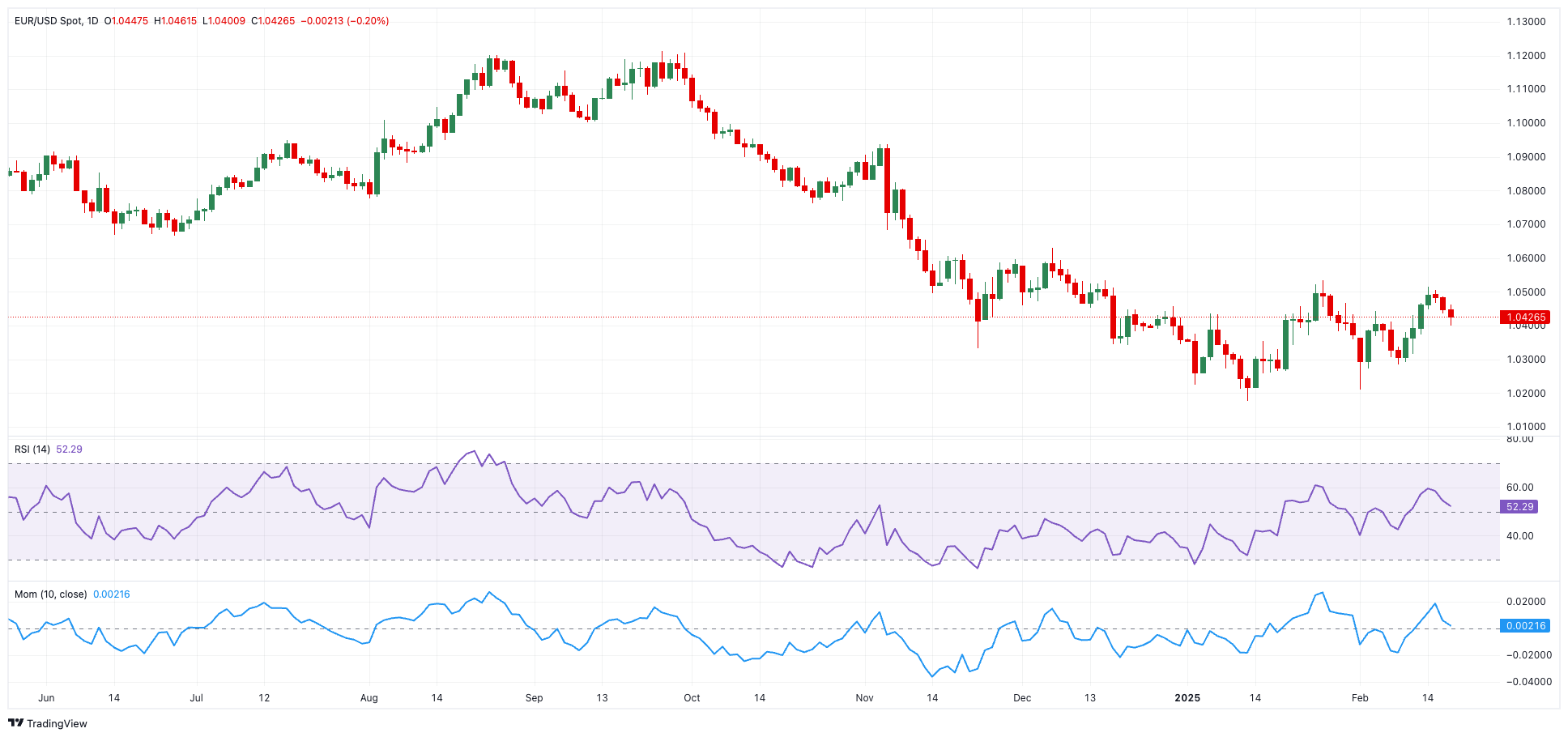
On the charts, EUR/USD has come under pressure and flirted with the key 1.0400 support zone.
A renewed push higher will run into resistance at the February peak of 1.0513 (February 14), seconded by 1.0532 (the 2025 high from January 27). Further up comes the interim 100-day SMA at 1.0564 prior to 1.0629 (December peak).
On the downside, there is an initial cushion at the weekly low of 1.0282 (February 10), which anticipates the monthly bottom of 1.0209 (February 3). A drop below this level could set the stage for a test of the YTD low at 1.0176 (January 13).
Technical indicators paint a mixed picture, with the RSI slipping back to around 50 (suggesting some loss of upside momentum) while the ADX near 14 points to a waning trend
EUR/USD daily chart
The road ahead
In the near term, EUR/USD will likely remain in a tug-of-war between trade headlines, diverging central bank policies, sluggish eurozone growth, and political uncertainty—especially in Germany. Until there’s more clarity on trade and a firmer policy direction from the Fed and ECB, the outlook for the euro will likely stay murky.
Premium
You have reached your limit of 3 free articles for this month.
Start your subscription and get access to all our original articles.
Author
Pablo Piovano
FXStreet
Born and bred in Argentina, Pablo has been carrying on with his passion for FX markets and trading since his first college years.