Markets hover at altitude waiting for payrolls to decide the weather


This was another choppy but ultimately wrong-way session. Price went precisely where it was never meant to stay. The S&P 500 briefly leaned above 7,000, notched a fresh all time high for the highlight reel, then quietly stepped back down the ladder to close modestly lower. Nothing broke. Nothing resolved. Further confirmation that this market is pacing within a 30-basis-point cage, coiled, contained, and waiting for either the ceiling or the trap door to open.
Renewed friction between Japan and China did little to help global risk markets overnight, an untimely reminder that Asia can still throw sand in the gears when supply chains and technology controls resurface. But the more telling feature of the tape was what traders chose to ignore. Latin American geopolitics still barely registers. Venezuela headlines drifted past without triggering a classic risk response. Data has taken the wheel, and the market has stopped glancing in the rearview mirror. Attention is fixed squarely ahead, with Friday’s jobs report sitting dead center in the crosshairs.
That focus explains the underlying unease. Futures still price roughly two Federal Reserve rate cuts this year, but the foundation beneath that optimism is narrow. A stronger-than-comfortable payrolls report doesn’t break the cycle, but it delays it. It sidelines the Fed early in the year and forces markets to reprice timing rather than direction. That kind of adjustment doesn’t crash markets, but it does wobble the pillars that have been holding this rally upright.
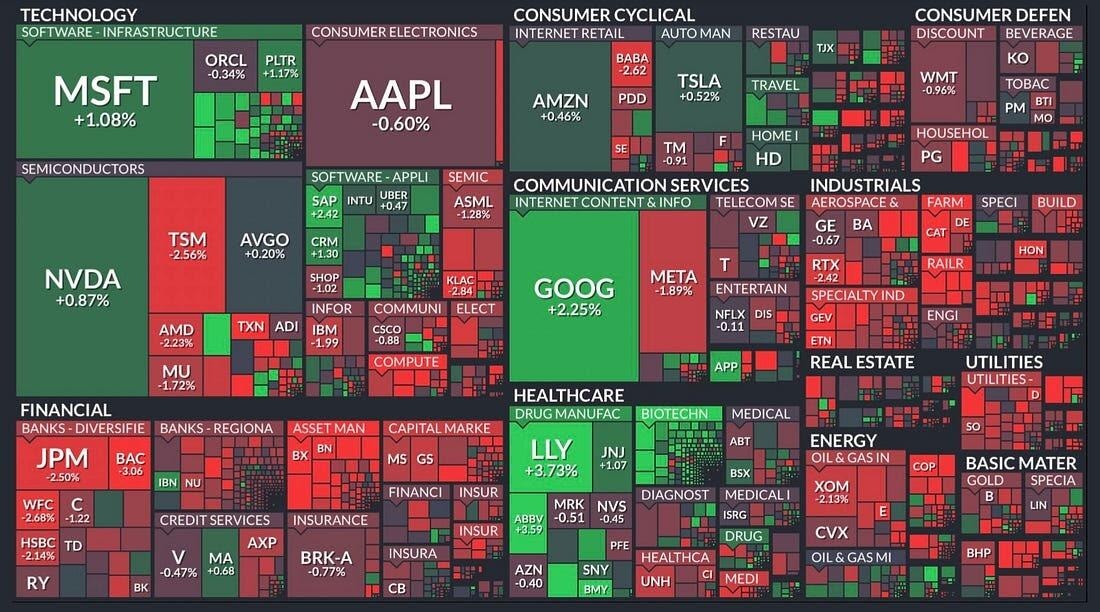
Rates markets told the story cleanly. Treasuries caught an early bid on the idea that growth is cooling rather than accelerating. ADP helped that narrative, showing hiring rising at a moderate pace and reinforcing the sense that momentum is leaking out as we head into 2026. Then the ISM services data hit the tape and spoiled the party. Services activity surged to a fourteen-month high, with output, orders, and employment all flashing strength. Bond bulls stepped back. Yields firmed. The market was left juggling two truths at once.
Add in the job openings data, which cooled more than expected, and the picture becomes clearer. Nevertheless, this is not a labour market in disarray. It is a low-hire, low-fire economy drifting toward a new balance. Cooling, not collapsing. That nuance matters because it keeps the Fed cautious rather than urgent, and it keeps volatility bottled up even as catalysts pile onto the calendar.
Volatility itself is telling a different story. The VIX crept higher on the day, but sub sixteen is still easy mode. For a week loaded with payrolls, tariff risk via a Supreme Court decision, and a market sitting at record highs, implied volatility remains remarkably cheap. That disconnect is why it feels like traders are starting to look over their shoulders. When vol refuses to price risk, some desks quietly buy insurance anyway.
Across assets, the same pattern played out. Precious metals paused. Gold snapped a three-day winning streak, silver slipped back below eighty, and copper retreated from its record perch. This was not liquidation. It was digestion.
Oil prices extended losses on Wednesday after Washington lifted some sanctions on Venezuelan exports. The move was compounded by President Trump’s comments that Venezuela’s interim authorities had agreed to hand over as much as 50 million barrels of previously sanctioned, high-quality crude to the US. The signal was clear. Incremental supply, even if phased and politically constrained, was sufficient to support prices.
While price action felt hesitant, capital markets sent the opposite signal. The primary bond market rebounded. The first week of the year delivered a surge in issuance that bordered on historic. US investment-grade supply blew past seventy billion dollars in just two days, the busiest back-to-back sessions on record. Europe followed suit, with a record number of tranches and more than 60 billion euros in commitments. That is not a market hiding from risk. That is confidence with a pen in hand. ( see below)
Energy markets added their own narrative layer. At the Goldman Energy conference, the tone was unapologetically bold. The message from the podium was that Venezuela represents a twenty-five-year policy failure and that the objective now is to change the game. More striking was the broader thesis. We are in the midst of the greatest energy and power investment cycle in history. Grid stability is the choke point. Nuclear is back on the table. The initial consideration of emissions was dismissed as a costly detour. The world, in this framing, needs more of everything that actually powers growth: oil, gas, coal, and electrons.
All of this circles back to Friday. The jobs report is the fulcrum, but only at the extremes. A very strong number forces markets to rethink timing. A very weak one reopens recession debates. Anything in between simply prolongs the range and keeps this market drifting sideways at altitude.
When cross-asset markets start moving along the same tangent line ahead of a known risk catalyst like Friday’s payrolls report, it is rarely accidental. It usually reflects positioning discipline rather than conviction. Equity, rates, FX, and rates sensiteve commodities are not expressing a view; they are marking time. Risk is being neutralized, exposures trimmed, and optionality preserved. In those moments, price action flattens not because nothing matters, but because everything does. The market is waiting for permission to break formation.
Until then, we are stuck in a familiar place. New highs without conviction. Volatility without fear. Risk assets are leaning forward but not committing. The market is neither panicking nor celebrating; it is simply waiting. And sometimes the most dangerous part of the tape is when nothing seems urgent, right up until it is.
Europe rearms and the market is forced to chase
Europe’s aerospace and defence complex is in full upside-down panic. Price has blown through the top of the range and is now camped at all-time highs, with momentum indicators stretched to levels not seen since last spring. This is not where you chase size for a clean entry. It is late in the short-term sense. But it is also unmistakably strong. When a sector trades in this manner, it is not being driven by tourists. It is being pulled by mandate money that cannot afford to miss it.
The deeper reason is structural rather than cyclical. Europe has crossed a line on defence spending. What began as a response has hardened into a baseline. Budgets that once hovered around 1.5 percent of GDP have moved to 2 percent, with a credible glide path toward 3 percent by decade's end and beyond. That shift changes everything. Revenue visibility is no longer hostage to election cycles. Defence spending has become an embedded line item rather than an optional lever.
The order book confirms it. Sector sales are now running dramatically above pre-war levels, which indicates this is not merely political rhetoric. Contracts are being signed. Factories are being loaded. The dispersion inside the trade also matters. Germany and Poland are moving fastest, Italy and Spain far more cautiously. That creates a stock-picker's market in which exposure to urgency, funding velocity, and potential EU-level support matters more than index beta.
Even the idea of peace does not unwind this trade. A ceasefire may soften rhetoric, but it does not reverse procurement. Europe has learned that reliance entails risk. Grey zone threats, cyber pressure, and power-based diplomacy do not disappear with a signature. The strategic direction is toward self-sufficiency, even if it rolls out unevenly across the bloc.
The common critique is that defence spending is economically wasteful. That framing misses the point. Europe’s defence industrial base was hollowed out for decades and is now undersized. What we are seeing is not excess but catch-up. Defence today is not just steel and shells. It is sensors, software, engines, electronics, and data. The spillovers into adjacent industrial capacity and strategic technology are real, and in a more frictional world, credible defence capability supports confidence rather than suppressing it.
At the stock level, the squeeze leaders are telling you where the pressure sits. Rheinmetall continues to grind higher as shorts retreat and momentum players refuse to fade it. The most direct beneficiaries of this cycle sit in the high-value parts of the stack where budgets are growing fastest. Names like Indra, Hensoldt, Rolls-Royce, Safran, and MTU Aero Engines are leveraged not to headlines but to where the money is actually being spent.
The risk here is not that the theme is wrong. It is that price has already moved faster than fundamentals in the very short term. Structurally, the bid is real. Tactically, patience still matters.
Author
Stephen Innes
SPI Asset Management
With more than 25 years of experience, Stephen has a deep-seated knowledge of G10 and Asian currency markets as well as precious metal and oil markets.