Conference Board Consumer Confidence Preview: Unhappy but still spending
- Consumer Confidence expected to rise slightly to 114.5 in September.
- August’s confidence reading at 113.8 was the lowest since February.
- Weak Consumer Confidence did not damage August Retail Sales or Durable Goods Orders.
- Markets unlikely to move on Conference Board September result.

The collapse of consumer optimism in August has not exacted the expected toll from American spending, the most important factor in sustaining the US economic recovery.
Consumer Confidence from the Conference Board, a non-profit business organization, is forecast to edge up to 114.5 in September from a six-month low of 113.8 in August.
Consumer attitude and spending in August
The two main surveys of US consumer sentiment, the University of Michigan and the Conference Board, witnessed sharp declines in their outlook last month. The Michigan reading tumbled from 81.2 in July to 70.3 in August, an 11 year low. The Conference Board score fell to 113.8, its weakest since February, from 125.1 In July.
Michigan Consumer Sentiment

These surveys have long been used to predict consumer behavior and at one remove are considered forerunners of consumption. About 70% of US economic activity is tied to consumer spending. The logic is straightforward. If consumers are concerned or depressed about their economic situation they will pull back on spending.
Contrary to expectations, and despite the plunge in sentiment, consumer spending rebounded smartly in August. Retail Sales rose 0.7% following July’s 1.1% plunge and nearly doubled the -0.8% forecast.
Retail Sales
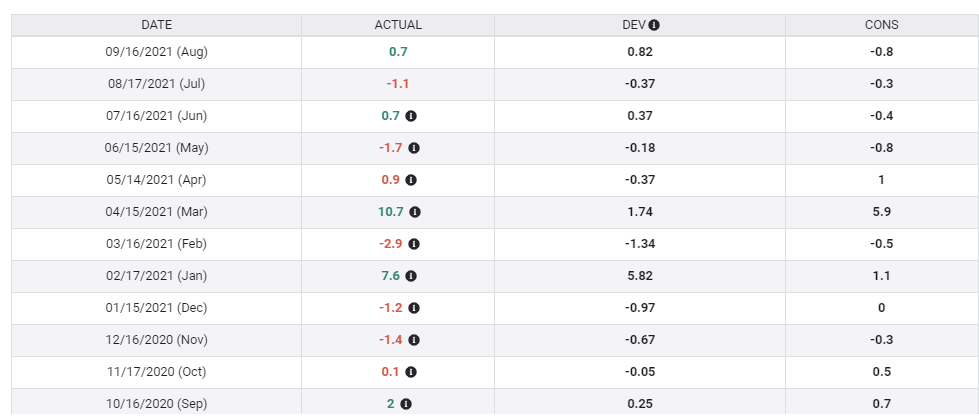
Sales ex-autos were even stronger, adding 1.8% on a -0.2% prediction and the same July decrease. The difference between the two figures largely stems from a shortage of new cars with production restricted by a scarcity of computer chips.
Durable Goods Orders, the category of consumer purchases designed to last three year or more, reflected the overall sales picture.
The headline orders jumped 1.8% in August, far outstripping the 0.7% projection. July’s result was revised up to 0.5% from 0.1%.
Nondefense Capital Goods Orders, the business investment proxy, rose 0.5%, just ahead of the 0.4% forecast. The July number was adjusted to 0.3% from flat.
Market reaction to Michigan August Sentiment
The collapse of the August Michigan Consumer Sentiment Survey to 70.2, (reported on Friday August 13) shocked markets. Sentiment had been expected to be unchanged from July at 81.2.
Treasury yields in the US dropped sharply, taking the dollar with them and equities rose with the reduced prospect for a bond taper from the Federal Reserve.
Long-term Treasury rates dropped with the release. The benchmark 10-year yield fell 7 basis points, closing at 1.297%. The 30-year return tumbled 6.5 points to 1.948%. In contrast, the 2-year yield, whose return has been restrained by the Federal Reserve bond purchase program, slipped 1 point to 0.215%.
Dollar rates fell with Treasury yields. The EUR/USD gained about three-quarters of a figure to 1.1796. The USD/JPY fell from 110.40 on August 12 to 109.60 the next day.
Conclusion
August’s surprise factor is gone.
Michigan Consumer Sentiment was issued on September 17. The consensus forecast was for a slight rise to 72.2 from August’s revised 70.3 score. Sentiment came in at 71, like the August figures, the lowest since the nadir of last year’s pandemic panic in April at 71.8.
There is little reason to expect the Conference Board Survey to produce a different result.
American consumers have kept their own counsel. Though they expressed great dissatisfaction with their economic situation to the Michigan pollsters, their behavior belied the survey results. Retail Sales and Durable Goods Orders were much stronger than forecast in August.
The unrelieved consumer sentiment in September’s Michigan Survey and the likely second from the Conference Board, will not, given the August disconnect, precipitate an expected drop in consumer spending.
Analysts will assume, given the evidence, that consumers are dissatisfied with something other than their economic life.
Markets are unlikely to give much credence to the predictive ability of consumer outlook until that link to consumption is reestablished.
Author

Joseph Trevisani
FXStreet
Joseph Trevisani began his thirty-year career in the financial markets at Credit Suisse in New York and Singapore where he worked for 12 years as an interbank currency trader and trading desk manager.