|

XOM Stock Price and News: Exxon Mobil dips again after mediocre earnings call and workforce cuts

  • NYSE:XOM drops 1.18% after its earnings call on Friday morning.
  • Exxon reported job-cuts and reduction of operating costs to save capital. 
  • Exxon announces that despite its struggles, the dividend will remain unchanged.

NYSE:XOM has had a forgettable year as the stock has dropped 53% over the past 52-weeks amidst the ongoing COVID-19 pandemic as well as a global shift away from fossil fuels. On Friday, the energy sector giant announced its earnings report for the most recent quarter and while the losses were only $680 million compared to $1.1 billion the quarter before, it is a far cry year-over-year from 2019 when Exxon reported $3.2 billion in profit during the same quarter. 

Exxon has raised some eyebrows around Wall Street with its recent announcement of cutting its workforce as well as its capital expenditures in order to stop the bleeding. It's interesting that the company has maintained its dividend and has even forecasted that it will continue to do so heading into 2021, at a time when many large companies have either cut their dividends or stopped them altogether. Exxon has recently reported that it donated over $4 million to the Democratic Party campaign, despite its candidate Joe Biden running on a green wave initiative that would shift America’s focus to clean energy. What does this mean for the future? Exxon could be reading the writing on the wall and shifting its own focus to clean energy, but ultimately we will have to wait for the official outcome of the election after counting all the votes.

XOM Stock Price History
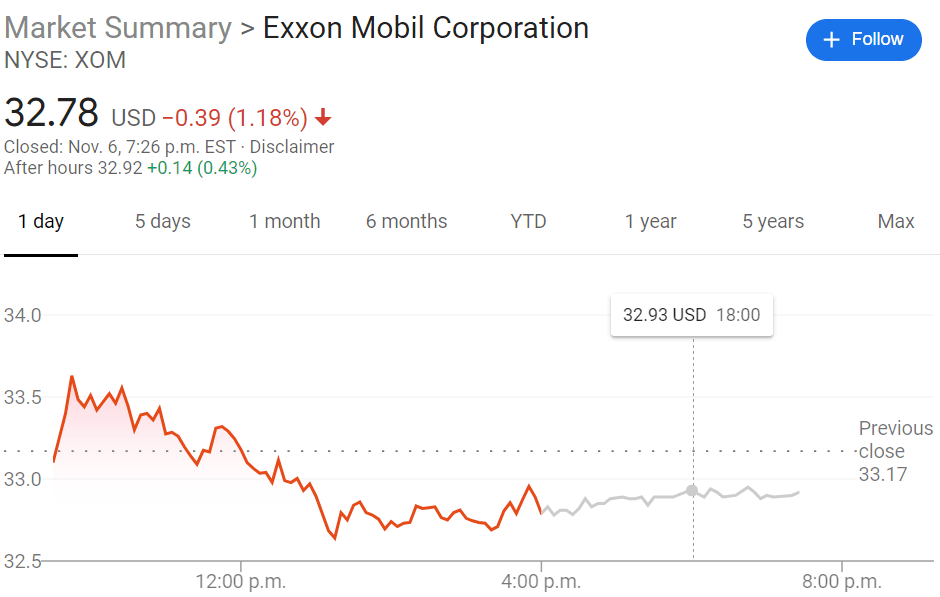
The entire energy industry continues to be beaten down as the coronavirus pandemic keeps people inside of their homes. The resulting drop in the demand for crude oil has sent the price per barrel down into the $30's although it was not too long ago that the price actually went negative during the heart of the pandemic. Exxon remains closely linked to the price of crude oil and with the next wave of COVID-19 continuing into 2021, we should not expect the demand to return to pre-pandemic levels anytime soon.

Author

More from Stocks Reporter
Share:

Editor's Picks

AUD/USD flirts with 0.7000, lowest since early August amid bullish USD

AUD/USD hits a fresh low since early August during the Asian session on Friday and looks vulnerable near 0.7000 after breaking below the 200-day SMA overnight. Against the backdrop of the hawkish Fed, a two-day rally in oil prices revives inflation fears and continues to push US bond yields to multi-year highs. Adding to this, geopolitical risks lift the US Dollar to a two-month high, overshadowing RBA rate hike bets and weighing on the pair.

USD/JPY pulls back from three-week high after failing near 159.00

USD/JPY edges lower during the Asian session on Friday, stalling its recent strong move to a three-week high of 159.00 as Japanese Yen bears turn cautious amid intervention fears. Meanwhile, the US Dollar retains a strong bullish undertone as the Fed's hawkish outlook and oil-driven inflation fears continue to push US bond yields to multi-year peaks. Furthermore, the BoJ's dovish rate hike last week might cap JPY and support spot prices.

Gold treads water below $4,300

Gold grabs some buying attention and advances marginally at the end of the week, partially retracing the weekly decline, although it is still navigating below the key $4,300 mark per troy ounce. The fresh selling bias on the Greenback and the modest decline in US Treasury yields appear to support the humble advance in the precious metal.

Crypto Today: Bitcoin and Ethereum edge lower, XRP extends recovery as macro headwinds weigh

The broader cryptocurrency market is consolidating on Friday, with Bitcoin paring losses slightly above $84,000. Ethereum declines in tandem with BTC. Ripple (XRP), meanwhile, paints a different picture.


Fed vs BoJ: Both hiked. The market only believes one of them – and the chart shows which
The Federal Reserve (Fed) and the Bank of Japan (BoJ) have just done something remarkably similar. Both central banks raised interest rates by 25 basis points (bps) last week, both are confronting inflation risks, and both signal that future decisions will depend on incoming economic data.
Fed vs BoJ: Both hiked. The market only believes one of them – and the chart shows which

The Fed and the BoJ have just done something remarkably similar. Both central banks raised interest rates by 25 bps last week, both are confronting inflation risks, and both signal that future decisions will depend on incoming economic data.















