|

USD/RUB up and down around 57.20 post-CBR decision

  • The pair stays sidelined above the 57.00 handle post-CBR.
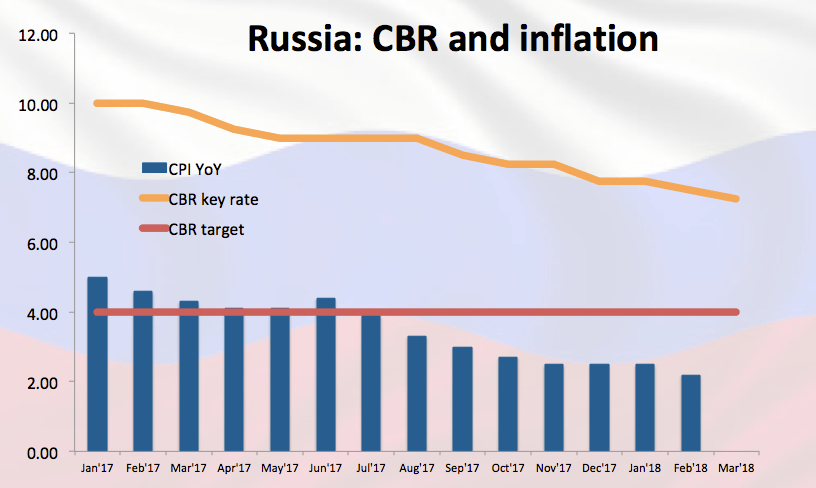
  • The Russian central bank (CBR) cut its key rate by 25 bp to 7.25%.
  • UK-Russia geopolitical effervescence still in centre stage.
The Russian currency is alternating gains with losses vs. its American counterpart at the end of the week, with USD/RUB hovering just above 57.00 the figure.

USD/RUB unchanged on CBR desicion

RUB remained apathetic after the Russian central bank (CBR) cut its key rate by 25 bp to 7.25% per anum, matching market consensus.

The CBR acknowledged that inflation figures remain low, while inflation expectations are also diminishing progressively. In addition, the central bank expects inflation to ‘gradually return to the target in the second half of the year’ in tandem with a recovery in the domestic demand. Inflation, therefore, is seen at 3-4% in 2018 and closer to the 4% target next year.

The CBR does not rule out further easing of the monetary conditions in order to help domestic demand and lift inflation to the bank’s target.

Regarding the economic activity, the CBR noted the economic growth resumed this year following the poor performance during 2017, and now sees the economy expanding by 1.5%-2% in the 2018-2020 period. The central bank also increased the price for crude oil in its baseline scenario.

In the meantime, spot is testing the 10-day sma in the 57.25 area following yesterday’s strong advance, although the current broad-based weakness around the buck is poised to keep it under pressure.

USD/RUB levels to watch

At the moment the pair is down 0.08% at 57.19 and a break below 56.87 (21-day sma) would expose 56.81 (55-day sma) and then 56.74 (low Mar.22). On the upside, the next hurdle is located at 58.02 (high Mar.19) seconded by 58.16 (200-day sma) and finally 58.75 (2018 high Feb.9).
Author

Pablo Piovano

Born and bred in Argentina, Pablo has been carrying on with his passion for FX markets and trading since his first college years.


More from Pablo Piovano
Share:

Editor's Picks

EUR/USD weakens to near 1.1900 as traders eye US data

EUR/USD eases to near 1.1900 in Tuesday's European trading hours, snapping the two-day winning streak. Markets turn cautious, lifting the haven demand for the US Dollar ahead of the release of key US economic data, including Retail Sales and ADP Employment Change 4-week average.

GBP/USD stays in the red below 1.3700 on renewed USD demand

GBP/USD trades on a weaker note below 1.3700 in the European session on Tuesday. The pair faces challenges due to renewed US Dollar demand, UK political risks and rising expectations of a March Bank of England rate cut. The immediate focus is now on the US Retail Sales data. 

Gold sticks to modest losses above $5,000 ahead of US data

Gold sticks to modest intraday losses through the first half of the European session, though it holds comfortably above the $5,000 psychological mark and the daily swing low. The outcome of Japan's snap election on Sunday removes political uncertainty, which along with signs of easing tensions in the Middle East, remains supportive of the upbeat market mood. This turns out to be a key factor exerting downward pressure on the safe-haven precious metal.

Bitcoin Cash trades lower, risks dead-cat bounce amid bearish signals

Bitcoin Cash trades in the red below $522 at the time of writing on Tuesday, after multiple rejections at key resistance. BCH’s derivatives and on-chain indicators point to growing bearish sentiment and raise the risk of a dead-cat bounce toward lower support levels.

Follow the money, what USD/JPY in Tokyo is really telling you

Over the past two Tokyo sessions, this has not been a rate story. Not even close. Interest rate differentials have been spectators, not drivers. What has moved USD/JPY in local hours has been flow and flow alone.

Bitcoin Cash trades lower, risks dead-cat bounce amid bearish signals

Bitcoin Cash (BCH) trades in the red below $522 at the time of writing on Tuesday, after multiple rejections at key resistance. BCH’s derivatives and on-chain indicators point to growing bearish sentiment and raise the risk of a dead-cat bounce toward lower support levels.