USD/MXN oscillates near week’s lows amid mixed Fed signals, easing Mexican inflation
- USD/MXN hovers around 17.5684, as lack of fresh economic catalysts and dovish Fed comments keep the pair in check.
- Despite strong US economic data, November rate hike odds remain at 43.6%, adding uncertainty to the USD/MXN trajectory.
- Easing Mexican inflation to 4.64% YoY in August provides some relief, but traders eye upcoming US and Mexican economic indicators.

The Mexican Peso (MXN) recovered some ground against the US Dollar (USD), though it remains near its week’s lows, while the USD trades soft, printing modest losses. The lack of an economic catalyst and a risk-on impulse keeps the USD/MXN pair oscillating at around 17.5684 after hitting a daily low of 17.4380.
Mexican Peso recovers ground as the US Dollar softens, but traders remain cautious ahead of crucial economic data next week
The Greenback is trading softer on Friday, as it’s headed to print weekly gains for an eighth consecutive week after reaching a six-month high of 105.057. Hence, the USD/MXN pair halted its rally despite data from the United States (US) depicting a solid economy, as business activity remains firm. At the same time, due to the latest unemployment claims data, the labor market is not as loose as expected by the US Federal Reserve.
Given the backdrop, traders braced for additional tightening by the Fed. Even though interest rate probabilities discount a September rate hike, November’s odds remain at 43.6% for a 25 bps increase. This spurred high US bond yields, underpinning the USD/MXN pair. However, appetite for US bonds keeps yields pressured.
Aside from this, the USD/MXN is pairing some of its earlier losses due to dovish comments from Fed officials. The New York Fed President John Williams and Atlanta’s President Raphael Bostic are amongst the most dovish officials in the Federal Reserve, with the former saying that monetary policy is “in a good place.” Contrarily, Dallas Fed President and 2023 voter Lorie Logan added that skipping a rate hike may be appropriate but stressed the Federal Funds Rate (FFR) needs to be at higher levels.
That said, investors trimmed some of their USD/MXN long positions after Mexico’s revealed inflation eased to its lowest level since March 2023 to 4.64% YoY in August. The Bank of Mexico Deputy Governor Jonathan Heath highlighted the same report, saying that core inflation slowing towards 6.08% YoY was “good news” while stressing that there is a long way to go.
Next week, the US agenda will feature inflation data, Retail Sales, unemployment claims, Industrial Production, and Consumer Sentiment from the University of Michigan. On the Mexican front, the docket will feature Industrial Production.
USD/MXN Price Analysis: Technical outlook
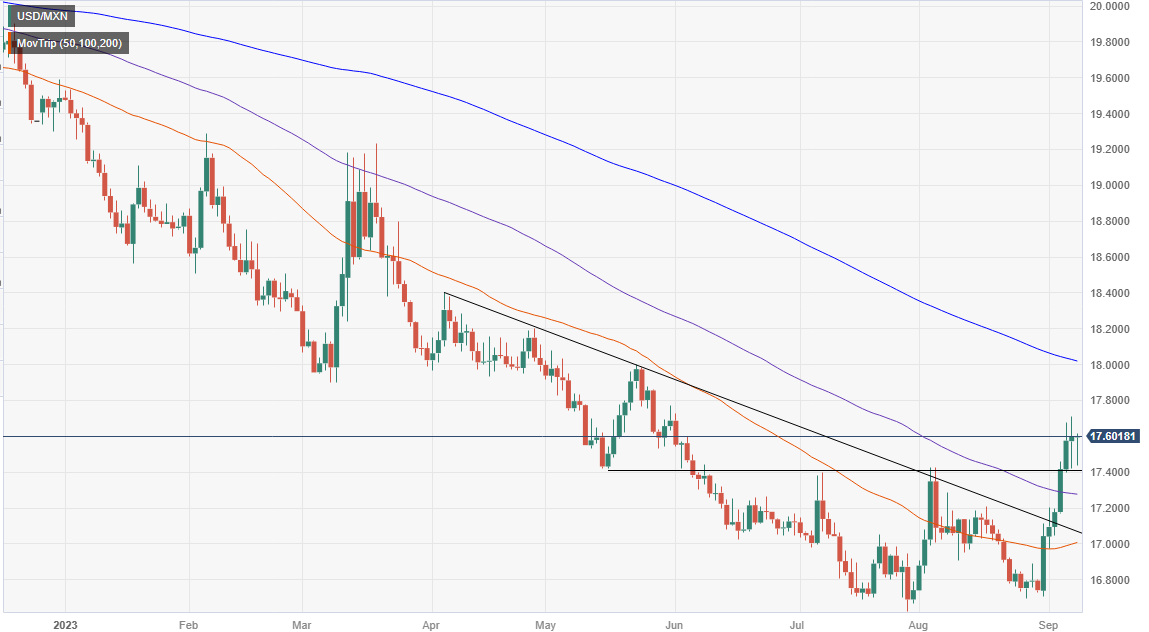
From a technical standpoint, the USD/MXN rally stalled at around 17.5000/7000. However, buyers reclaimed the critical May 17 daily lof of 17.4038, keeping buyers hopeful of lifting the exchange rate towards the 18.0000 psychological barrier. A tick above that level sits the 200-day Moving Average (DMA) at 18.0112, which, once cleared, would put into play key resistance areas at 18.4010 and 18.6074, the April 5 high and the March 24 swing high, respectively.
Author

Christian Borjon Valencia
FXStreet
Markets analyst, news editor, and trading instructor with over 14 years of experience across FX, commodities, US equity indices, and global macro markets.

















