USD/JPY Price Forecast: Consolidates around 156.70 as focus shifts to US NFP
- USD/JPY trades sideways around 156.70 ahead of the US NFP data on Friday.
- The impact of the US NFP is expected to be significant on the interest rate outlook.
- USD/JPY continues to wobble near the 20-day EMA for weeks.

The USD/JPY pair trades in a tight range around 156.70 during the European trading session on Thursday. The pair consolidates as investors shift focus to the United States (US) Nonfarm Payrolls (NFP) data for December, which will be released on Friday.
Investors will pay close attention to the US NFP data as it will influence market expectations for the Federal Reserve’s (Fed) monetary policy outlook. In 2025, the Fed delivered three interest rate cuts of 25 basis points (bps) to support weak job market conditions.
The US NFP report is expected to show that the economy added 60K fresh workers, slightly lower than 64K in November. The Unemployment Rate is seen lower at 4.5% from the prior reading of 4.6%.
Meanwhile, the Japanese Yen (JPY) gains ground after underperforming in the past few weeks. The JPY gains as market sentiment remains risk-averse on fresh tariff threats from US President Donald Trump.
USD/JPY technical analysis
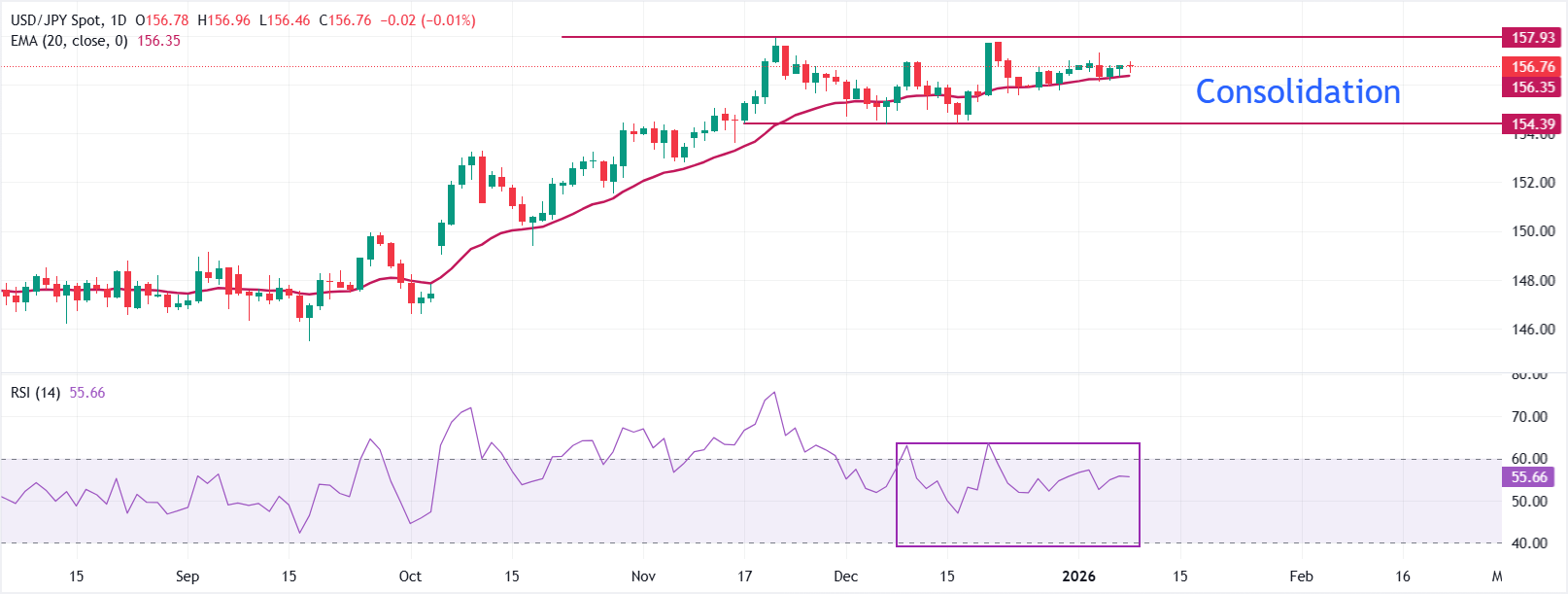
USD/JPY trades flat around 156.76 at the time of writing. The pair has been trading in a range between 154.40 and 157.90 for over six weeks. The price holds above the rising 20-day Exponential Moving Average (EMA) at 156.35, keeping the short-term uptrend intact. The 20-day EMA’s positive slope supports demand on dips.
The 14-day Relative Strength Index (RSI) at 55.67 (neutral) stays above the 50 midline, aligning with a mild bullish bias.
As long as the pair holds above the 20-day EMA, the path would favor trend-following extensions, while a daily close below it would weaken the setup and shift momentum toward neutrality. The asset could advance towards the January 2025 high of 158.88 if it breaks above the November 20 high of 157.90. On the contrary, the price could slide towards the November 7 low of 152.80 if it fails to hold the December 16 low of 154.40.
(The technical analysis of this story was written with the help of an AI tool.)
Economic Indicator
Nonfarm Payrolls
The Nonfarm Payrolls release presents the number of new jobs created in the US during the previous month in all non-agricultural businesses; it is released by the US Bureau of Labor Statistics (BLS). The monthly changes in payrolls can be extremely volatile. The number is also subject to strong reviews, which can also trigger volatility in the Forex board. Generally speaking, a high reading is seen as bullish for the US Dollar (USD), while a low reading is seen as bearish, although previous months' reviews and the Unemployment Rate are as relevant as the headline figure. The market's reaction, therefore, depends on how the market assesses all the data contained in the BLS report as a whole.
Read more.Next release: Fri Jan 09, 2026 13:30
Frequency: Monthly
Consensus: 60K
Previous: 64K
Source: US Bureau of Labor Statistics
America’s monthly jobs report is considered the most important economic indicator for forex traders. Released on the first Friday following the reported month, the change in the number of positions is closely correlated with the overall performance of the economy and is monitored by policymakers. Full employment is one of the Federal Reserve’s mandates and it considers developments in the labor market when setting its policies, thus impacting currencies. Despite several leading indicators shaping estimates, Nonfarm Payrolls tend to surprise markets and trigger substantial volatility. Actual figures beating the consensus tend to be USD bullish.
Author

Sagar Dua
FXStreet
Sagar Dua is associated with the financial markets from his college days. Along with pursuing post-graduation in Commerce in 2014, he started his markets training with chart analysis.