|

USD/INR Price News: 50-DMA tests India rupee sellers below 75.00

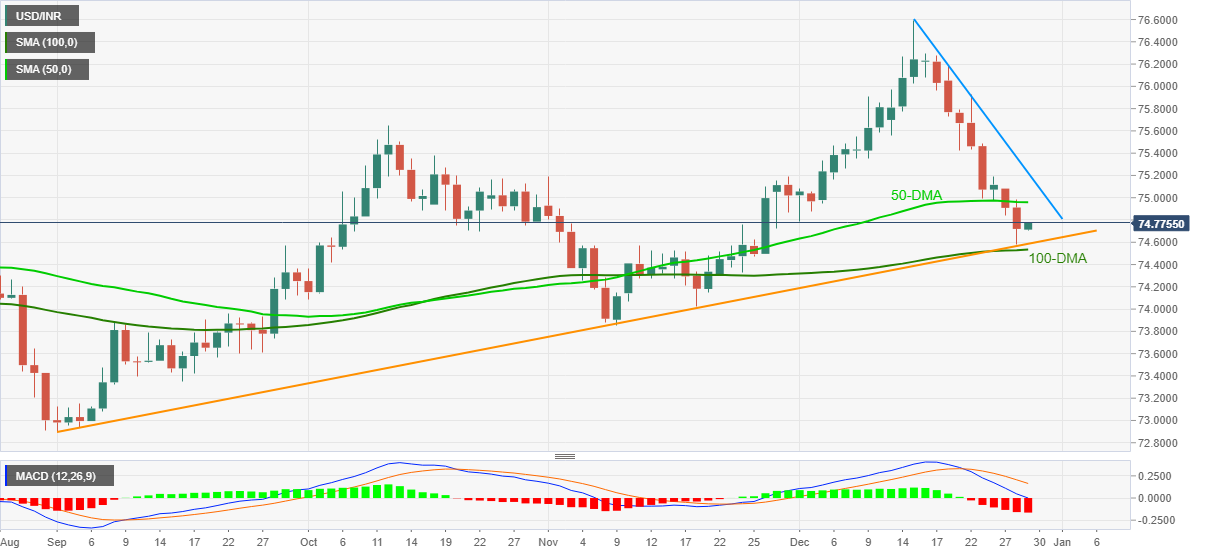
  • USD/INR bounces off four-month-old support line, monthly low to snap two-day downtrend.
  • Bearish MACD, 50-DMA challenge recovery moves, 100-DMA adds to the downside filters.

USD/INR pare recent losses around 74.77, up 0.07% intraday during the late Asian session on Wednesday.

The Indian rupee (INR) pair dropped to the lowest levels since November 26 the previous day before bouncing off 74.58. The corrective pullback took place near an ascending trend line from early September, as well as the 100-DMA.

However, the 50-DMA level of 74.96 guards the quote’s immediate upside amid bearish MACD signals.

Even if the USD/INR buyers cross the 74.96 hurdle, the 75.00 threshold and a two-week-old descending trend line close to 75.25, will test the further upside before convincing the bulls.

Alternatively, the 100-DMA adds strength to the 74.58-53 support zone, a break of which will quickly recall the 74.00 round figure to the chart.

However, the USD/INR pair’s further weakness will make it vulnerable to test November’s low of 73.85.

USD/INR: Daily chart
Trend: Bearish bias remains intact

Additional important levels

Overview
Today last price74.7515
Today Daily Change0.0315
Today Daily Change %0.04%
Today daily open74.72
 
Trends
Daily SMA2075.5028
Daily SMA5074.9608
Daily SMA10074.5282
Daily SMA20074.2292
 
Levels
Previous Daily High74.9818
Previous Daily Low74.58
Previous Weekly High76.1832
Previous Weekly Low74.9755
Previous Monthly High75.1908
Previous Monthly Low73.8515
Daily Fibonacci 38.2%74.7335
Daily Fibonacci 61.8%74.8283
Daily Pivot Point S174.5394
Daily Pivot Point S274.3588
Daily Pivot Point S374.1377
Daily Pivot Point R174.9412
Daily Pivot Point R275.1623
Daily Pivot Point R375.3429

Author

Anil Panchal

Anil Panchal

FXStreet

Anil Panchal has nearly 15 years of experience in tracking financial markets. With a keen interest in macroeconomics, Anil aptly tracks global news/updates and stays well-informed about the global financial moves and their implications.


More from Anil Panchal
Share:

Editor's Picks

AUD/USD: The 0.7000 level holds the downside…for now

AUD/USD has clinched its fourth consecutive daily pullback on Thursday, coming closer to the key 0.7000 region while breaking below the critical 200-day SMA at the same time. The Aussie’s decline comes on the back of further gains in the Greenback in a context of rising yields and Fed rate hike bets.

USD/JPY keeps the red near 158.00 as Japanese Yen firms up

USD/JPY retreats from three-week highs and holds losses near 158.00 in the Asian session on Thursday. Surging Japanese bond yields lift the Yen amid looming intervention risks, while the US Dollar preserves overnight gains to a two-month high amid hawkish Fed bets and elevated US bond yields.

Gold bounces off lows, still below $4,300

Gold builds on Wednesday’s retracement, briefly slipping back below $4,250 per troy ounce to attempt a lacklustre rebound afterwards. The better tone in the US Dollar, rising US Treasury yields and expectation of extra rate hikes by the Fed continue to weigh on the precious metal in the latter part of Thursday’s NA session.

XRP is flashing three bullish signals heading into a historically weak October
XRP (XRP) is still flashing 3 bullish signals across its holders, derivatives, and ETF data. These signals come as the token gave back part of its September gains on Thursday. The token traded near $1.50 at press time, down about 6.3% over 24 hours, according to BeInCrypto Markets data. The pullback still leaves XRP up over 15.6% on the week, a gain that tracks a broader market rally.
Advanced economies: From one example of resilience to another
History tends to repeat itself in advanced economies. Once again, growth ultimately fell short of expectations by only a small margin in the first half of 2026, despite the conflict in Iran. As early as 2025, the impact of tariffs was less severe than feared.
BoJ Recap: Not as hawkish as expected

The Bank of Japan (BoJ) raised its short-term interest-rate target to 1.25% from 1.00% in a 7-2 vote, marking another step in the normalisation of monetary policy and widely matching what everyone has been expecting for weeks.