USD/INR turns positive as FIIs continue to pare stake in Indian stock market
- The Indian Rupee gives up early gains and rises to near 88.80 against the US Dollar.
- Investors expect the RBI to intervene in the currency market to support the Indian Rupee.
- The US ADP Employment and ISM Services PMI data for October beat estimates.

The Indian Rupee (INR) surrenders its early gains and turns positive against the US Dollar (USD) during afternoon trading hours in India on Thursday.
The USD/INR pair rises to near 88.80 as the Indian Rupee struggles despite hopes that the Reserve Bank of India (RBI) will continue to intervene in both local spot and offshore markets to support the currency from extending its losses against the US Dollar beyond the all-time high around 89.10.
A report from Reuters showed that the RBI intervened on Tuesday, both in the NDF market before the local open and in the onshore spot market, reinforcing its intent to prevent the rupee from weakening further.
The outlook of the Indian Rupee remains uncertain as overseas investors continue to pare their stake in the Indian stock market due to uncertainty over the trade deal between the United States (US) and India.
Foreign Institutional Investors (FIIs) have started the November series with selling in the Indian equity market. In the two trading days of November, FIIs have turned out to be net sellers, selling cumulatively Rs. 2,950.79 crore worth of shares.
The table below shows the percentage change of Indian Rupee (INR) against listed major currencies today. Indian Rupee was the weakest against the Euro.
| USD | EUR | GBP | JPY | CAD | AUD | INR | CHF | |
|---|---|---|---|---|---|---|---|---|
| USD | -0.20% | -0.12% | -0.15% | -0.07% | -0.09% | 0.03% | -0.17% | |
| EUR | 0.20% | 0.07% | 0.04% | 0.14% | 0.11% | 0.24% | 0.04% | |
| GBP | 0.12% | -0.07% | -0.02% | 0.05% | 0.03% | 0.15% | -0.04% | |
| JPY | 0.15% | -0.04% | 0.02% | 0.09% | 0.08% | 0.20% | 0.00% | |
| CAD | 0.07% | -0.14% | -0.05% | -0.09% | -0.01% | 0.09% | -0.10% | |
| AUD | 0.09% | -0.11% | -0.03% | -0.08% | 0.00% | 0.12% | -0.08% | |
| INR | -0.03% | -0.24% | -0.15% | -0.20% | -0.09% | -0.12% | -0.21% | |
| CHF | 0.17% | -0.04% | 0.04% | -0.00% | 0.10% | 0.08% | 0.21% |
The heat map shows percentage changes of major currencies against each other. The base currency is picked from the left column, while the quote currency is picked from the top row. For example, if you pick the Indian Rupee from the left column and move along the horizontal line to the US Dollar, the percentage change displayed in the box will represent INR (base)/USD (quote).
Daily digest market movers: USD/INR gains despite US Dollar corrects
- The USD/INR recovers early losses, even as the US Dollar has witnessed a slight pullback. The US currency retraces after posting a fresh five-month high on Wednesday, following the US data releases.
- At the time of writing, the US Dollar Index (DXY), which tracks the Greenback’s value against six major currencies, trades lower to near 100.00 after correcting from its immediate highs of 100.35.
- On Wednesday, the US ADP Employment Change and ISM Services Purchasing Managers’ Index (PMI) data for October showed better-than-projected numbers. In October, the US private sector created 42K fresh jobs, higher than estimates of 25K. In September, employers laid off 29K workers.
- Meanwhile, the Services PMI came in at 52.4, beating estimates of 50.8 and the prior reading of 50.0. Upbeat US ADP Employment and Services PMI data have weighed further on market expectations for more interest rate cuts by the Federal Reserve (Fed) this year.
- The CME FedWatch tool shows that the probability of the Fed cutting interest rates by 25 basis points (bps) to 3.50%-3.75% in the December meeting has eased to 62.5% from 94.4% seen before the monetary policy announcement on October 29.
- Fed dovish speculation for the December policy meeting started receding after Chairman Jerome Powell commented in the press conference following the monetary policy announcement that the December rate cut is “far from a foregone conclusion”.
- Meanwhile, Fed Governor Stephen Miran has reiterated the need for more interest rate cuts amid labor market risks. “I think policy is too restrictive and that we’re too far above where neutral rates would be,” Miran said in an interview on Yahoo Finance’s website, Reuters reported.
Technical Analysis: USD/INR stays above 20-day EMA
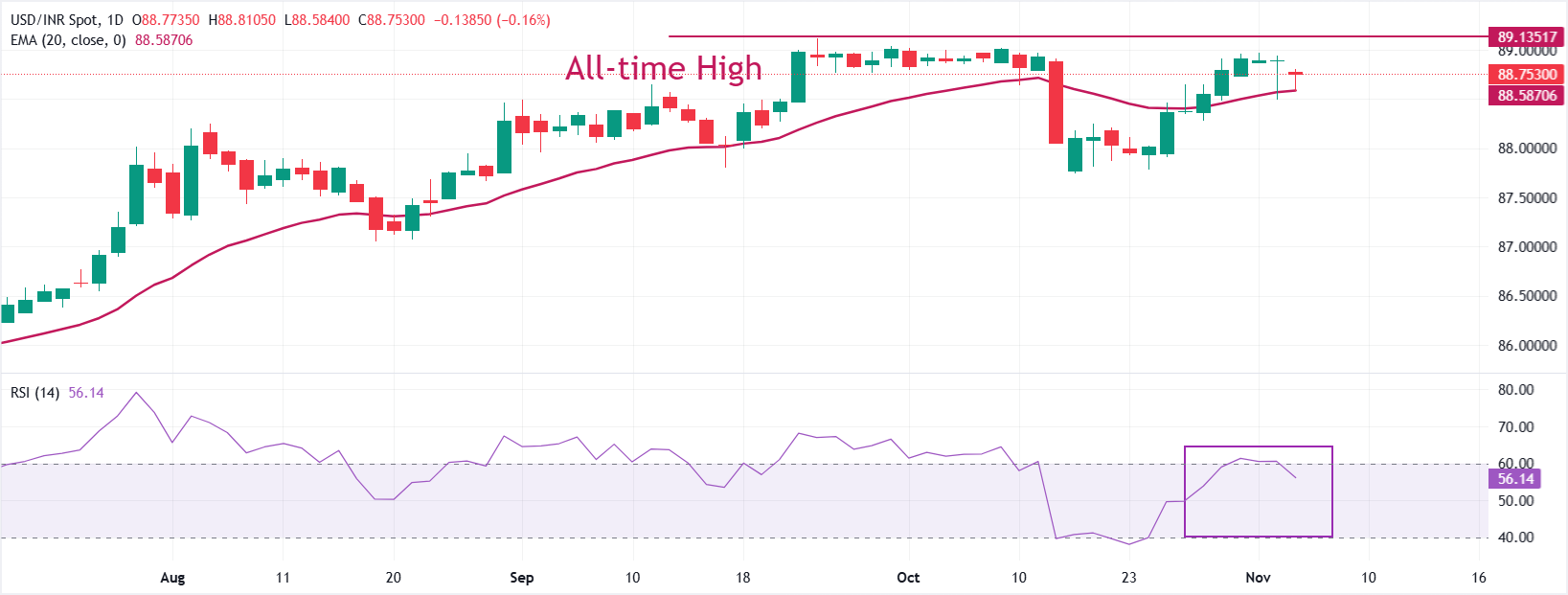
USD/INR flattens around 88.75 on Wednesday. The pair continues to find support near the 20-day Exponential Moving Average (EMA), which trades around 88.58.
The 14-day Relative Strength Index (RSI) falls after failing to break above 60.00, suggesting selling pressure at higher levels.
Looking down, the August 21 low of 87.07 will act as key support for the pair. On the upside, the all-time high of 89.12 will be a key barrier.
US Dollar FAQs
The US Dollar (USD) is the official currency of the United States of America, and the ‘de facto’ currency of a significant number of other countries where it is found in circulation alongside local notes. It is the most heavily traded currency in the world, accounting for over 88% of all global foreign exchange turnover, or an average of $6.6 trillion in transactions per day, according to data from 2022. Following the second world war, the USD took over from the British Pound as the world’s reserve currency. For most of its history, the US Dollar was backed by Gold, until the Bretton Woods Agreement in 1971 when the Gold Standard went away.
The most important single factor impacting on the value of the US Dollar is monetary policy, which is shaped by the Federal Reserve (Fed). The Fed has two mandates: to achieve price stability (control inflation) and foster full employment. Its primary tool to achieve these two goals is by adjusting interest rates. When prices are rising too quickly and inflation is above the Fed’s 2% target, the Fed will raise rates, which helps the USD value. When inflation falls below 2% or the Unemployment Rate is too high, the Fed may lower interest rates, which weighs on the Greenback.
In extreme situations, the Federal Reserve can also print more Dollars and enact quantitative easing (QE). QE is the process by which the Fed substantially increases the flow of credit in a stuck financial system. It is a non-standard policy measure used when credit has dried up because banks will not lend to each other (out of the fear of counterparty default). It is a last resort when simply lowering interest rates is unlikely to achieve the necessary result. It was the Fed’s weapon of choice to combat the credit crunch that occurred during the Great Financial Crisis in 2008. It involves the Fed printing more Dollars and using them to buy US government bonds predominantly from financial institutions. QE usually leads to a weaker US Dollar.
Quantitative tightening (QT) is the reverse process whereby the Federal Reserve stops buying bonds from financial institutions and does not reinvest the principal from the bonds it holds maturing in new purchases. It is usually positive for the US Dollar.
Author

Sagar Dua
FXStreet
Sagar Dua is associated with the financial markets from his college days. Along with pursuing post-graduation in Commerce in 2014, he started his markets training with chart analysis.