USD/INR gains on consistent overseas outflows, RBI’s interest rate cut
- The Indian Rupee slides to near 90.50 against the US Dollar as FIIs continue to offload stake in the Indian equity market.
- The RBI cuts its Repo Rate by 25 bps to 5.25%.
- Investors expect the Fed to announce a hawkish cut on Wednesday.

The Indian Rupee (INR) trades lower against the US Dollar (USD) at the start of the week. The USD/INR pair jumps to near 90.50 as the Indian Rupee continues to underperform due to the continuous outflow of foreign funds from the Indian stock market, and a dovish monetary policy announcement by the Reserve Bank of India (RBI) on Friday.
So far in December, Foreign Institutional Investors (FIIs) have remained net sellers on each trading day, and have offloaded shares worth Rs. 10,403.62 crore. FIIs also remained net sellers in the last five months on a net basis.
Trade frictions between the United States (US) and India have remained a key concern behind FIIs' consistent selling in the Indian equity market. Analysts at MUFG have predicted that the Indian Rupee could depreciate further to near 92.00 against the US Dollar if a US-India bilateral deal doesn’t strike in the coming months.
On Friday, the RBI cut its Repo Rate by 25 basis points (bps) to 5.25%, as expected, and announced Open Market Operations worth Rs. 1 lakh crore and a three-year USD/INR swap of $5 billion. The RBI assured that both the headline and the core Consumer Price Index (CPI) could rise to 4% in Financial Year (FY) 2026-27. Taking strong cues from the Q3 Gross Domestic Product (GDP) data, the RBI has raised growth projections for the current fiscal year to 7.3% from 6.8%.
This week, investors will focus on the retail CPI data for November, which will be released on Friday. Inflation at the retail level grew by 0.25% in October on an annualized basis.
The table below shows the percentage change of Indian Rupee (INR) against listed major currencies today. Indian Rupee was the weakest against the Euro.
| USD | EUR | GBP | JPY | CAD | AUD | INR | CHF | |
|---|---|---|---|---|---|---|---|---|
| USD | -0.16% | 0.03% | -0.05% | -0.05% | -0.07% | 0.23% | -0.11% | |
| EUR | 0.16% | 0.18% | 0.11% | 0.11% | 0.09% | 0.40% | 0.05% | |
| GBP | -0.03% | -0.18% | -0.08% | -0.07% | -0.09% | 0.20% | -0.14% | |
| JPY | 0.05% | -0.11% | 0.08% | 0.01% | -0.02% | 0.30% | -0.06% | |
| CAD | 0.05% | -0.11% | 0.07% | -0.01% | -0.02% | 0.29% | -0.06% | |
| AUD | 0.07% | -0.09% | 0.09% | 0.02% | 0.02% | 0.31% | -0.04% | |
| INR | -0.23% | -0.40% | -0.20% | -0.30% | -0.29% | -0.31% | -0.37% | |
| CHF | 0.11% | -0.05% | 0.14% | 0.06% | 0.06% | 0.04% | 0.37% |
The heat map shows percentage changes of major currencies against each other. The base currency is picked from the left column, while the quote currency is picked from the top row. For example, if you pick the Indian Rupee from the left column and move along the horizontal line to the US Dollar, the percentage change displayed in the box will represent INR (base)/USD (quote).
Daily digest market movers: Investors await Fed's interest rate decision, dot plot
- The Indian Rupee trades lower against the US Dollar on Monday, even as the latter trades with caution ahead of the Federal Reserve’s (Fed) monetary policy announcement on Wednesday.
- At the press time, the US Dollar Index (DXY), which tracks the Greenback’s value against six major currencies, strives to hold its over five-week low of 98.75 posted on Thursday.
- According to the CME FedWatch tool, the probability of the Fed cutting interest rates by 25 basis points (bps) to 3.50%-3.75% in the December policy meeting is 87%.
- The odds of a December interest rate cut are high due to soft job market conditions. The major catalyst behind the recent surge in Fed dovish expectations was support for easing monetary conditions by New York Fed Bank President John Williams in late November.
- As traders are confident of a Fed interest rate cut on Wednesday, the major trigger for the US Dollar’s outlook will be monetary policy guidance for 2026. It is likely that the Fed will call for a pause in the monetary-easing cycle as inflationary pressures have remained well above the 2% target for a longer period.
- Investors will also focus on the Fed’s dot plot, which shows where policymakers see the Federal Funds Rate heading in the medium and longer term.
- Market participants would also like to know the current status of the labor market and inflation amid the absence of the latest Nonfarm Payrolls (NFP) and the inflation data.
Technical Analysis: USD/INR holds key 20-day EMA
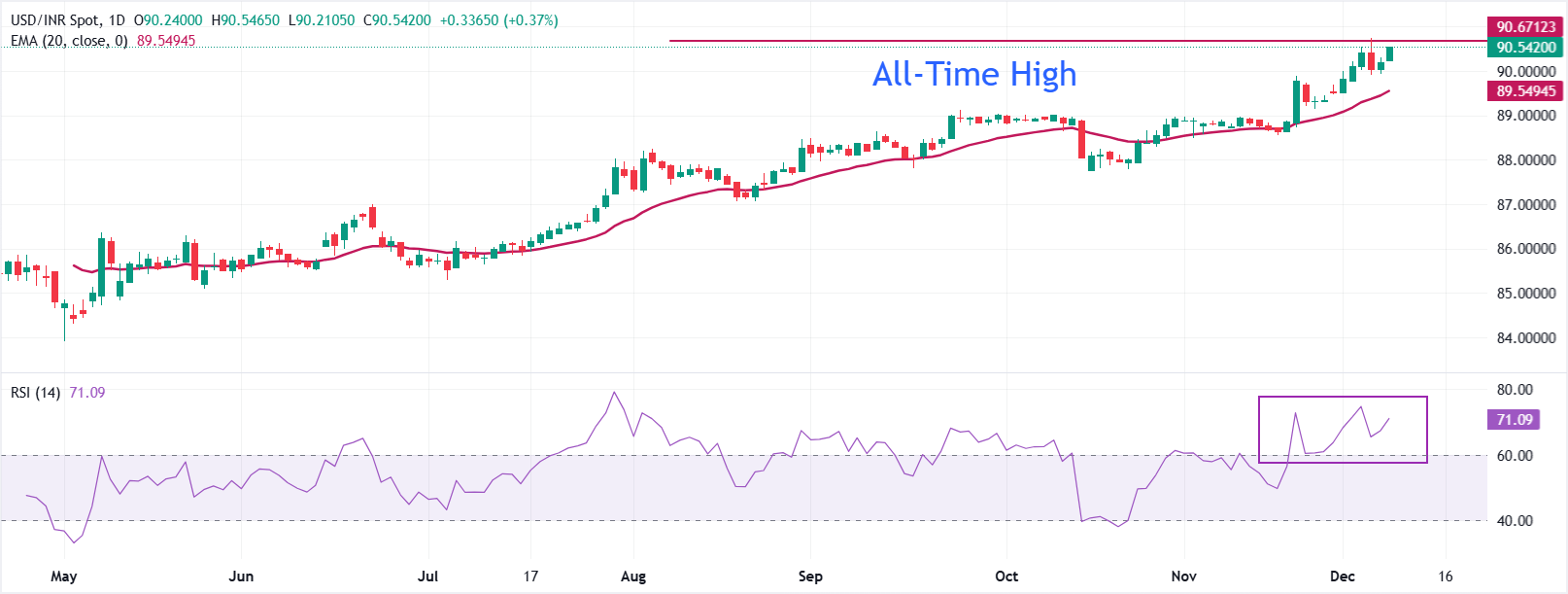
USD/INR trades at 90.50 as of writing. The 20-day Exponential Moving Average (EMA) is rising and the pair holds above it, reinforcing a bullish short-term trend.
The 14-day Relative Strength Index (RSI) at 70.61 is overbought, pointing to stretched momentum. Initial support sits at the 20-day EMA at 89.54, while a clean break of all-time highs around 90.70 would open the door to further gains.
With price action tracking above a rising average, dip-buying remains favored in the near term. A pause or mild pullback could relieve overbought conditions without damaging the broader advance. Should the daily close slip beneath the 20-day EMA, the bias would shift toward consolidation; maintaining the current stance would keep the upside path in play.
Economic Indicator
Fed Interest Rate Decision
The Federal Reserve (Fed) deliberates on monetary policy and makes a decision on interest rates at eight pre-scheduled meetings per year. It has two mandates: to keep inflation at 2%, and to maintain full employment. Its main tool for achieving this is by setting interest rates – both at which it lends to banks and banks lend to each other. If it decides to hike rates, the US Dollar (USD) tends to strengthen as it attracts more foreign capital inflows. If it cuts rates, it tends to weaken the USD as capital drains out to countries offering higher returns. If rates are left unchanged, attention turns to the tone of the Federal Open Market Committee (FOMC) statement, and whether it is hawkish (expectant of higher future interest rates), or dovish (expectant of lower future rates).
Read more.Next release: Wed Dec 10, 2025 19:00
Frequency: Irregular
Consensus: 3.75%
Previous: 4%
Source: Federal Reserve
Author

Sagar Dua
FXStreet
Sagar Dua is associated with the financial markets from his college days. Along with pursuing post-graduation in Commerce in 2014, he started his markets training with chart analysis.