USD/INR turns marginally positive even as US Dollar declines ahead of Fed's policy
- The Indian Rupee gains further against the US Dollar as trade talks between the US and India begin.
- Investors expect the Fed to cut interest rates by 25 bps to 3.50%-3.75%.
- This week, investors will focus on India’s retail CPI data, scheduled for release on Friday.

The Indian Rupee (INR) gives back early gains and ticks up against the US Dollar (USD) during afternoon trading hours in India on Wednesday. The USD/INR pair edges higher to near 90.25, even as the US Dollar declines, with investors turning cautious ahead of the Federal Reserve’s (Fed) monetary policy announcement at 19:00 GMT.
As of writing, the US Dollar Index (DXY), which gauges the Greenback’s value against six major currencies, trades 0.1% lower to near 99.10.
The CME FedWatch tool shows that the probability of the Fed cutting interest rates by 25 basis points (bps) to 3.50%-3.75% in the December policy meeting is 87.6%. This will be the Fed's third interest rate cut in a row. Firm Fed dovish expectations are driven by weak United States (US) labour market conditions.
Lately, a significant number of Federal Open Market Committee (FOMC) members have also supported the need for further policy expansion amid downside employment risks. In late November, New York Fed Bank President John Williams stated that there is room for further interest rate cuts in the near term as the policy is still modestly restrictive, while warning that the "economic growth has slowed and the labour market has gradually cooled".
As the Fed is almost certain to bring borrowing rates down further, the major driver for the US Dollar’s outlook will be the Fed’s guidance on interest rates. Investors would like to know whether the Fed will announce a pause to the ongoing monetary-easing campaign or lean towards a data-dependent approach.
Financial market participants will also focus on the Fed’s dot plot, which shows where policymakers collectively see the Federal Funds Rate heading in the near-to-longer term.
Daily digest market movers: Indian Rupee falls back while US-India trade talks begin
- The Indian Rupee retreats against the US Dollar as two-day trade talks between the United States (US) and India begin on Wednesday. US Deputy Trade Representative Rick Switzer was scheduled to visit India on December 10-11, while India's foreign ministry described Switzer's meetings as a "familiarisation" trip, Reuters reported.
- Officials from India would look to push for reducing tariffs on exports to the US, which currently stands at 50%, one of the highest among Washington’s trading partners.
- Signs from the meeting that the US and India have made progress towards reaching a consensus would be favorable for the Indian Rupee, which has lost significant interest from overseas investors due to trade deal uncertainty.
- So far in December, Foreign Institutional Investors (FIIs) have turned out to be net sellers on all trading days, and have offloaded stake worth Rs. 14,819.29 crores. FIIs have also remained net sellers in the last five months.
- On the domestic front, investors will focus on the retail Consumer Price Index (CPI) data for November, which will be released on Friday. According to a December 4-8 Reuters poll, India’s retail inflation grew at an annualized pace of 0.7%, faster than 0.25% in October.
The table below shows the percentage change of Indian Rupee (INR) against listed major currencies today. Indian Rupee was the weakest against the Australian Dollar.
| USD | EUR | GBP | JPY | CAD | AUD | INR | CHF | |
|---|---|---|---|---|---|---|---|---|
| USD | -0.12% | -0.10% | -0.03% | 0.03% | -0.14% | 0.08% | -0.14% | |
| EUR | 0.12% | 0.02% | 0.07% | 0.15% | -0.03% | 0.22% | -0.02% | |
| GBP | 0.10% | -0.02% | 0.06% | 0.13% | -0.05% | 0.19% | -0.04% | |
| JPY | 0.03% | -0.07% | -0.06% | 0.06% | -0.11% | 0.13% | -0.11% | |
| CAD | -0.03% | -0.15% | -0.13% | -0.06% | -0.17% | 0.08% | -0.17% | |
| AUD | 0.14% | 0.03% | 0.05% | 0.11% | 0.17% | 0.28% | 0.00% | |
| INR | -0.08% | -0.22% | -0.19% | -0.13% | -0.08% | -0.28% | -0.25% | |
| CHF | 0.14% | 0.02% | 0.04% | 0.11% | 0.17% | -0.00% | 0.25% |
The heat map shows percentage changes of major currencies against each other. The base currency is picked from the left column, while the quote currency is picked from the top row. For example, if you pick the Indian Rupee from the left column and move along the horizontal line to the US Dollar, the percentage change displayed in the box will represent INR (base)/USD (quote).
Technical Analysis: USD/INR stays above key 20-day EMA
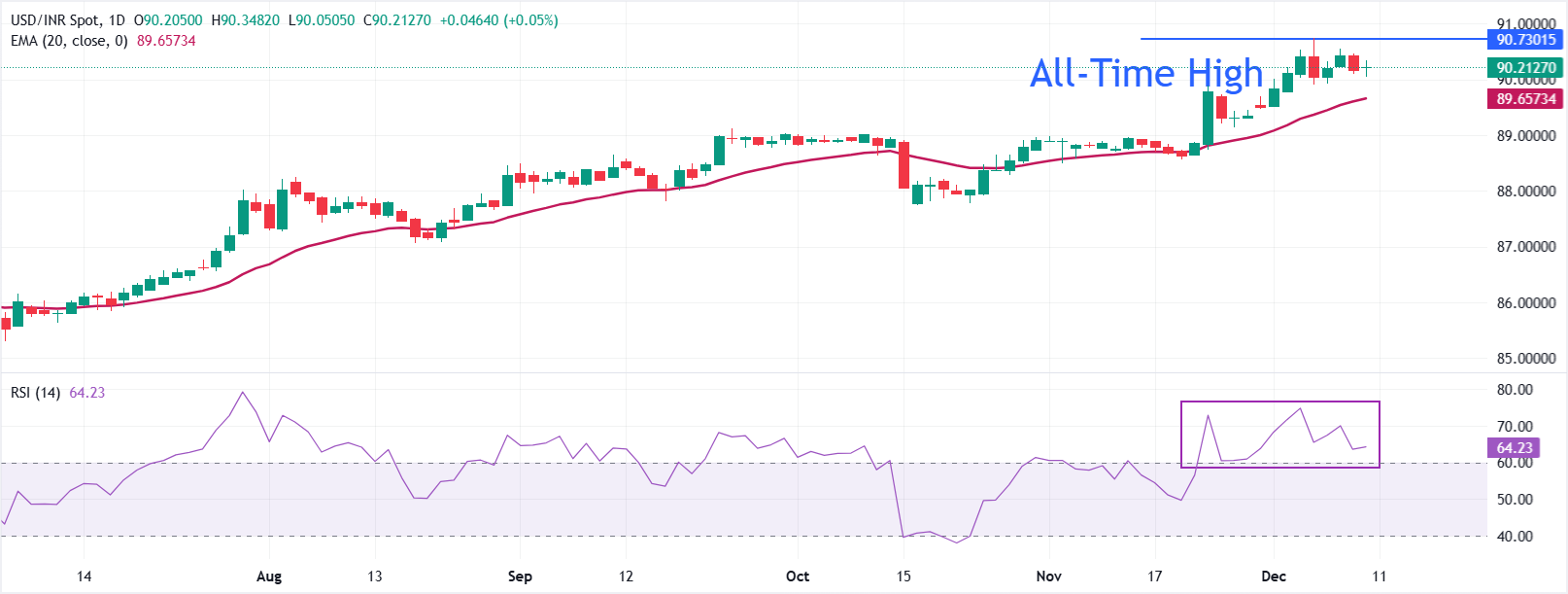
USD/INR trades flat near 90.20 in the European trading session on Wednesday. The upward-sloping 20-day Exponential Moving Average (EMA) at 89.6463 underscores a steady uptrend, with the spot holding above it.
The 14-day Relative Strength Index (RSI) at 62.00 has eased from earlier overbought readings, indicating firm yet moderating momentum.
Trend strength would remain in place while price stays above the 20-day EMA, where pullbacks could find support. A renewed push in momentum toward the RSI 70.00 band could extend gains, whereas a drop toward 50.00 would signal consolidation. Buyers defending the 20-day EMA would keep the path higher intact, while a close below it could open a deeper correction toward the November 13 high at 88.97.
(The technical analysis of this story was written with the help of an AI tool.)
Economic Indicator
Fed Interest Rate Decision
The Federal Reserve (Fed) deliberates on monetary policy and makes a decision on interest rates at eight pre-scheduled meetings per year. It has two mandates: to keep inflation at 2%, and to maintain full employment. Its main tool for achieving this is by setting interest rates – both at which it lends to banks and banks lend to each other. If it decides to hike rates, the US Dollar (USD) tends to strengthen as it attracts more foreign capital inflows. If it cuts rates, it tends to weaken the USD as capital drains out to countries offering higher returns. If rates are left unchanged, attention turns to the tone of the Federal Open Market Committee (FOMC) statement, and whether it is hawkish (expectant of higher future interest rates), or dovish (expectant of lower future rates).
Read more.Next release: Wed Dec 10, 2025 19:00
Frequency: Irregular
Consensus: 3.75%
Previous: 4%
Source: Federal Reserve
Author

Sagar Dua
FXStreet
Sagar Dua is associated with the financial markets from his college days. Along with pursuing post-graduation in Commerce in 2014, he started his markets training with chart analysis.














