USD/INR rises ahead of US PPI, Retail Sales data
- The Indian Rupee loses ground as the US Dollar (USD) advances despite rising Fed rate cut bets.
- India’s economy likely expanded 7.3% in the July–September quarter, driven by robust rural demand and increased government spending.
- The CME FedWatch Tool indicates pricing in an 81% chance of a 25-basis-point Fed rate cut in December.

The Indian Rupee (INR) declines against the US Dollar (USD) after registering modest gains in the previous session. The USD/INR pair appreciates as the US Dollar (USD) gains ground despite rising expectations of a Fed rate cut in December. However, the upside of the pair could be restrained as traders expect the Reserve Bank of India (RBI) to intervene in the market.
Reuters reported that private bankers said the central bank intervened before the market opened, sending an early signal that Friday’s price action would not be allowed to escalate. One banker noted, “Monday felt like a message. The RBI will not allow the pair a free run beyond 88.80.”
India’s economy likely grew 7.3% in the July–September quarter, supported by strong rural demand and government spending. Household consumption, around 60% of GDP, also improved last quarter as rural spending picked up on better agricultural output, according to a Reuters poll of economists.
S&P Global Ratings said Monday that India’s economy could grow 6.5% in the current fiscal year and 6.7% in FY27, supported by tax relief measures and monetary policy easing that are expected to lift consumption. Real GDP expanded 7.8% in the April–June quarter of FY26, its fastest pace in five quarters. Official Q2 FY26 GDP data is due for release on November 28, according to FE Bureau.
Monday's RBI monthly report added to the positive sentiment, highlighting that domestic tax cuts and this year’s rate reductions are expected to bolster private investment and GDP growth.
US Dollar strengthens despite Fed rate-cut odds
- The US Dollar Index (DXY), which measures the value of the US Dollar against six major currencies, is gaining ground and trading around 100.20 at the time of writing. Traders await the release of the US ADP Employment Change Weekly, Retail Sales, and Producer Price reports, due later on Tuesday.
- The CME FedWatch Tool suggests that markets are now pricing in an 81% chance that the Fed will cut its benchmark overnight borrowing rate by 25 basis points (bps) at its December meeting, up from 71% probability that markets priced a day ago.
- Fed Governor Christopher Waller told Fox Business on Monday that his primary concern is the weakening labour market, stating that inflation is “not a big problem” in light of recent softness in employment. Waller also suggested that the September payrolls figure is likely to be revised lower and cautioned that concentrated hiring is “not a good sign,” signalling his support for a near-term rate cut.
- Fed Waller’s remarks reinforced comments made on Friday by New York Fed President John Williams, which also contributed to shifting expectations toward earlier rate cuts. Williams indicated that interest rates could be lowered in the near term, ahead of key US retail sales and producer price data scheduled for release this week.
- The University of Michigan’s (UoM) Consumer Sentiment Index rose in November to 51 from a preliminary 50.3, beating forecasts but posting a decline from October's reading of 53.6. Inflation expectations improved, with the one-year outlook easing to 4.5% from 4.7% and the five-year measure falling to 3.4% from 3.6%.
- Nonfarm Payrolls (NFP) in the United States (US) rose by 119,000 in September, compared to the 4,000 decrease (revised from +22,000) recorded in August. This figure surpassed the market expectation of 50,000. The US Unemployment Rate ticked up to 4.4% in September from 4.3% in August. The Average Hourly Earnings held steady at 3.8% YoY, compared to the market expectation of 3.7%.
- FOMC Minutes for the October 28-29 meeting indicated that Fed officials are divided and cautious about the path forward for interest rates. Most participants indicated further rate cuts would likely be appropriate over time, but several indicated they did not necessarily view a reduction in December as appropriate.
- India's HSBC Composite PMI dropped to 59.9 in November from the final reading of 60.4 in October due to a slowdown in the growth of manufacturing sector activity. The Manufacturing PMI fell to 57.4 from the prior reading of 59.2, despite the government's reduction of Goods and Services Tax (GST) rates across all product categories. Meanwhile, the Services PMI expanded at a faster pace to 59.5 from the former release of 58.9.
- The United States (US) and India have not yet reached a trade deal despite months of negotiations. However, they have stated that a bilateral pact will be announced soon. Earlier this month, US President Donald Trump stated that he will reduce tariffs on imports from India “at some point in time”. Currently, Washington is charging 50% tariffs on imports coming from India, which includes a 25% additional levy as a penalty for buying Oil from Russia.
Technical Analysis: USD/INR tests the psychological support at 89.00
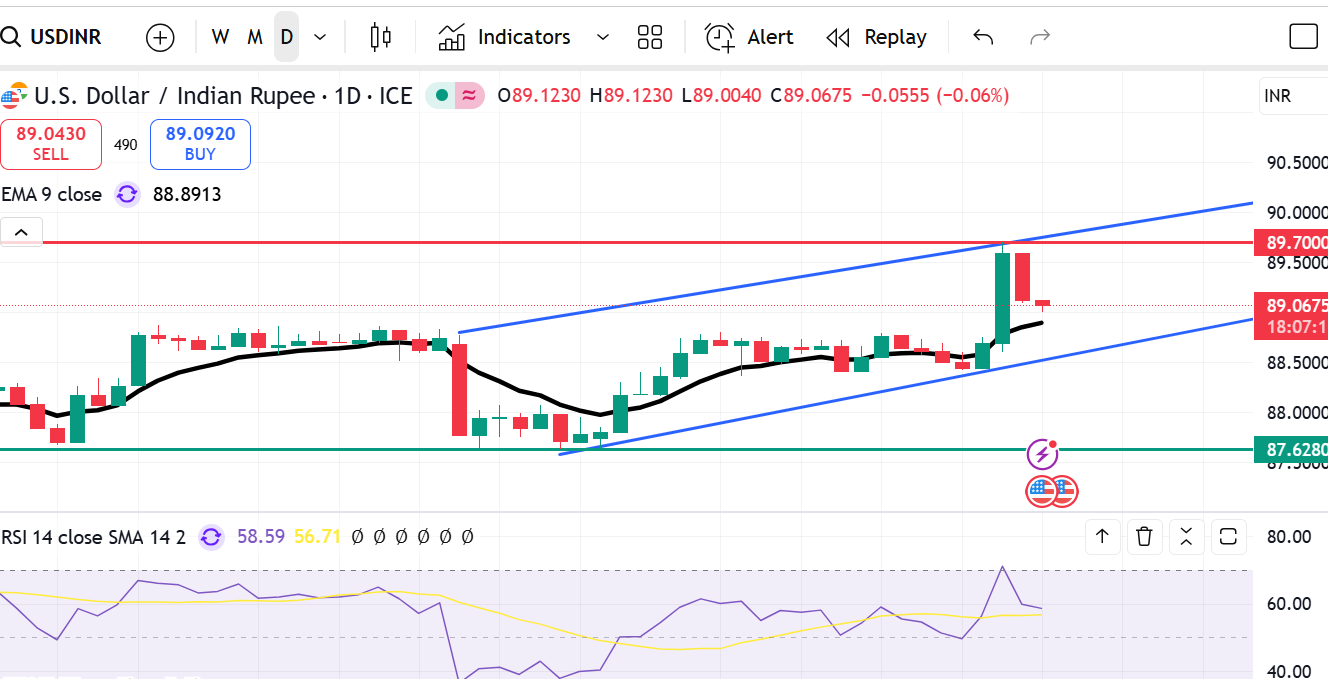
USD/INR trades around 89.10 during the Asian hours on Tuesday, with technical analysis suggesting a bullish bias as the pair remains within the ascending channel pattern. Additionally, the 14-day Relative Strength Index (RSI) remains above the 50 level, strengthening the bullish bias.
The USD/INR pair may target the initial resistance at the all-time high of 89.70, reached on November 21, followed by the upper boundary of the ascending channel around 89.80.
On the downside, the USD/INR may find its primary support crucial level of 89.00, followed by the nine-day Exponential Moving Average (EMA) of 88.88. A break below this level would weaken the bullish bias and prompt the pair to test the lower boundary of the ascending channel around 88.50.
Indian Rupee FAQs
The Indian Rupee (INR) is one of the most sensitive currencies to external factors. The price of Crude Oil (the country is highly dependent on imported Oil), the value of the US Dollar – most trade is conducted in USD – and the level of foreign investment, are all influential. Direct intervention by the Reserve Bank of India (RBI) in FX markets to keep the exchange rate stable, as well as the level of interest rates set by the RBI, are further major influencing factors on the Rupee.
The Reserve Bank of India (RBI) actively intervenes in forex markets to maintain a stable exchange rate, to help facilitate trade. In addition, the RBI tries to maintain the inflation rate at its 4% target by adjusting interest rates. Higher interest rates usually strengthen the Rupee. This is due to the role of the ‘carry trade’ in which investors borrow in countries with lower interest rates so as to place their money in countries’ offering relatively higher interest rates and profit from the difference.
Macroeconomic factors that influence the value of the Rupee include inflation, interest rates, the economic growth rate (GDP), the balance of trade, and inflows from foreign investment. A higher growth rate can lead to more overseas investment, pushing up demand for the Rupee. A less negative balance of trade will eventually lead to a stronger Rupee. Higher interest rates, especially real rates (interest rates less inflation) are also positive for the Rupee. A risk-on environment can lead to greater inflows of Foreign Direct and Indirect Investment (FDI and FII), which also benefit the Rupee.
Higher inflation, particularly, if it is comparatively higher than India’s peers, is generally negative for the currency as it reflects devaluation through oversupply. Inflation also increases the cost of exports, leading to more Rupees being sold to purchase foreign imports, which is Rupee-negative. At the same time, higher inflation usually leads to the Reserve Bank of India (RBI) raising interest rates and this can be positive for the Rupee, due to increased demand from international investors. The opposite effect is true of lower inflation.
Author

Akhtar Faruqui
FXStreet
Akhtar Faruqui is a Forex Analyst based in New Delhi, India. With a keen eye for market trends and a passion for dissecting complex financial dynamics, he is dedicated to delivering accurate and insightful Forex news and analysis.















