USD/CHF rebounds slightly, yet prints losses following Fed’s cut
- USD/CHF recovers slightly post-Fed decision, yet buyers struggle to significantly elevate the rate.
- Fed enacts a 50 bps rate cut, forecasts a 4.4% federal funds rate by 2024, and maintains a data-driven policy stance.
- Jerome Powell notes reduced inflation risks, with flexibility for adjusting the pace of future rate cuts as necessary.

The USD/CHF recovered after whipsawing after the Federal Reserve lowered borrowing costs by 50 basis points (bps), though it reaffirmed its data-dependent stance, according to Chairman Jerome Powell. At the time of writing, the major trades were at 0.8459, slightly down to some 0.14%.
USD/CHF falls as Fed signals confidence in inflation control but leaves room for flexible policy adjustments
The Fed began its easing cycle, which will take the federal funds rate to 4.4% in 2024, according to the median in the Summary of Economic Projections (SEP). In its monetary policy statement, officials hinted that they had grown confident that inflation is on a “sustainable” path to the central bank’s 2% goal and that dual mandate risk had “roughly” balanced.
Policymakers estimate the US economy to grow at a 2% pace during the 2024-2027 period, and project inflation to edge down to 2.6% in 2024 and 2.2% in 2025 and reach the 2% target in 2026.
The Unemployment Rate, seen as the main driver for Fed Chair Powell’s decision to slash rates by 0.50%, is expected to climb to 4.4% toward the end of the year.
After the Fed’s statement, Fed Chair Jerome Powell commented that inflation risks had diminished, and the economy remained strong. He added that if higher prices persist, the Fed can adjust policy more slowly while keeping its options open to “go quicker, slower or pause on rate cuts if it is appropriate.” Powell said that the Committee is not in a rush to normalize policy.
Meanwhile, the USD/CHF erased some of its losses, though buyers could not increase the exchange rate.
USD/CHF Price Forecast: Technical outlook
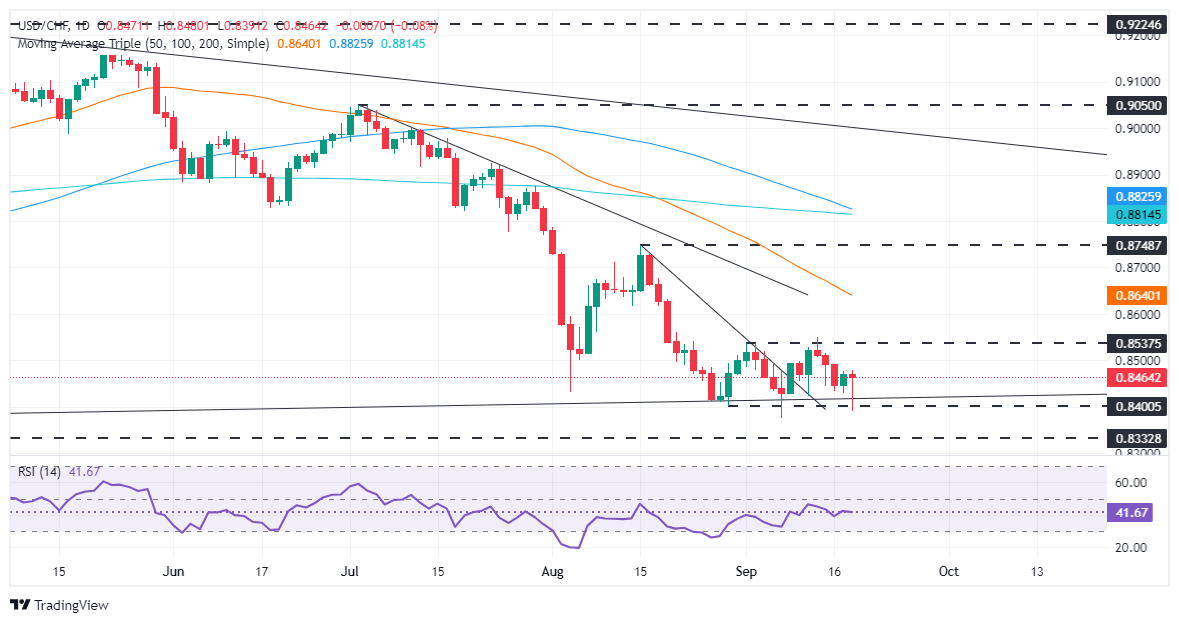
The USD/CHF daily chart hints an ‘inverted head and shoulders’ could be emerging at the lows at around0.8400,
Momentum remains bearishly biased, as the Relative Strength Index (RSI) portrays. Still, the latter's failure to print another trough could pave the way for a leg-up in the USD/CHF pair.
If the major edges above the September 12 high of 0.8549, that could pave the way for a confirmation of the ‘inverted head-and-shoulders.’ The next resistance would be the August 15 peak at 0.8748. Conversely, if USD/CHF drops below 0.8400, look for a re-test of the year-to-date (YTD) low of 0.8373.
Swiss economy FAQs
Switzerland is the ninth-largest economy measured by nominal Gross Domestic Product (GDP) in the European continent. Measured by GDP per capita – a broad measure of average living standards –, the country ranks among the highest in the world, meaning that it is one the richest countries globally. Switzerland tends to be in the top spots in global rankings about living standards, development indexes, competitiveness or innovation.
Switzerland is an open, free-market economy mainly based on the services sector. The Swiss economy has a strong export sector, and the neighboring European Union (EU) is its main trading partner. Switzerland is a leading exporter of watches and clocks, and hosts leading firms in the food, chemicals and pharmaceutical industries. The country is considered to be an international tax haven, with significantly low corporate and income tax rates compared with its European neighbors.
As a high-income country, the growth rate of the Swiss economy has diminished over the last decades. Still, its political and economic stability, its high education levels, top-tier firms in several industries and its tax-haven status have made it a preferred destination for foreign investment. This has generally benefited the Swiss Franc (CHF), which has historically kept relatively strong against its main currency peers. Generally, a good performance of the Swiss economy – based on high growth, low unemployment and stable prices – tends to appreciate CHF. Conversely, if economic data points to weakening momentum, CHF is likely to depreciate.
Switzerland isn’t a commodity exporter, so in general commodity prices aren’t a key driver of the Swiss Franc (CHF). However, there is a slight correlation with both Gold and Oil prices. With Gold, CHF’s status as a safe-haven and the fact that the currency used to be backed by the precious metal means that both assets tend to move in the same direction. With Oil, a paper released by the Swiss National Bank (SNB) suggests that the rise in Oil prices could negatively influence CHF valuation, as Switzerland is a net importer of fuel.
Author

Christian Borjon Valencia
FXStreet
Markets analyst, news editor, and trading instructor with over 14 years of experience across FX, commodities, US equity indices, and global macro markets.