|

USD/CHF Price Prediction: Unfolding down leg within range

  • USD/CHF is trading lower within a range formed since August. 
  • It is in a sideways trend and a decisive breakout would be required to give directionality.
     

USD/CHF continues trading up and down within a range. It is probably in a sideways trend, which given the principle that “the trend is your friend” is likely to endure.

USD/CHF 4-hour Chart 
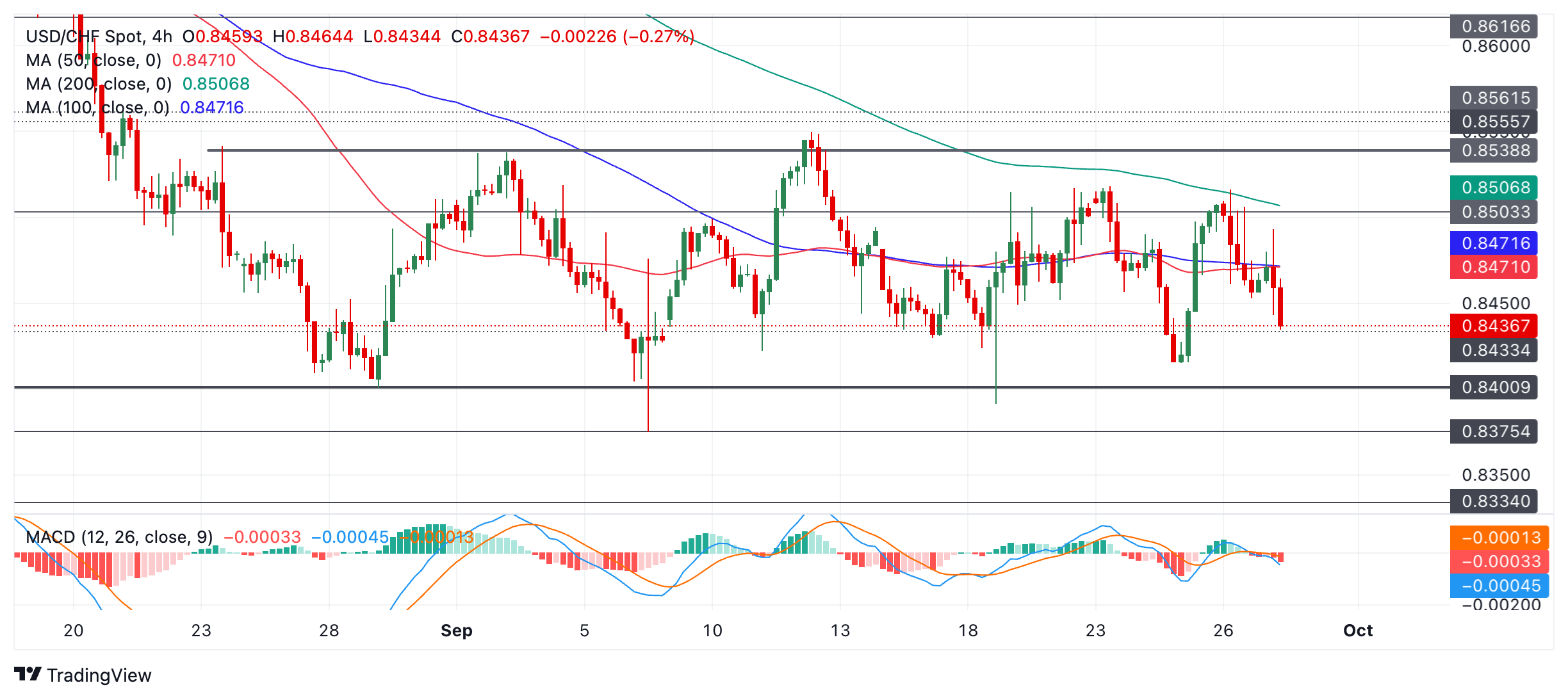


USD/CHF is currently moving down within the range and it will probably reach at least as far as the 0.8415, the September 25 lows. A particularly bearish move might even fall to the 0.8400 floor. After that it will probably recover and continue the sideways trend. 

The Moving Average Convergence Divergence (MACD) momentum indicator is below the signal and the zero lines indicating bearishness. 

A decisive break out of the range – either higher or lower – would change the range-bound consolidation mode.  The top of the range lies at 0.8550 (September 12 high); the bottom at 0.8375 (September 6 low). A decisive break would be one accompanied by a longer-than-average candlestick that closed near its high in the case of a bullish break and low in a bearish case. That, or three consecutive bullish or bearish candles that broke either above or below the levels. 

Given the trend prior to the range was bearish the odds margin ally favor a downside breakout. Such a move would be expected to go as low as 0.8318, the 61.8% Fibonacci extrapolation of the height of the range extrapolated lower. 

Author

Joaquin Monfort

Joaquin Monfort is a financial writer and analyst with over 10 years experience writing about financial markets and alt data. He holds a degree in Anthropology from London University and a Diploma in Technical analysis.


More from Joaquin Monfort
Share:

Editor's Picks

AUD/USD remains under presure above 0.7000; focus on data

AUD/USD has met some renewed selling pressure on Thursday, coming down from tops near 0.7040 to revisit the 0.7000 region ahead of the opening bell in Asia. The pair’s daily decline has come despite a lacklustre performance in the Greenback at the time when investors continued to monitor developments from the Middle East. Looking ahead, the release of flash PMIs will grab the attention in Oz at the end of the week.

USD/JPY declines to a one-week low; eyes trading range support near 157.50 on weaker USD

USD/JPY drops to a one-week low during Thursday’s Asian session, with bears now awaiting a break below multi-week range support near mid-157.00s before placing fresh bets amid a broadly weaker US Dollar. Despite bets for a December Fed rate hike and Middle East jitters, the recent decline in US bond yields keeps USD depressed near a three-week low. Moreover, hawkish BoJ expectations and intervention risks underpin the Japanese Yen, further weighing on the currency pair.

Gold remains offered just above $4,000

Gold prices resume their decline on Thursday, easing toward the area of two-month lows around $4,050 per troy ounce. Higher crude oil prices have reignited speculation of further tightening by the Fed, supporting the US Dollar and weighing on the precious metal.

The estimates keep falling: Why Bitcoin's quantum countdown is accelerating
The threat that Artificial Intelligence (AI) and quantum computing pose to Bitcoin (BTC) and cryptocurrencies in general is no longer a matter of if hardware will catch up; it is a matter of when. Advances in AI-assisted research are adding a new dimension to the quantum computing threat, although neither technology can currently break Bitcoin’s cryptography on its own.
The Bank of England just got its clearest reason to hike. Here's what it's really watching

UK inflation as measured by the CPI accelerated to 3.5% YoY in September, up from 3.1% in August, according to the Office for National Statistics. This is the highest level since October 2025, exceeding economists' expectations of 3.4% and pushing inflation further from the BoE's 2% target.

What November 3 means for the Fed's rate path and the US Dollar

The USD faces a decisive period ahead of the November 3 midterm elections. While markets anticipate another interest rate increase from the Fed in December, the battle for control of Congress could reshape fiscal policy expectations and, indirectly, the path of US monetary policy in 2027.