US Dollar under pressure as markets digest US mid-tier data
- DXY remains under pressure, testing 107.35 support despite upbeat ADP and S&P Global PMI data.
- ISM Services PMI disappoints, signaling weaker-than-expected service sector growth and moderating price pressures.
- US 10-year yield rebounds, hovering around 4.40% after touching a yearly low.

The US Dollar Index (DXY), which measures the US Dollar (USD) against a basket of currencies, struggled to recover losses on Wednesday and declined against most major peers. Despite stronger than expected ADP Employment and S&P Global PMI data, the ISM Services PMI fell short of forecasts, casting doubt on the strength of the United States (US) economy.
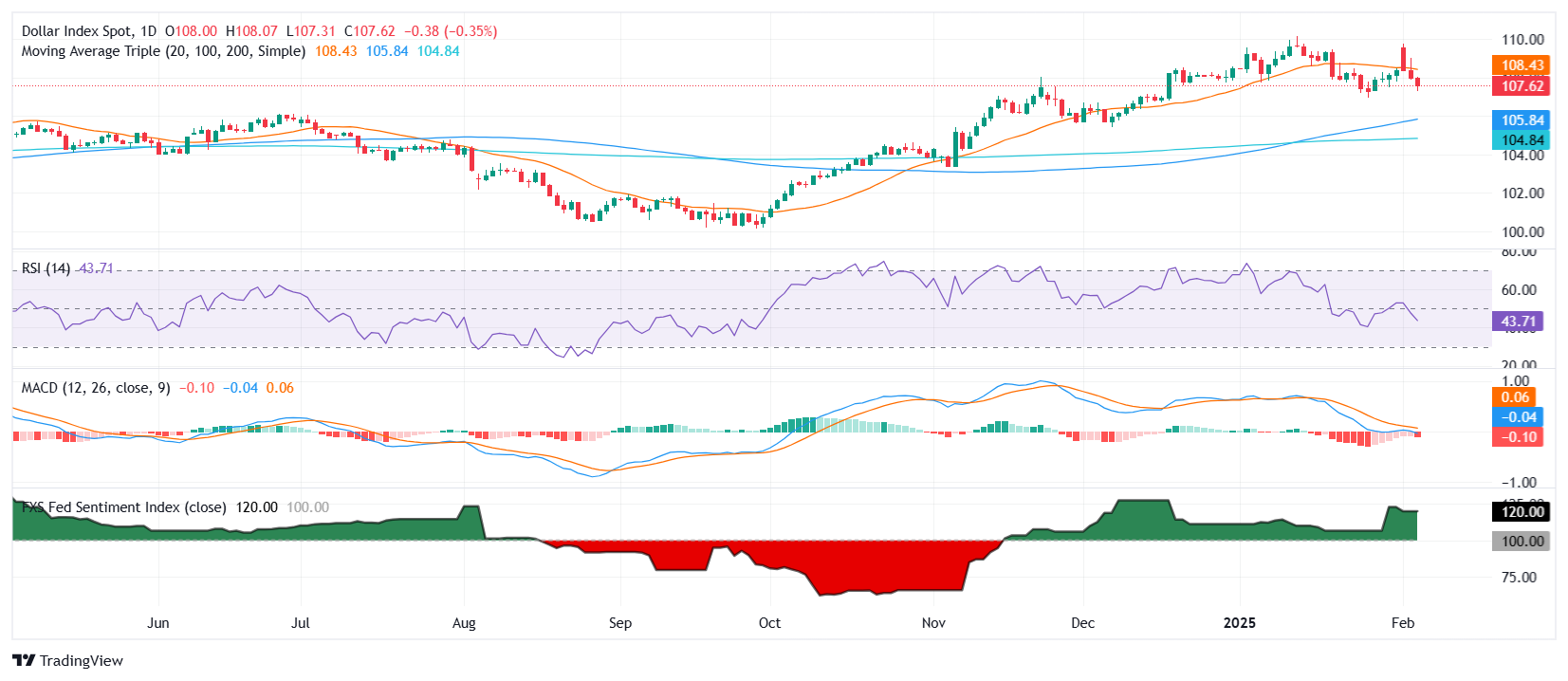
The Fed Sentiment Index, which previously sat at 130.00, has cooled off, signaling a less hawkish tone from policymakers. As a result, traders are reassessing the Federal Reserve’s (Fed) rate path, contributing to the DXY’s weak price action around 107.35 support.
Daily digest market movers: US Dollar struggles as mixed data weighs on sentiment
- ADP Employment Report showed that private sector employment jumped by 183,000 in January, exceeding the 150,000 forecast. Consumer-facing industries drove job creation, while manufacturing saw weaker gains.
- S&P Global PMI data revealed that the final readings for January saw minor upward revisions with the Services PMI at 52.9 (vs. 52.8 expected) and the Composite PMI at 52.7 (vs. 52.4 prior).
- ISM Services PMI: Disappointed at 52.8, missing the expected 54.3, while the Prices Paid index eased to 60.4 from 64.4, indicating softer inflationary pressures.
- All eyes are now on Friday's Nonfarm Payrolls for January, which are expected to print a weak result that might weaken the USD further.
DXY technical outlook: Bears eye 107.00 support
The DXY's momentum indicators reflect a shift toward bearish traction. The Fed Sentiment Index cooling off from 130.00 aligns with weaker ISM data, weighing on the USD.
The Relative Strength Index (RSI) has dropped below 50, while the index has fallen beneath the 20-day Simple Moving Average (SMA) at 108.50. If downside pressure persists, the next key level to watch is the psychological support at 107.00.
Fed FAQs
Monetary policy in the US is shaped by the Federal Reserve (Fed). The Fed has two mandates: to achieve price stability and foster full employment. Its primary tool to achieve these goals is by adjusting interest rates. When prices are rising too quickly and inflation is above the Fed’s 2% target, it raises interest rates, increasing borrowing costs throughout the economy. This results in a stronger US Dollar (USD) as it makes the US a more attractive place for international investors to park their money. When inflation falls below 2% or the Unemployment Rate is too high, the Fed may lower interest rates to encourage borrowing, which weighs on the Greenback.
The Federal Reserve (Fed) holds eight policy meetings a year, where the Federal Open Market Committee (FOMC) assesses economic conditions and makes monetary policy decisions. The FOMC is attended by twelve Fed officials – the seven members of the Board of Governors, the president of the Federal Reserve Bank of New York, and four of the remaining eleven regional Reserve Bank presidents, who serve one-year terms on a rotating basis.
In extreme situations, the Federal Reserve may resort to a policy named Quantitative Easing (QE). QE is the process by which the Fed substantially increases the flow of credit in a stuck financial system. It is a non-standard policy measure used during crises or when inflation is extremely low. It was the Fed’s weapon of choice during the Great Financial Crisis in 2008. It involves the Fed printing more Dollars and using them to buy high grade bonds from financial institutions. QE usually weakens the US Dollar.
Quantitative tightening (QT) is the reverse process of QE, whereby the Federal Reserve stops buying bonds from financial institutions and does not reinvest the principal from the bonds it holds maturing, to purchase new bonds. It is usually positive for the value of the US Dollar.
Author

Patricio Martín
FXStreet
Patricio is an economist from Argentina passionate about global finance and understanding the daily movements of the markets.