|

US Dollar Index Price Analysis: DXY bounce aim for April low above 90.00

  • DXY keeps the previous day’s corrective pullback from late February lows.
  • RSI recovery backs extension of the latest bounce.
  • April’s bottom can probe buyers inside short-term bullish chart pattern.

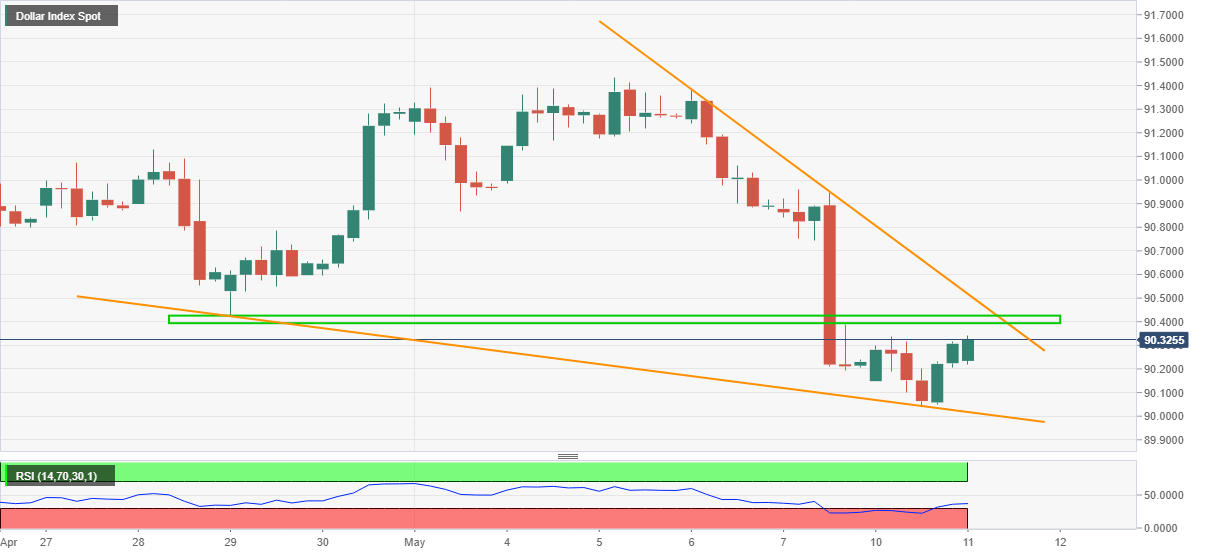
US dollar index (DXY) picks up bids around 90.33, up 0.05% intraday, during its second consecutive daily run-up on early Tuesday. The greenback gauge dropped to the lowest in 10 weeks, before closing the day on a positive side, on Monday.

Given the RSI bounce off oversold territory, DXY run-up may gain momentum but the 90.40-45 area comprising April’s low guards the immediate up-moves.

If at all the US dollar bulls manage to cross the 90.45 hurdle, an eight-day-old falling wedge chart formation gains the market’s attention, which in turn highlights 90.52 as important resistance.

Should the DXY recovery extends beyond 90.52, it becomes capable to attack the monthly top near 91.45.

Meanwhile, the stated formation’s support line near the 90.00 threshold becomes the key to watch during the quote’s fresh downside.

Following that, February’s low of 89.68 and the yearly bottom surrounding 89.20 will be crucial.

DXY four-hour chart
Trend: Further recovery expected

Additional important levels

Overview
Today last price90.33
Today Daily Change0.02
Today Daily Change %0.02%
Today daily open90.31
 
Trends
Daily SMA2091.07
Daily SMA5091.72
Daily SMA10091.06
Daily SMA20091.9
 
Levels
Previous Daily High90.34
Previous Daily Low90.05
Previous Weekly High91.44
Previous Weekly Low90.19
Previous Monthly High93.33
Previous Monthly Low90.42
Daily Fibonacci 38.2%90.23
Daily Fibonacci 61.8%90.16
Daily Pivot Point S190.12
Daily Pivot Point S289.94
Daily Pivot Point S389.83
Daily Pivot Point R190.41
Daily Pivot Point R290.52
Daily Pivot Point R390.7

Author

Anil Panchal

Anil Panchal

FXStreet

Anil Panchal has nearly 15 years of experience in tracking financial markets. With a keen interest in macroeconomics, Anil aptly tracks global news/updates and stays well-informed about the global financial moves and their implications.


More from Anil Panchal
Share:

Editor's Picks

GBP/USD stabilizes near 1.3200 following latest rebound

GBP/USD holds steady at around 1.3200 in the European session on Friday after closing in positive territory on Thursday. Still, the cautious market mood makes it difficult for the pair to gather bullish momentum as investors remain focused on US-Iran conflict and the volaility surrounding global technology shares.

EUR/USD rebounds to 1.1400 as USD corrects lower

EUR/USD gains traction in the European session on Friday and rises to the 1.1400 area. The US Dollar (USD) struggles to find demand and helps the pair edge higher as investors keep a close eye on headlines coming out of the Middle East and the action in global technology stocks.

Gold holds above $4,000 but Fed hike bets cap the upside

Gold moves sideways in a tight channel above $4,000 after posting modest gains on Thursday. Nevertheless, the precious metal finds it difficult to gather bullish momentum as markets grow increasingly concerned about a hawkish Federal Reserve policy outlook.

Ripple price clings to $1 as long liquidations deepen bearish trend

Ripple (XRP) trades near the key psychological support level of $1 after losing more than 8% so far this week. CoinGlass liquidation data shows that over 97% XRP long positions were wiped out over the past 24 hours. In addition, derivatives metrics continue to favor the bears.

The Mag 7 trade is ending – The AI cash-flow divorce is just beginning

The AI boom is not weakening. The market is simply becoming less willing to reward companies for writing ever-larger infrastructure cheques without a clearer cash-return timetable. Microsoft, Amazon, Alphabet and Meta are becoming the financing arm of the AI cycle, while chips, memory, networking and power infrastructure increasingly look like the early cash beneficiaries.

Regime change: Inside Kevin Warsh's first move to make the Fed unreadable on purpose

The rate did not move. That was the least interesting thing about Kevin Warsh's first meeting in charge of the Fed. The FOMC held its benchmark at 3.50%-3.75% for the fourth straight meeting, exactly as priced, and then the new chair used his first press conference to dismantle the machinery the market has leaned on for a decade.