US Dollar resides near three-month high markets hiding for US election uncertainties
- The US Dollar locks in gains for this week with the Greenback seeing investors pile into the currency.
- US equities are falling again on disappointed earnings while markets calibrate the new normal for the Fed interest-rate outlook.
- The US Dollar index adds even more gains to its October rally and trades in a crucial technical area.

The US Dollar (USD) rallies higher this Wednesday, hitting a fresh three-month high in the US Dollar Index (DXY) ahead of the US Opening Bell, fueled by uncertainty ahead of the US presidential election and safe-haven inflow after equities extend their downbeat performance. Meanwhile, US bonds are continuing to sell off, which means US rates are surging with the US 10-year benchmark having rallied from 4.07% on Monday to 4.23% on Wednesday. The King Dollar is back on the scene and might even accelerate further as uncertainty picks up ahead of the November 5 election.
On the US economic front, a very light calendar is ahead for markets to digest on Wednesday. Besides the Existing Home Sales numbers, nothing really from an economic data view that could alter the current stance. Rather look at US earnings where heavyweights Tesla, IBM, Boeing and Coca cola are due to release earnings.
Daily digest market movers: Yields are crushing markets
- At 11:00 GMT, the Mortgage Bankers Association (MBA) has released the weekly Mortgage Applications for the week ending October 18. A forth week on contraction with a -6.7% against the contraction of 17% the prior week.
- At 13:00 GMT, Federal Reserve Governor Michelle Bowman delivered opening remarks at the Eight Annual Fintech Conference Hosted by the Federal Reserve Bank of Philadelphia. No real market comments were formulated.
- At 14:00 GMT, the Existing Home Sales for September fell to 3.84 million units, lower than the 3.9 million units consensus view against 3.86 million units in August.
- At 16:00 GMT, Federal Reserve Bank of Richmond President Thomas Barkin speaks about community colleges at the 2024 Virginia Education and Workforce Conference.
- China’s indices are the last man standing in a pool of red in the equity markets. US equity are eking out more losses with the Nasdaq leading the decline near 1% lower.
- The CME Fedwatch Tool is backing a 25 basis point (bps) rate cut with an 88.9% probability against an 11.1% chance of no rate cut for the upcoming Fed meeting on November 7.
- The US 10-year benchmark rate trades at 4.24% and continues to rally for this week.
US Dollar Index Technical Analysis: King Dollar is back on the scene
The US Dollar Index (DXY) rallies again, set to close out October on a very high note in what looks to be a very solid rally. King Dollar is returning to the scene with traders finally up and starting to position themselves for the US elections on November 5 and the US Federal Reserve rate decision on November 7. It is one of the heaviest weeks in this financial year, and the Greenback looks to be the place to be ahead of those two events.
The DXY has broken above 104.00 and is now in an empty area that could quickly see 105.00 emerge as the first cap on the upside. Once above that level, watch out for the pivotal 105.53 and 105.89. Ultimately, 106.52 or even 107.35 could show sharp resistance and selling pressure with profit taking on the rally to materialize at these levels.
On the downside, the 200-day SMA is very strong support due to a test at 103.81. Look out for false breaks, and consider waiting for a daily close below that level when reassessing if there will be more downside for the DXY. The next big support is double, with the 100-day SMA at 103.19 and the pivotal 103.18 level (the March 12 high). If that level breaks, a big gap lower would occur to the 101.90 support zone, with the 55-day SMA at 101.91.
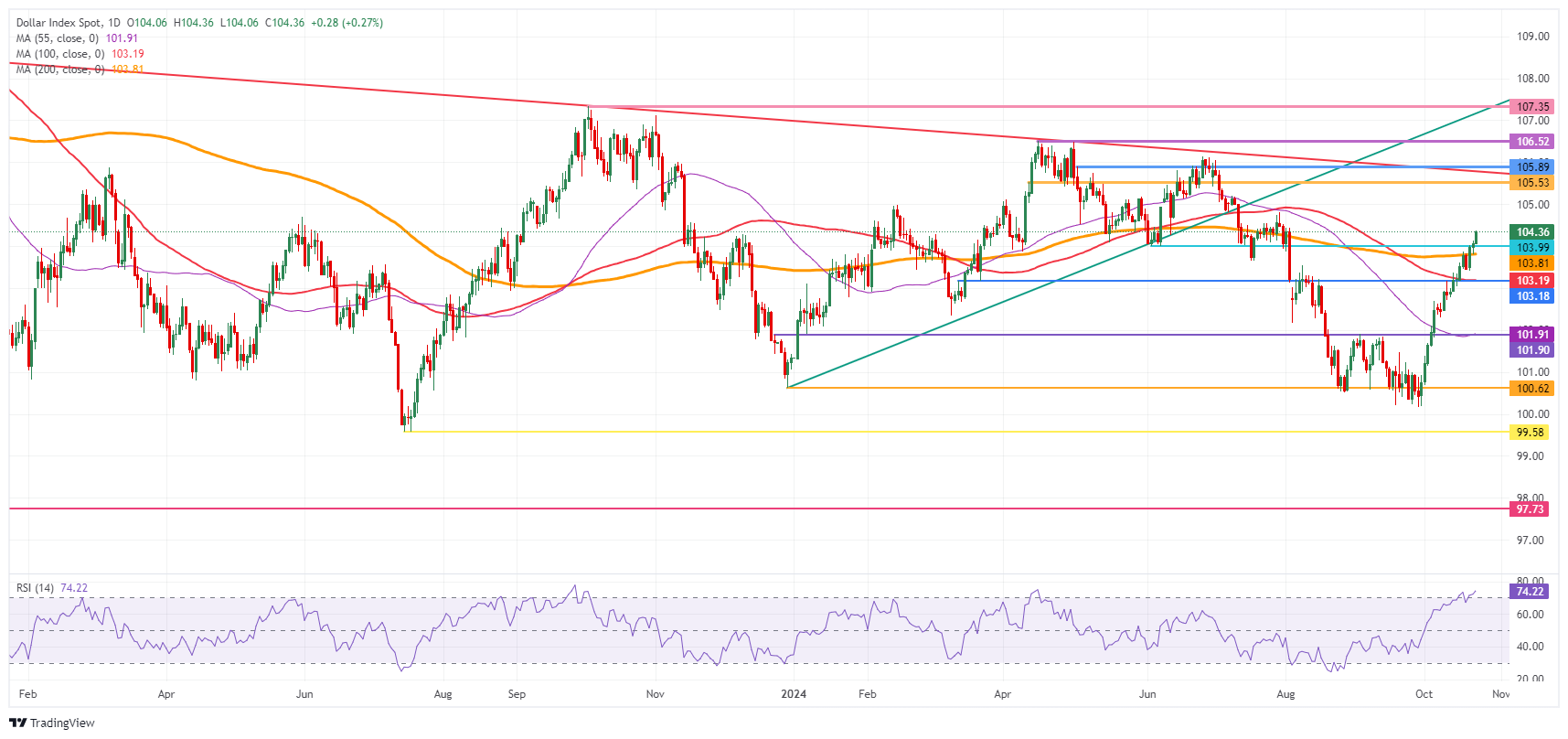
US Dollar Index: Daily Chart
Central banks FAQs
Central Banks have a key mandate which is making sure that there is price stability in a country or region. Economies are constantly facing inflation or deflation when prices for certain goods and services are fluctuating. Constant rising prices for the same goods means inflation, constant lowered prices for the same goods means deflation. It is the task of the central bank to keep the demand in line by tweaking its policy rate. For the biggest central banks like the US Federal Reserve (Fed), the European Central Bank (ECB) or the Bank of England (BoE), the mandate is to keep inflation close to 2%.
A central bank has one important tool at its disposal to get inflation higher or lower, and that is by tweaking its benchmark policy rate, commonly known as interest rate. On pre-communicated moments, the central bank will issue a statement with its policy rate and provide additional reasoning on why it is either remaining or changing (cutting or hiking) it. Local banks will adjust their savings and lending rates accordingly, which in turn will make it either harder or easier for people to earn on their savings or for companies to take out loans and make investments in their businesses. When the central bank hikes interest rates substantially, this is called monetary tightening. When it is cutting its benchmark rate, it is called monetary easing.
A central bank is often politically independent. Members of the central bank policy board are passing through a series of panels and hearings before being appointed to a policy board seat. Each member in that board often has a certain conviction on how the central bank should control inflation and the subsequent monetary policy. Members that want a very loose monetary policy, with low rates and cheap lending, to boost the economy substantially while being content to see inflation slightly above 2%, are called ‘doves’. Members that rather want to see higher rates to reward savings and want to keep a lit on inflation at all time are called ‘hawks’ and will not rest until inflation is at or just below 2%.
Normally, there is a chairman or president who leads each meeting, needs to create a consensus between the hawks or doves and has his or her final say when it would come down to a vote split to avoid a 50-50 tie on whether the current policy should be adjusted. The chairman will deliver speeches which often can be followed live, where the current monetary stance and outlook is being communicated. A central bank will try to push forward its monetary policy without triggering violent swings in rates, equities, or its currency. All members of the central bank will channel their stance toward the markets in advance of a policy meeting event. A few days before a policy meeting takes place until the new policy has been communicated, members are forbidden to talk publicly. This is called the blackout period.
Author

Filip Lagaart
FXStreet
Filip Lagaart is a former sales/trader with over 15 years of financial markets expertise under its belt.

















