US Dollar flat after CPI closes door for potential 50 basis points rate cut next week
- The US Dollar reverses earlier losses and gains on the day.
- US CPI data for August comes in a touch stronger in the Core segment and supports only a 25 basis point rate cut.
- The US Dollar Index rallies and tests 101.90 on the upside.

The US Dollar (USD) falls flat for this Wednesday after the release from the US Consumer Price Index (CPI) release for August. Although the Headline component came in lower, the monthly Core inflation ticked up a bit. This came as a surprise as markets were expecting inflation to further decrease and would open the door for a 50 basis point rate cut from the US Federal Reserve and its Federal Open Market Committee (FOMC) next week.
On the economic data front, all data for this Wednesday is out of the way. Focus will now shift to the other side of the Atlantic with the European Central Bank (ECB) coming up on Thursday. It will be important to see which message the the ECB and its Chairman Christine Lagarde will deliver.
Daily digest market movers: CPI locks in 25 basis point cut
- A CNN poll revealed that 63% of the viewers saw Harris as the winner of the presidential election debate, Bloomberg reported.
- At 11:00 GMT, the Mortgage Bankers Association released its weekly Mortgage Applications number for the week ending September 6. Prior week, there was a rise of 1.6%, with this week coming in at 1.4%.
- At 12:30 GMT, the US Consumer Price Index (CPI) for August will be released:
- Monthly Headline CPI inflation came in unchanged as expected at 0.2%.
- Yearly Headline CPI inflation came in at 2.5%, from 2.9%.
- Monthly Core CPI inflation ticked up to 0.3%, coming from 0.2%.
- Yearly Core CPI inflation remained stable at 3.2%.
- At 17:00 GMT, the US Treasury will allocate 10-year notes.
- US equities are split with the Dow Jones down by 1%, the S&P 500 is down by 0.5% and the Nasdaq tries to turn green for this Wednesday.
- The CME Fedwatch Tool shows a 67.0% chance of a 25 basis points (bps) interest rate cut by the Fed on September 18 against a 33.0% chance for a 50 bps cut. For the meeting on November 7, another 25 bps cut (if September is a 25 bps cut) is expected by 27.2%, while there is a 53.2% chance that rates will be 75 bps (25 bps + 50 bps) and a 19.6% probability of rates being 100 (25 bps + 75 bps) basis points lower.
- The US 10-year benchmark rate trades at 3.64%, and bounces off its fresh 15 month low at levels not seen since mid-June 2023.
US Dollar Index Technical Analysis: Small correction after CPI
The US Dollar Index (DXY) is stuck in a range between 101.90 on the upside to 100.62 on the downside since September began. Markets are still awaiting clarity from US data on whether the Fed’s interest rate cut next week will be a 25 or a 50 basis point. Expect the US CPI release on Wednesday to give some more clarity or even an answer on that question.
The first resistance at 101.90 is getting ready for a second test after its rejection last week. Further up, a steep 1.2% uprising would be needed to get the index to 103.18. The next tranche up is a very misty one, with the 55-day Simple Moving Average (SMA) at 103.40, followed by the 200-day SMA at 103.89, just ahead of the big 104.00 round level.
On the downside, 100.62 (the low from December 28) holds strong and has already made the DXY rebound four times in recent weeks. Should it break, the low from July 14, 2023, at 99.58, will be the ultimate level to look out for. Once that level gives way, early levels from 2023 are coming in near 97.73.
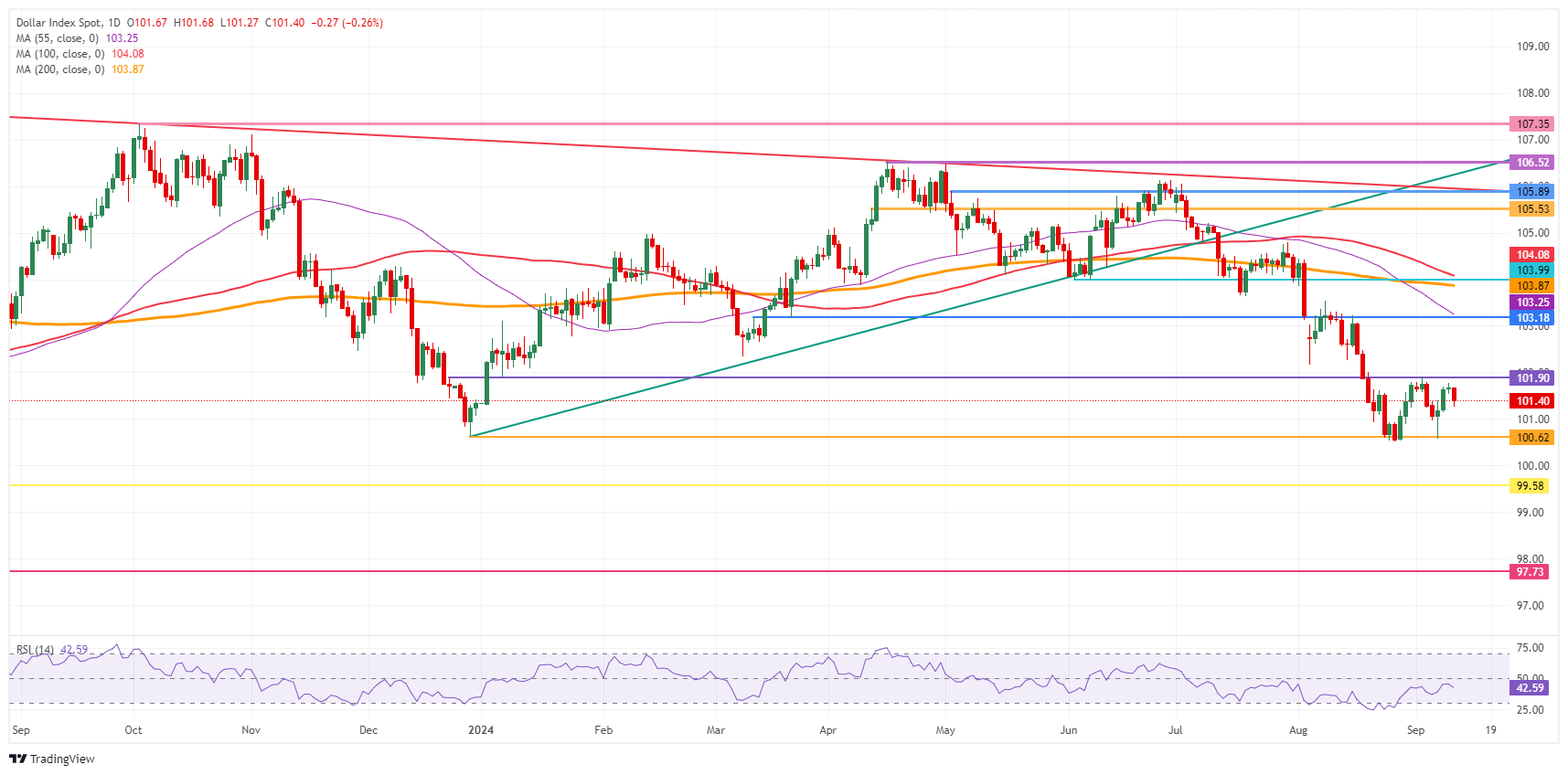
US Dollar Index: Daily Chart
Risk sentiment FAQs
In the world of financial jargon the two widely used terms “risk-on” and “risk off'' refer to the level of risk that investors are willing to stomach during the period referenced. In a “risk-on” market, investors are optimistic about the future and more willing to buy risky assets. In a “risk-off” market investors start to ‘play it safe’ because they are worried about the future, and therefore buy less risky assets that are more certain of bringing a return, even if it is relatively modest.
Typically, during periods of “risk-on”, stock markets will rise, most commodities – except Gold – will also gain in value, since they benefit from a positive growth outlook. The currencies of nations that are heavy commodity exporters strengthen because of increased demand, and Cryptocurrencies rise. In a “risk-off” market, Bonds go up – especially major government Bonds – Gold shines, and safe-haven currencies such as the Japanese Yen, Swiss Franc and US Dollar all benefit.
The Australian Dollar (AUD), the Canadian Dollar (CAD), the New Zealand Dollar (NZD) and minor FX like the Ruble (RUB) and the South African Rand (ZAR), all tend to rise in markets that are “risk-on”. This is because the economies of these currencies are heavily reliant on commodity exports for growth, and commodities tend to rise in price during risk-on periods. This is because investors foresee greater demand for raw materials in the future due to heightened economic activity.
The major currencies that tend to rise during periods of “risk-off” are the US Dollar (USD), the Japanese Yen (JPY) and the Swiss Franc (CHF). The US Dollar, because it is the world’s reserve currency, and because in times of crisis investors buy US government debt, which is seen as safe because the largest economy in the world is unlikely to default. The Yen, from increased demand for Japanese government bonds, because a high proportion are held by domestic investors who are unlikely to dump them – even in a crisis. The Swiss Franc, because strict Swiss banking laws offer investors enhanced capital protection.
Author

Filip Lagaart
FXStreet
Filip Lagaart is a former sales/trader with over 15 years of financial markets expertise under its belt.