US Dollar bears move in as markets turn on a dime during Fed event
- US Dollar is back on its backside following a mixed reaction to the Fed event.
- Two-way price action was the outcome in financial asset classes to the Fed and US Dollar prints fresh bear cycle low.

The US Dollar is tailing off from the highs that were made on the knee-jerk in what was perceived to be a hawkish rate hike of 50 basis points by the United States Federal Reserve. At the time of writing, DXY, an index that measures the US Dollar vs. a basket of currencies, is correcting all of the post-Fed announcement rally from the high of 104.163 to the current level of 103.448.
While the Fed has signalled its plans to keep lifting rates next year to combat high inflationFed's chair Jerome Powell is currently speaking and his comments have given mixed messages to the market. Consequently, we are seeing two-way price action in asset classes, including the US Dollar and bonds. More on Powell below.
US Treasury yields have spun around in the 10-year from a high of 3.5610% to print 3.47% currently, well on course towards the day's low of 3.46%.
Fed key takeaways
- The Federal Reserve hikes 50 basis points, as expected
- Target Range stands At 4.25% - 4.50%.
- The vote was unanimous.
- The guidance in the statement repeats that: "The Committee anticipates that ongoing increases in the target range will be appropriate."
Powell's comments
Opening comments:
We still have "some ways to go".
We expect ongoing hikes are appropriate to get sufficiently restrictive.
US economy slowed ‘significantly from last year.
Without price stability, no sustained strong labour market.
Strongly committed to inflation target.
Yet to feel full effects of tightening, have more work to do.
Not at restrictive policy stance yet.
Recent comments:
Getting close to sufficiently restrictive rates level.
No rate cuts until confident inflation moving toward 2%.
By middle of 2023 should begin to see slower inflation from housing services sector.
Size of february rate hike will depend on incoming data.
DXY technical analysis
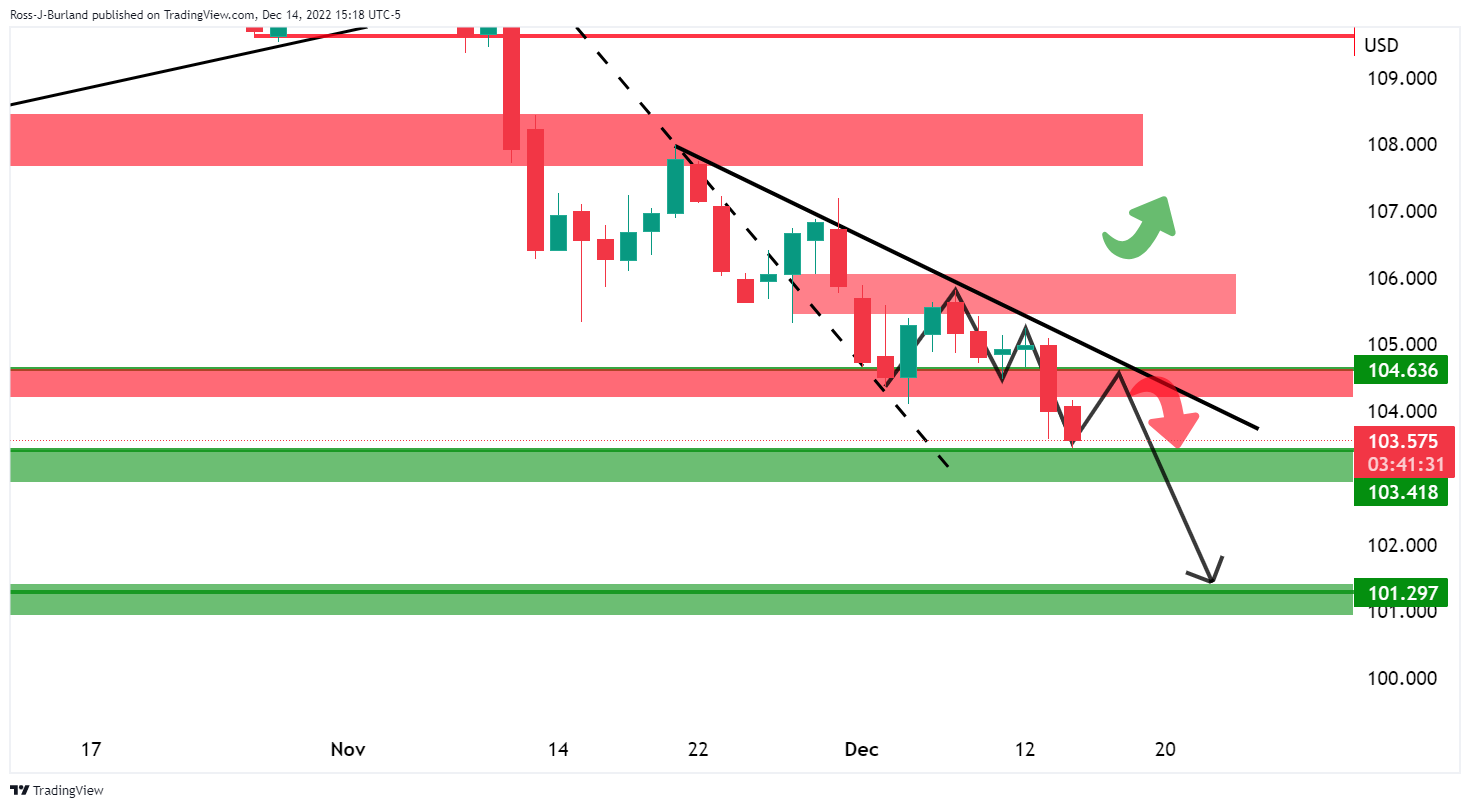
The M-formation is a reversion pattern that has shown up on the daily chart above. While on the front side of the trendline, a move into the neckline could be the next phase of the bearish cycle prior to a downside continuation to test 102.00 and below.
Author

Ross J Burland
FXStreet
Ross J Burland, born in England, UK, is a sportsman at heart. He played Rugby and Judo for his county, Kent and the South East of England Rugby team.