UnitedHealth stock craters as CEO resigns, insurer suspends guidance
- UNH stock plunges 10% to four-year low on suspended 2025 guidance.
- UnitedHealth is experiencing ongoing increases in medical care costs.
- CEO Andrew Witty resigns, Chair Stephen Hemsley takes over.
- US CPI for April came in below consensus forecasts.

UnitedHealth Group (UNH) stock slumped 10.4% in Tuesday's premarket after the United States' largest private health insurer said it would suspend guidance for 2025 due to increasing healthcare costs. The sell-off sent shares down to a more than four-year low near $340.
Additionally, the Minnesota-based company said that CEO Andrew Witty would step down from his position immediately and that Chair Stephen Hemsley would take his place.
“We are grateful for Andrew’s stewardship of UnitedHealth Group, especially during some of the most challenging times any company has ever faced,” Hemsley said in a statement.
The Dow Jones Industrial Average (DJIA) is feeling the impact of the UNH stock sell-off. The index of 30 large stocks is off 0.4% on Tuesday due to UnitedHealth being one of the Dow Jones' largest holdings. Meanwhile, the NASDAQ Composite rises 0.5%. The broader market is optimistic after the US Consumer Price Index (CPI) for April came in before the market open at 2.3% YoY, below the 2.4% annual inflation level that analysts had predicted.
UnitedHealth Group stock news
Hemsley was previously the CEO of the company, which consists of the UnitedHealthcare insurance unit and the pharmacy benefits manager Optum, from 2016 to 2017. Before becoming the chair in 2017, Hemsley became the chief operating officer in 1997 and president in 1999.
UNH stock was already in the doldrums before Tuesday's news. The stock fell more than 22% on April 17 following the company's quarterly earnings release, which saw management trim the 2025 earnings per share guidance (EPS) by close to 12%. The midpoint of $29.75 per share was lowered to a midpoint of $26.25 due to rising healthcare costs, particularly in its Medicare Advantage plans. Due to the higher medical expense ratio, the company said in a statement that it would take until 2026 to return to growth.
Witty's resignation comes after the fallout from the killing of UnitedHealthcare CEO Brian Johnson in December 2024, a major news story that demonstrated some Americans' frustration with the health insurer's high medical claim denial rate.
Additionally, UnitedHealth has seen jostling among executives of late. On May 6, Patrick Conway moved from his position as CEO of Optum Rx to lead the entire Optum unit. He replaced Heather Cianfrocco, who became executive vice-president of governance, compliance and information security at UnitedHealth Group.
In an executive order on Monday, Optum was also in US President Donald Trump's crosshairs as he laid out a position of cutting out "drug middlemen" in the US healthcare system in an attempt to lower prescription drug prices.
UnitedHealth Group stock forecast
The sell-off on Tuesday places UNH stock back to its price level in March 2021 and well off all-time highs from November 2024 above $630. This is a decline of 46% from peak to trough.
The market will view this as unusual for a stock that is normally a major holding of institutions for its above average long-term growth profile. While value investors will be growing interested in UNH stock at this price level, the Fibonacci Extension tells us that the next point of interest is all the way down at $313.19. That's the 161.8% Fibo and lies about 8% below Tuesday's opening price level.
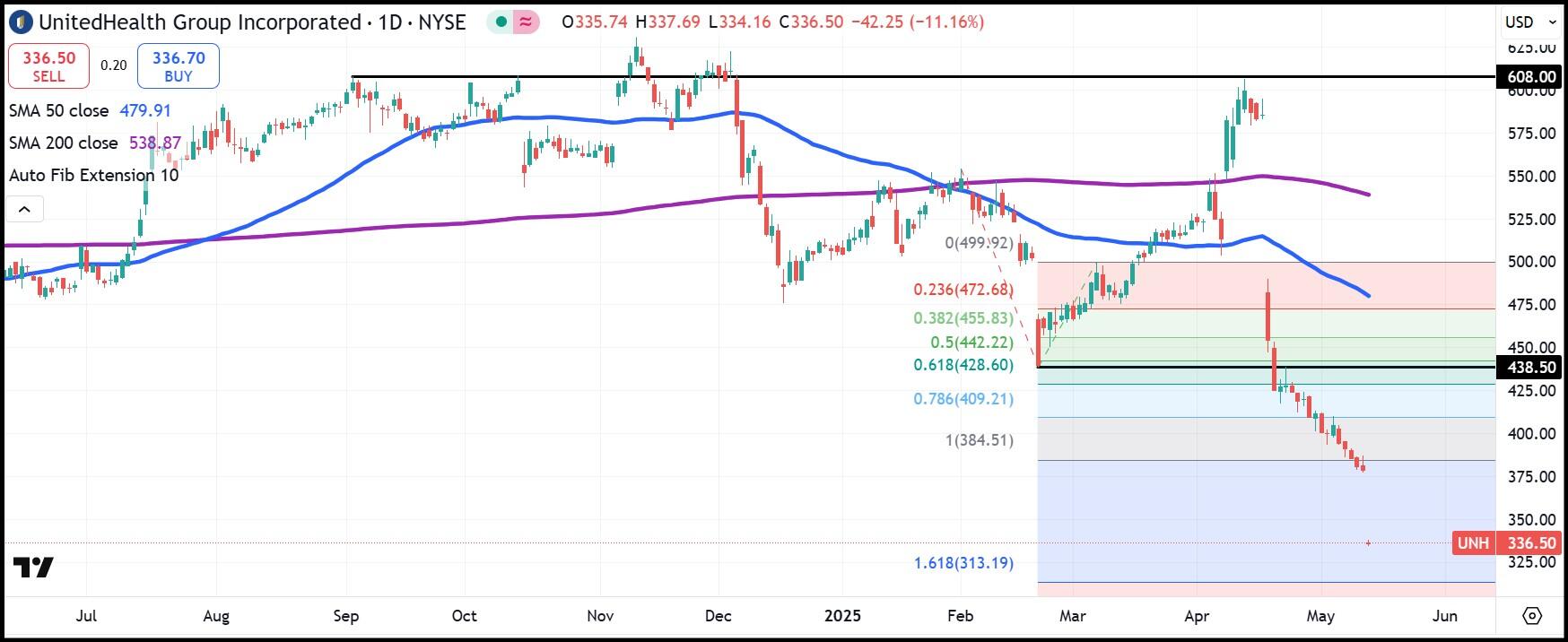
UNH daily stock chart
Author

Clay Webster
FXStreet
Clay Webster grew up in the US outside Buffalo, New York and Lancaster, Pennsylvania. He began investing after college following the 2008 financial crisis.

















