This isn’t a buyable bottom for stocks

The stock market bottomed, but
Equity markets hit a bottom a few weeks ago but we would not call it a buyable bottom. There are numerous risks facing today’s market that have so clouded the outlook that buying “the bottom” now is a pure gamble. Jamie Dimon said it best when he described the outlook as stormy and then corrected himself to say “hurricane”. Between the fallout from Ukraine, supply chain disruption related to China lockdowns, energy prices, inflation, and the FOMC the world is facing an economic shift that will take several quarters if not years to play out. The good news is that long-term secular trends within the economy are still driving the market, the bad news is the S&P 500 (NYSEARCA: SPY) will be in a rolling bear market if not an outright bear market until those trends can catch up with stock valuations.
The S&P 500 confirmed a reversal
The S&P 500 broke through major support the week of May 2nd and has since confirmed a reversal in the market. That reversal was confirmed last week when the market rebounded and halted at the short-term 30-day moving average. This level is coincident with the 4,130 level and the bottom of a consolidation range that has been in place since the middle of 2020. Now, with the reversal confirmed, the consolidation smacks of a Head & Shoulders pattern that could lead the market much lower. The risk for the bears, however, is that institutional and big-money participants “sold in May and went away” which means downward pressure on the market has abated. In this light, the market is more likely to have reversed into a sideways pattern that will linger into the fall trading season or until the next major catalyst arises.
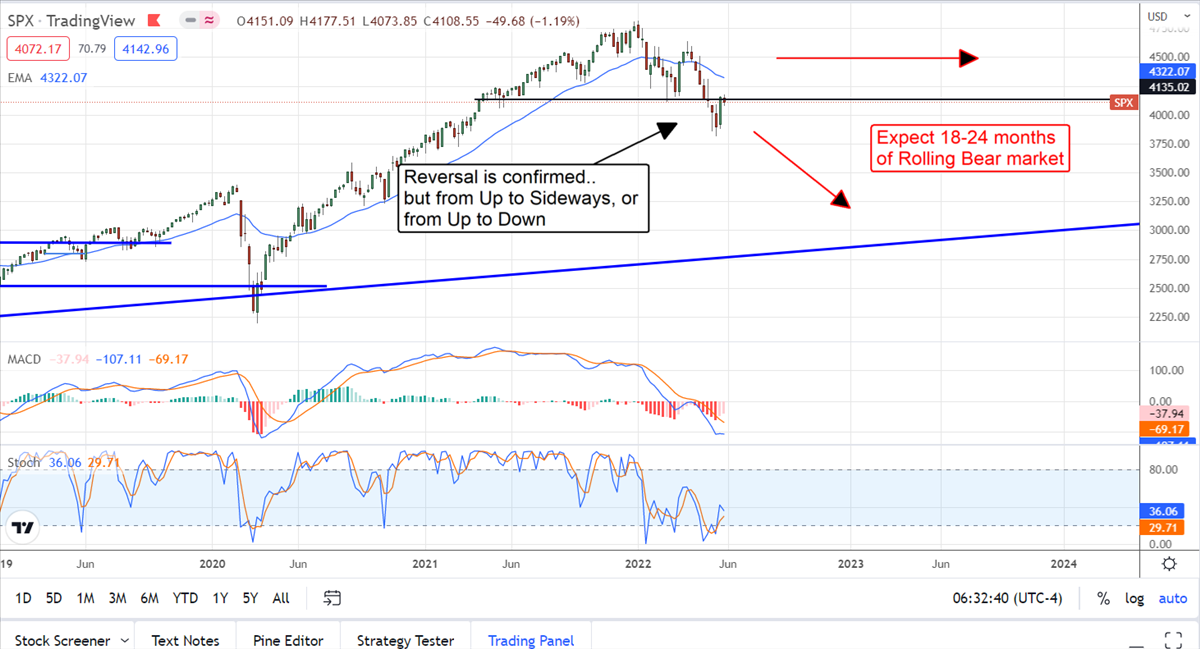
The next most likely catalyst is the inflation data and the FOMC. The PCE price index is due out at the end of the week and it should be another hot one. The economists are expecting to see headline and core inflation accelerate on a month-to-month basis and they could come in above consensus. Not only are energy prices tickling a 14-year high but CEOs across the S&P 500 are still working to offset the impacts of higher inflation. The takeaway is that inflation may moderate now but it is not expected to go away and there are plenty of reasons to think it will reaccelerate later in the year. As for the FOMC, they continue to increase in hawkishness.
Beware of the outlook for earnings
The biggest risk to the market, the factor that will bring the S&P 500 to its knees, is the outlook for earnings. Looking at the market from the perspective valuation is based on the expectation for future earnings a downshift in consensus will bring the market down. And the outlook is in decline. While the consensus estimate for Q3 has not budged over the past few weeks the consensus estimate for Q2, Q4 and now FY 2023 are moving lower. The consensus estimate for Q2 has been flat at 4.1% for the last three weeks but that is down almost 300 basis points from the peak and we expect it to move lower as the reporting cycle gets closer. And for Q4 and next year? The consensus for Q4 fell 210 basis points over the last week while the outlook for next year fell by 230 bps. No reason to be bullish on stocks, at all.
Author

Jacob Wolinsky
ValueWalk
Jacob Wolinsky is the founder of ValueWalk, a popular investment site. Prior to founding ValueWalk, Jacob worked as an equity analyst for value research firm and as a freelance writer. He lives in Passaic New Jersey with his wife and four children.