USD/JPY sinks back below 153.00 as undaunted Yen continues to climb
- USD/JPY lost ground for a fourth straight trading session on Thursday, driven by continuing geopolitical factors.
- BoJ officials continue to verbally intervene on Yen markets to keep the ball rolling.

The Japanese Yen strengthened past 153 per US Dollar on Thursday, rising for the fourth straight session after Prime Minister Sanae Takaichi's decisive general election victory on February 8 gave her a clear mandate to pursue expansionary fiscal policy. Markets are betting that her agenda of increased government spending, tax cuts, and a two-year suspension of the 8% food sales tax will strengthen economic growth and provide the Bank of Japan (BoJ) with greater scope to normalize monetary policy through additional rate hikes. Verbal intervention from Japanese officials reinforced the Yen bid, with top currency diplomat Atsushi Mimura warning that the government remains on high alert over foreign exchange movements, while Finance Minister Satsuki Katayama reaffirmed Tokyo's commitment to act on currency moves consistent with the US-Japan joint statement.
On the US side, January Non-Farm Payrolls (NFP) surprised higher at 130K with unemployment falling to 4.3%, which initially supported the US Dollar but was quickly overshadowed by the Yen rally. The Federal Reserve (Fed) held rates at 3.50% to 3.75% at its January meeting and confirmed the end of quantitative tightening. Looking to Friday, the delayed US Consumer Price Index (CPI) release for January is the focal point, with consensus forecasting headline CPI at 0.29% month-on-month and core CPI at 0.39% month-on-month. A softer print would reinforce expectations for Fed rate cuts later in 2026 and could accelerate Yen gains.
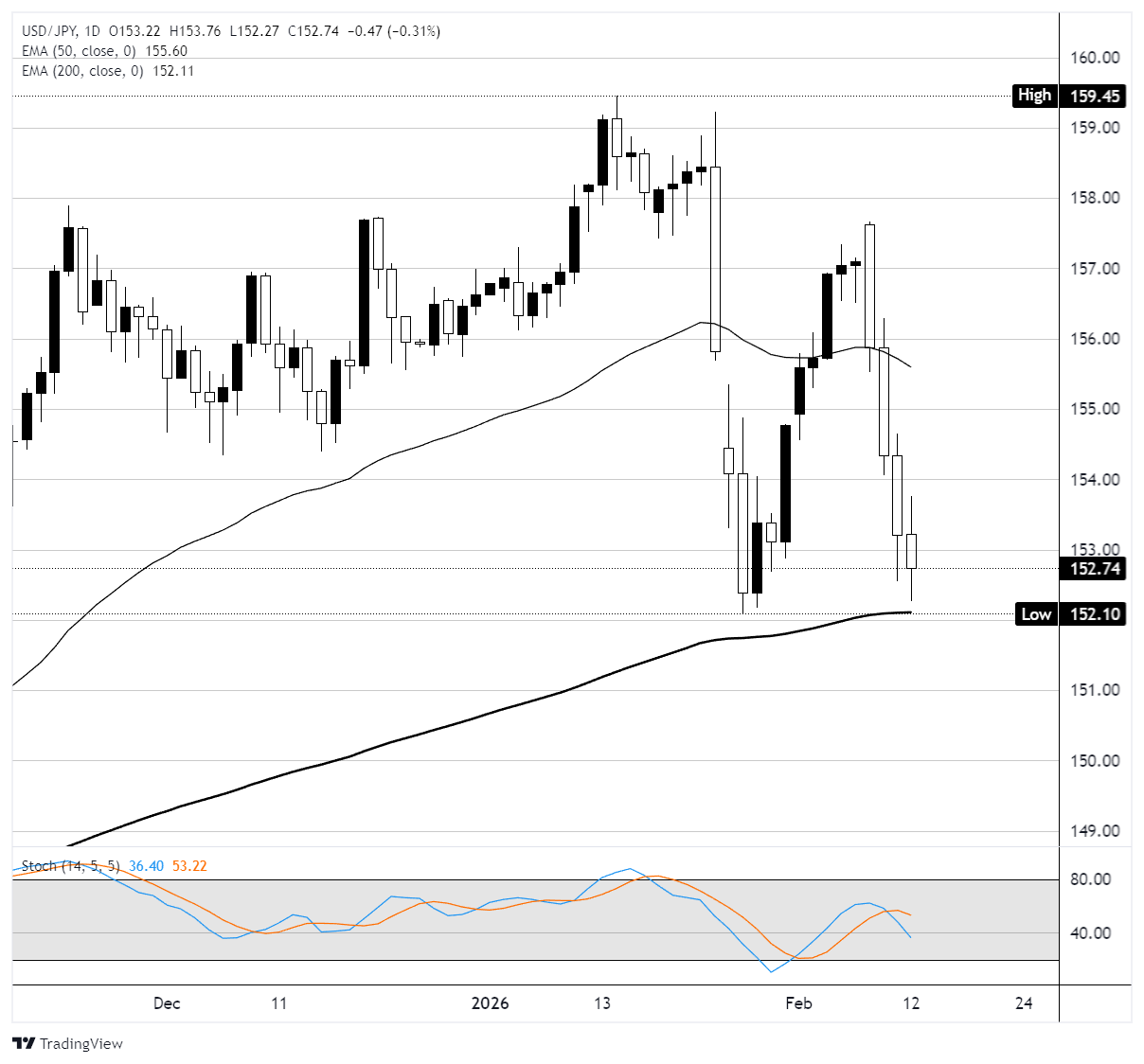
On the daily chart, USD/JPY has fallen sharply from its February 7 high near 157.70 to test the 152.50 area, its lowest level since early January. Price action shows a steep bearish impulse driven by the post-election Yen surge, with the pair now trading below the 50-day Exponential Moving Average (EMA), confirming a bearish shift in the short-term trend. The 200-day EMA sits higher near 155.00, a level the pair broke below decisively this week, reinforcing the bearish bias. The Relative Strength Index (RSI) on the daily chart has dropped toward 35, approaching oversold territory but not yet signaling exhaustion.
On the 4H timeframe, the sell-off has been relentless since the February 8 election result, with price carving out a series of lower highs and lower lows. Immediate support stands at the 152.50 area, where the pair found a session low, followed by the 2026 low near 152.00 and the psychological 150.00 handle. A break below 152.00 would open the door toward the 38.2% Fibonacci retracement of the 139.87 to 159.44 range near 151.70. To the upside, resistance is now layered at 153.50 (broken support turned resistance), 155.00 (the 200-day EMA confluence), and the 156.00 to 157.00 zone. The Moving Average Convergence-Divergence (MACD) histogram on the 4H chart is showing expanding bearish momentum, suggesting further downside pressure ahead of Friday's CPI data.
USD/JPY daily chart
Japanese Yen FAQs
The Japanese Yen (JPY) is one of the world’s most traded currencies. Its value is broadly determined by the performance of the Japanese economy, but more specifically by the Bank of Japan’s policy, the differential between Japanese and US bond yields, or risk sentiment among traders, among other factors.
One of the Bank of Japan’s mandates is currency control, so its moves are key for the Yen. The BoJ has directly intervened in currency markets sometimes, generally to lower the value of the Yen, although it refrains from doing it often due to political concerns of its main trading partners. The BoJ ultra-loose monetary policy between 2013 and 2024 caused the Yen to depreciate against its main currency peers due to an increasing policy divergence between the Bank of Japan and other main central banks. More recently, the gradually unwinding of this ultra-loose policy has given some support to the Yen.
Over the last decade, the BoJ’s stance of sticking to ultra-loose monetary policy has led to a widening policy divergence with other central banks, particularly with the US Federal Reserve. This supported a widening of the differential between the 10-year US and Japanese bonds, which favored the US Dollar against the Japanese Yen. The BoJ decision in 2024 to gradually abandon the ultra-loose policy, coupled with interest-rate cuts in other major central banks, is narrowing this differential.
The Japanese Yen is often seen as a safe-haven investment. This means that in times of market stress, investors are more likely to put their money in the Japanese currency due to its supposed reliability and stability. Turbulent times are likely to strengthen the Yen’s value against other currencies seen as more risky to invest in.
Author

Joshua Gibson
FXStreet
Joshua joins the FXStreet team as an Economics and Finance double major from Vancouver Island University with twelve years' experience as an independent trader focusing on technical analysis.

















