GBP/USD inching closer to 1.36
- GBP/USD is trading within familiar territory, easing back into 1.3600.
- US CPI inflation looms ahead on Friday.

The Pound Sterling edged higher to 1.3640 on Thursday, recovering from an earlier pullback after stronger-than-expected US jobs data initially weighed on the pair. The Bank of England (BoE) held rates at 3.75% at its February 4 meeting in a narrow 5-4 vote split, with four members preferring a 25 basis point cut to 3.50%. Governor Andrew Bailey voted with the majority to hold but said he sees "scope for some further easing" and expects "a sharp drop in inflation over coming months," with the BoE projecting CPI to fall back to the 2% target by April. UK Q4 2025 Gross Domestic Product (GDP) data released on February 12 showed growth of just 0.1%, with monthly GDP for December also rising 0.1%, confirming the sluggish pace of the UK economy. Sterling found some support from easing domestic political uncertainty after Prime Minister Keir Starmer secured backing from senior cabinet members following the resignation of his chief of staff Morgan McSweeney amid the Lord Peter Mandelson scandal.
On the US side, January Non-Farm Payrolls (NFP) came in at 130K with unemployment at 4.3%, pushing the expected timing of the next Federal Reserve (Fed) rate cut from June to July. Friday's delayed US Consumer Price Index (CPI) release for January is the week's most important event, with consensus expecting headline CPI at 0.29% month-on-month and core CPI at 0.39% month-on-month. A softer reading would weaken the US Dollar and likely push Cable back toward its late-January high.
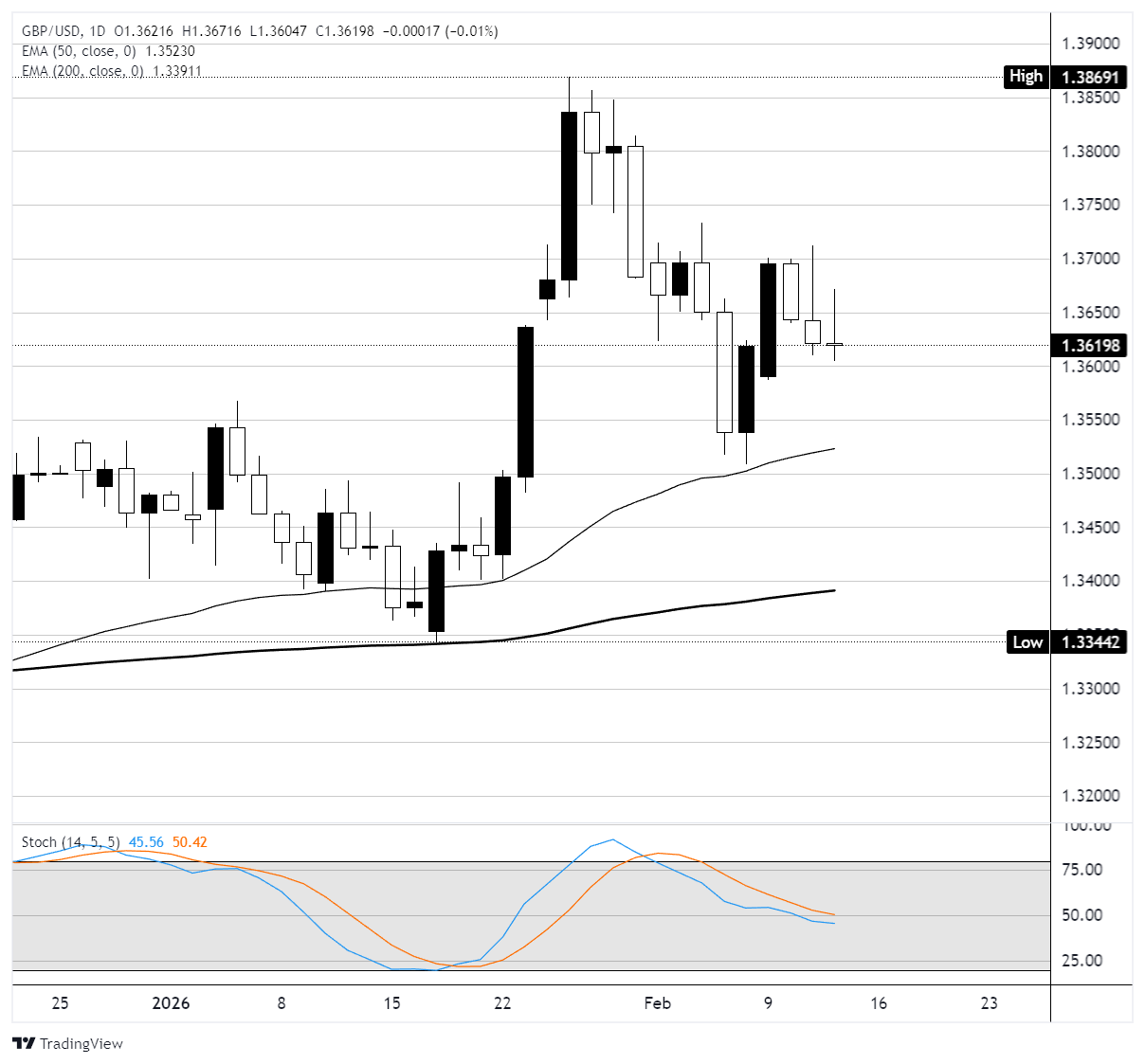
On the daily chart, GBP/USD is trading at 1.3640, consolidating below the late-January high of 1.3870, which marked its strongest level in over four years. The pair has pulled back from that peak but is holding above the 50-day Exponential Moving Average (EMA), suggesting the broader uptrend still holds. This week's range has been contained between 1.3520 and 1.3710, with price forming a higher-low structure off the February 6 dip to 1.3520. The Relative Strength Index (RSI) on the daily chart reads near 55, pointing to neutral momentum with room to move in either direction.
On the 4H timeframe, resistance stands at 1.3710 (this week's high), followed by the 1.3820 to 1.3870 zone, where the pair stalled in late January. A break above 1.3870 would mark a fresh multi-year high and target the 1.3900 to 1.3950 area. Support on the downside sits at 1.3550 (the 50-day EMA area), followed by 1.3520 (last week's low) and the psychological 1.3500 level. The Moving Average Convergence-Divergence (MACD) on the daily chart shows a bearish crossover forming below the signal line, suggesting short-term momentum is fading, though the broader trend structure remains constructive as long as 1.3500 holds. A decisive move from Friday's CPI data is likely to determine whether Cable resumes its advance toward 1.3870 or extends the corrective pullback toward the 1.3400 to 1.3500 demand zone.
GBP/USD daily chart
Pound Sterling FAQs
The Pound Sterling (GBP) is the oldest currency in the world (886 AD) and the official currency of the United Kingdom. It is the fourth most traded unit for foreign exchange (FX) in the world, accounting for 12% of all transactions, averaging $630 billion a day, according to 2022 data. Its key trading pairs are GBP/USD, also known as ‘Cable’, which accounts for 11% of FX, GBP/JPY, or the ‘Dragon’ as it is known by traders (3%), and EUR/GBP (2%). The Pound Sterling is issued by the Bank of England (BoE).
The single most important factor influencing the value of the Pound Sterling is monetary policy decided by the Bank of England. The BoE bases its decisions on whether it has achieved its primary goal of “price stability” – a steady inflation rate of around 2%. Its primary tool for achieving this is the adjustment of interest rates. When inflation is too high, the BoE will try to rein it in by raising interest rates, making it more expensive for people and businesses to access credit. This is generally positive for GBP, as higher interest rates make the UK a more attractive place for global investors to park their money. When inflation falls too low it is a sign economic growth is slowing. In this scenario, the BoE will consider lowering interest rates to cheapen credit so businesses will borrow more to invest in growth-generating projects.
Data releases gauge the health of the economy and can impact the value of the Pound Sterling. Indicators such as GDP, Manufacturing and Services PMIs, and employment can all influence the direction of the GBP. A strong economy is good for Sterling. Not only does it attract more foreign investment but it may encourage the BoE to put up interest rates, which will directly strengthen GBP. Otherwise, if economic data is weak, the Pound Sterling is likely to fall.
Another significant data release for the Pound Sterling is the Trade Balance. This indicator measures the difference between what a country earns from its exports and what it spends on imports over a given period. If a country produces highly sought-after exports, its currency will benefit purely from the extra demand created from foreign buyers seeking to purchase these goods. Therefore, a positive net Trade Balance strengthens a currency and vice versa for a negative balance.
Author

Joshua Gibson
FXStreet
Joshua joins the FXStreet team as an Economics and Finance double major from Vancouver Island University with twelve years' experience as an independent trader focusing on technical analysis.














