|

The head and shoulders pattern forming on Tesla

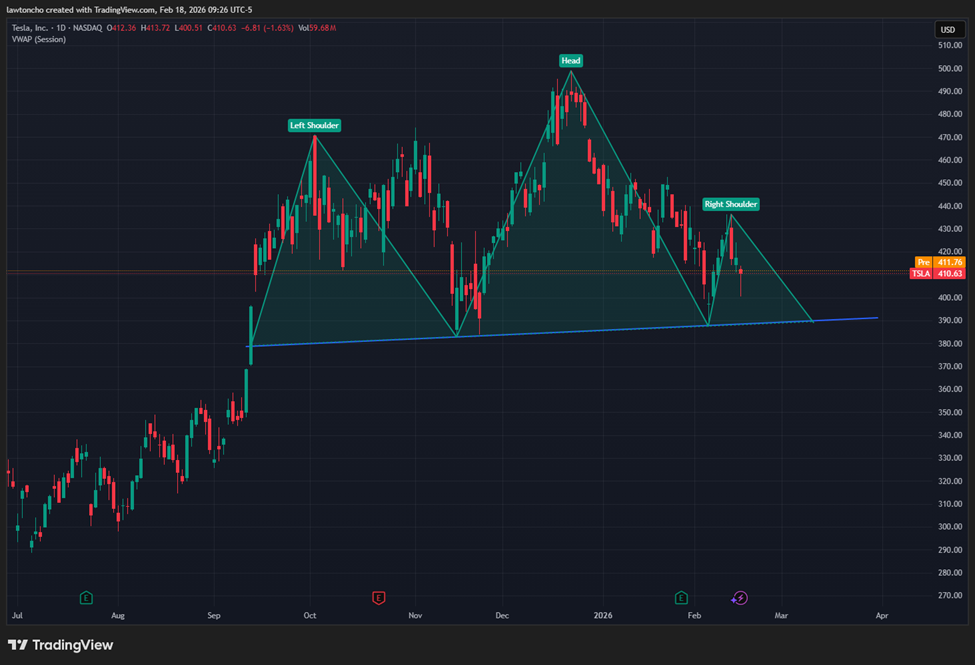
Tesla (TSLA) has seen sharp and emotional price action since reporting earnings at the end of last month. Following the earnings release, the stock sold off aggressively, falling more than 11.5%, before staging a strong rebound of over 12.7%. This type of two-sided volatility is something I pay close attention to, because it often sets the stage for meaningful technical developments on the chart.

When I step back and look at the daily timeframe, the technicals are beginning to take shape in a way that deserves respect. The structure that is forming resembles a classic head and shoulders pattern. This is a well-known technical formation that reflects shifting momentum and changing market behavior, particularly after periods of heightened volatility like the one Tesla has just experienced.

If this head and shoulders pattern confirms and breaks to the downside, the measured move projects a potential decline toward the $276 level. That target is derived directly from the structure of the pattern itself, and it serves as a reference point rather than a prediction. I never treat any single technical pattern as a guarantee, but I do believe it’s important to acknowledge what the chart is suggesting and prepare accordingly.

From a broader perspective, Tesla’s recent price action provides important context for this setup. The stock has been actively repricing since earnings, with both sharp downside pressure and equally aggressive upside responses. That push and pull is visible in the chart and is ultimately what gives rise to recognizable technical patterns like the one currently forming. Understanding this backdrop helps frame why the current technicals matter.

As always, my focus remains on discipline and risk management. Regardless of how clean or compelling a setup appears, protecting capital comes first. Technical patterns are tools, not promises, and they work best when paired with proper position sizing and clearly defined risk. Tesla’s chart is offering information right now, and my job is simply to read it objectively and trade responsibly.
Author

Lawton Ho

Lawton Ho

Verified Investing

A marketing expert sharing his journey to mastering the charts.

More from Lawton Ho
Share:

Editor's Picks

GBP/USD bounces off lows, back above 1.3200

After bottoming out near 1.3160, GBP/USD manages to regain a bit of shine and reclaim the 1.3200 mark and beyond at the end of the week. Stronger-than-expected UK Retail Sales data seem to be helping the British Pound limit its losses, while the chaotic UK political environment keeps the bulls at bay for now.

EUR/USD looks consolidative around 1.1460

EUR/USD stages a modest rebound after slipping to a three-month low below 1.1420 at the end of the week. That said, the pair now looks to consolidate humble gains just above 1.1460 despite growing uncertainty surrounding the next round of US-Iran negotiations, which keeps the US Dollar’s downside contained.

Gold slips back to six-day lows, targets $4,100

Gold retreats for the third consecutive day on Friday, eroding gains seen in the first half of the week and approaching the key $4,100 mark per troy ounce. Indeed, the precious metal continues to face headwinds from the Fed's hawkish stance and renewed uncertainty surrounding the next round of US-Iran negotiations.

Solana extends correction despite ETF inflows, RWA adoption

Solana (SOL) price edges below $70 extending its losses for the fourth straight day this week. The institutional demand for Solana is building, with steady inflows so far this week and Morgan Stanley’s amended S-1 filing for a Solana-focused Exchange-Traded Fund.

The Iran war didn't break the US economy, but what happens next?

Nearly four months after the start of the Iran war, the US economy remains remarkably resilient. While the conflict initially triggered a severe disruption to global energy markets and a sharp rise in Oil prices, recent diplomatic progress between Washington and Tehran has eased concerns about a prolonged supply shock.

Regime change: Inside Kevin Warsh's first move to make the Fed unreadable on purpose

The rate did not move. That was the least interesting thing about Kevin Warsh's first meeting in charge of the Fed. The FOMC held its benchmark at 3.50%-3.75% for the fourth straight meeting, exactly as priced, and then the new chair used his first press conference to dismantle the machinery the market has leaned on for a decade.

The head and shoulders pattern forming on Tesla