|

Tesla Stock Price and Forecast: Should I buy TSLA, RIVN or LCID?

  • TSLA drops nearly 5% on Friday as macro factors in charge.
  • All EV stocks LCID, Chinese names suffer the same fate.
  • Tesla once again is targetting its 200-day moving average.

Tesla (TSLA) followed many EV names (all, if we are correct) lower on Friday as macro factors took charge over equity markets. The dominant theme so far in 2022 has been one of rising rates and inflationary pressures. This has led to high growth and tech names underperforming, while energy and financial stocks have been the place to be. That is likely to remain the theme for at least the next quarter if not also Q2.

Russia and Ukraine tensions have pushed the oil price above $90, and financial stocks benefit from higher interest rates. Growth stocks, however, do not benefit from higher interest rates as investors look for businesses with cash. With higher interest rates, future cash flows become less valuable. So of the three names mentioned, Tesla, Rivian (RIVN) or Lucid (LCID), we would not want to currently be long any of them. We expect TSLA to perform best of the three due to its market-leading position and revenue, but this sector is out of favour and likely to remain so. 

Tesla Stock News

The latest data from the China Passenger Car Association (CPCA) confirms what we saw from Chinese EV companies earlier. Deliveries for January were down versus December. This is due to the lunar new year in China. Tesla sold 59,845 vehicles in January, down from 70,847 China-made vehicles in December. The Chinese electric vehicle market remains the largest EV market in the world, helped by government incentives and population demand. 

Tesla Stock Forecast

Tesla remains in the strong downtrend identified earlier this year. $945 was tested multiple times as resistance and failed. This has resulted in the recent pullback. Now $824 remains as the 200-day moving average. Below we have trendline support at $752. The 200-day is the key level. Tesla has not closed below its 200-day moving average since June 2021. It has broken the 200-day on an intraday basis several times since but always failed to close below. Notice how volume has steadily been declining in Tesla this month, despite some hugely volatile days. This is indicative of a lack of conviction in the stock. 
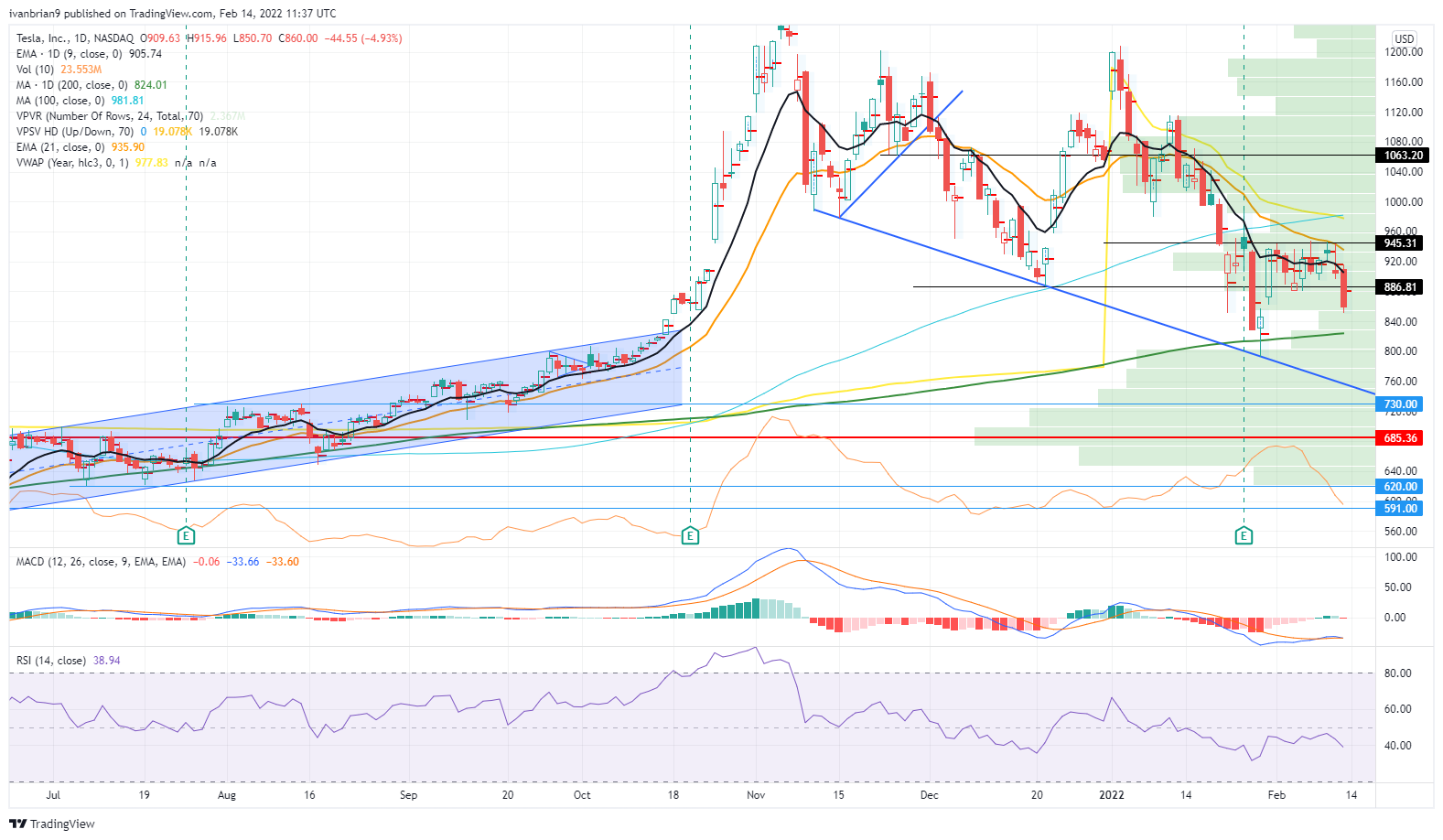
Tesla (TSLA) chart, daily


Like this article? Help us with some feedback by answering this survey:

Author

Ivan Brian

Ivan Brian

FXStreet

Ivan Brian started his career with AIB Bank in corporate finance and then worked for seven years at Baxter. He started as a macro analyst before becoming Head of Research and then CFO.


More from Ivan Brian
Share:

Editor's Picks

AUD/USD eyes 0.7000 as USD remains on the back foot amid softer bond yields

AUD/USD fills a modest bearish gap on Monday, approaching 0.7000 during the Asian session amid holiday-thinned liquidity. The US Dollar remains on the back foot as US bond yields pull back from multi-year highs, supporting the pair. However, the Fed's hawkish outlook and the US-Iran standoff should limit USD losses. Moreover, diminishing odds of another RBA rate hike in November might cap the Aussie.

USD/JPY remains confined in a familiar range around 158.00

USD/JPY extends its range-bound price action at the start of a new week, trading around 158.00 as bulls remain on high alert amid speculation that authorities would step in to prop up the Japanese Yen. Furthermore, softer US bond yields keep US Dollar bulls on the back foot and cap the currency pair. However, geopolitical uncertainties could limit losses for the safe-haven buck amid thin liquidity due to a holiday in Japan and the US.

Gold advances to over one-week top, above $4,200 on softer bond yields/USD

Gold moves above $4,200 on Monday, hitting an over one-week high during the Asian session as softer US bond yields keep US Dollar bulls on the defensive. However, the US-Iran standoff over the Strait of Hormuz, along with a hawkish Fed, could limit USD losses. This could cap non-yielding bullion as traders look to US inflation figures and Fed Chair Kevin Warsh's speech for a fresh impetus during the latter part of this week.

Week ahead: US CPI, France’s budget crisis and Q3 earnings to set the market tone
The US dollar held relatively strong this week, despite the disappointing US jobs report on October 2, which further decreased the probability of a back-to-back rate hike by the Fed at the upcoming gathering on October 28.
Middle East War updates: New attack launched on Saudi airport
Here’s a brief recap of the key developments in the Middle East war that occurred over the weekend, which are expected to have a significant impact on markets in the upcoming week. In the world of financial jargon the two widely used terms “risk-on” and “risk off'' refer to the level of risk that investors are willing to stomach during the period referenced.
Has Bitcoin really escaped the macro forces it was built to fight?
Over 17 years ago, Satoshi Nakamoto designed Bitcoin (BTC) on the back of a global financial crisis as an alternative to the global monetary system outside the control of central banks, governments and traditional intermediaries. This raises a key question: has Bitcoin really become independent of the macroeconomic forces it was built to challenge?















