Tesla Stock Forecast: TSLA has best week since January following delivery dump
- Tesla's 444K deliveries bested the 439K consensus for Q2.
- TSLA stock performance (+16.9%) is best week since mid-January.
- RoboTaxi unveiling on August 8 remains the focus for traders.
- Tesla stock has risen above the 200-week SMA.
So far, this has been the best week for Tesla (TSLA) shareholders since the third week of January, and it’s only Tuesday. Tesla stock has gained 16.9% so far this week, rising more than 10% on Tuesday alone.
The cause of the rally was Tesla’s second-quarter delivery numbers arriving on Tuesday ahead of expectations.
Tesla stock news: Q2 surprises to upside
Tesla reported nearly 444K in second-quarter deliveries globally on Tuesday. Analysts had expected 439,300. Additionally, 410,831 vehicles were produced during the quarter.
The mainstream Model 3 and Model Y accounted for 422,405 of the total deliveries in the quarter, while its luxury models sold more than 21,500 units.
While the figures continue to show that demand for Teslas has flattened over the past 18 months, the data was much better than the vibe heading into its release. Barclays had cited registration data on Monday to lower its delivery forecast to 415K. So when the announcement came ahead of expectations, a burst of pent-up optimism was unleashed in the market.
The figure was still beneath year ago deliveries of 466K. Tesla's best quarter in its history was Q4 2023 when it deliveried more than 484K.
The stock dynamics were aided by a general swell leading up to the August 8 announcement of Tesla’s RoboTaxi efforts. Elon Musk and company have pegged their hopes on branching away from the primary auto business into an autonomous competitor to UBER and Cruise.
EV stocks FAQs
Electric vehicles or EVs are automobiles that use rechargable batteries and electric motors to accelerate rather than internal combustion engines (ICEs). They have been around for more that 100 years, but battery technology research & development was meager for much of the 20th century. Lithium-ion battery technology became advanced enough to produce EVs at scale in the late 1990s and 2000s, and sales have been steadily increasing since then Tesla’s Roadster was unveiled in 2008. EVs are viewed as a means of reducing carbon emissions since battery electric vehicles (BEVs) themselves produce zero emissions. Other vehicles called plug-in hybrid electric vehicles (PHEVs) utilize both battery electric power and ICEs as a backup.
EVs are growing from a small base, but they rose from 9% of global new auto sales in 2021 to 14% of the total in 2022. This was a 65% YoY growth rate, and the industry delivered 10.2 million EVs worldwide in 2022. Projections show this number climbing above 16 million in 2023. Across the world, market shares differ greatly among nations. Nearly 88% of Norwegian new car sales in 2022 were EVs. On the other hand, the United States, where much of the modern innovation in EVs was forged, had less than 8% of new vehicle sales go to EVs in 2022. The largest EV market in the world, China, saw 30% of the market go to EVs that year.
We know you’re thinking Elon Musk, but he’s probably more like the father of the mass-market, contemporary EV. All the way back in 1827, a Hungarian priest named Anyos Jedlik invented the electric motor and used it the following year to power a vehicle of sorts. French scientist Gaston Planté invented the lead-acid battery in 1859, and German engineer Andreas Flocken built the first true electric car for the public in 1888. EVs made up about 38% of all vehicles sold in the US around 1900. They began losing market share rapidly after 1910 when gasoline-powered vehicles grew much more affordable. They largely died off until new research programs in the 1990s led to gradual private sector investment in the 2000s.
China’s BYD is by far the largest manufacturer of EVs in the world. In 2022 it sold 1.8 million EVs and in the second half of the year made up 20% of the global market. The asterisk given to BYD is that the vast majority of these vehicles are hybrids. Tesla’s 12% market share is often treated as more significant than BYD, because it only sells BEVs and is the most famous EV brand in the world. Volkswagen, BMW and Wuling then round out the top five. As a new sector with heavy investment though, many startups have flooded the market. These include China’s Nio, Li Auto and Xpeng; a Swedish-Chinese manufacturer called Polestar; and Lucid and Rivian from the US.
Tesla stock forecast
Tesla stock has broken above the descending top trendline on the weekly chart. This pattern had its start in the Summer of 2023, so this is rather significant. Obviously, this leads us to believe that the rally will continue.
TSLA stock is trading above its 200-week Simple Moving Average (SMA) for the first time since January as well. From here, the projected price target of the Inverse Head-and-Shoulders pattern (seen in pink) is $246.20. Above there lies historical resistance near $265. Happy trading.
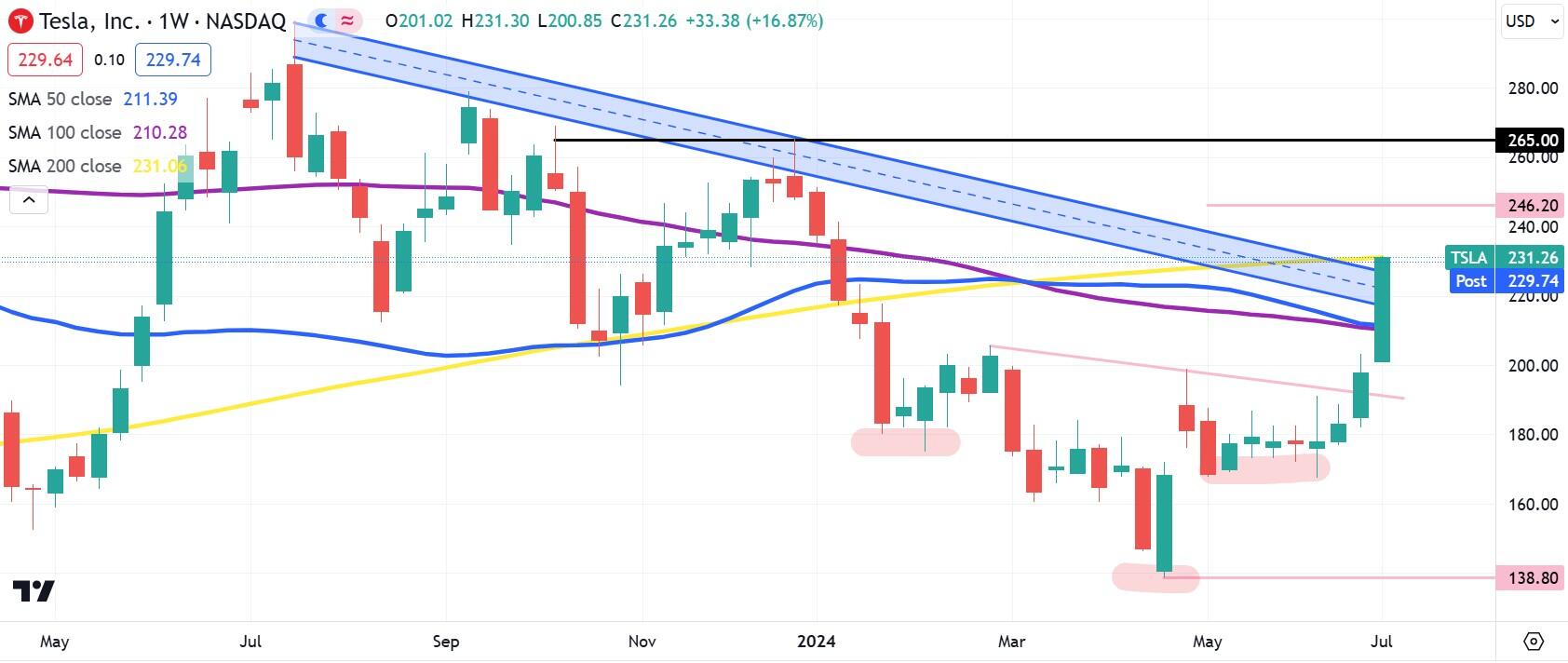
TSLA weekly stock chart
Author

Clay Webster
FXStreet
Clay Webster grew up in the US outside Buffalo, New York and Lancaster, Pennsylvania. He began investing after college following the 2008 financial crisis.