Stocks face a mountain to climb in Q4

Financial markets are mostly in a risk off mood on Tuesday, as China has stopped its drip feed of stimulus, commodity prices fall, Middle East tensions continue to rage and the surge in US Treasury yields starts to worry investors. World bond markets are mostly stable on Tuesday. US Treasury yields have retreated slightly after the surge in yields in the previous two sessions, however, the 10-year yield is still above 4%, which is a psychologically significant number.
The FTSE 100 underperforms
Stock markets are lower across Europe and the FTSE 100 is the weakest performer in Europe on Tuesday. The FTSE 100 reflects the issues facing financial markets right now. The weakest performers include miners Rio Tinto, Glencore and Anglo American. Rio Tinto is leading the index lower, and its share price has had its biggest daily decline in 17 months.
The UK miners have been hit by weaker commodity prices on Tuesday, after China’s National Development and Reform Commission failed to deliver more stimulus at their conference. HSBC is also lower, as stocks with links to China take a hit. HSBC has given back more than 60% of its gains since September, when the Chinese government announced its recent stimulus measures. This could be a warning sign that the boost global equities received from the China stimulus measures may not persist.
UK asset prices may also remain under pressure in the lead up to the UK budget later this month. Although sterling has managed to regain some of its recent losses, it is still below $1.31 vs. the USD. Rising yields, a stronger dollar and a sell off in stocks is not helping the pound to recover in a meaningful way. The question for investors is whether this will set the tone for the rest of Q4.
Rising speculation the US may not cut rates next month
It's been a tough start to the fourth quarter, and the fallout from the monster US payrolls report is still being felt in the market. The Fed Fund Futures market has priced out potential cuts to interest rates in the next few months. There is now only 23bps of cuts priced in for the November meeting, which is less than one full cut. There is also a growing chance of no rate cut at the Fed’s November meeting. According to the CME’s Fedwatch tool there is now an 11.3% chance that the Fed will not cut rates in November.
We expect a lot of volatility in interest rate futures markets in the coming weeks. There is another payrolls report and a US Presidential election before the next FOMC meeting on 7th November. Thus, there is plenty of opportunity for the narrative to change depending on what happens with the October payrolls, if there are any downside revisions to September’s numbers and the outcome of the US Presidential election. For now, there can be no denying the major shift in sentiment in recent days, that has the potential to disrupt the risk rally that dominated markets in Q3.
Expensive stocks are a turn off
But it is not only external drivers that are dampening enthusiasm for stocks. In the last 3 months, stock markets have become noticeably more expensive. As you can see in the chart below. This shows the P/E ratios of the S&P 500, the FTSE 100, the Eurostoxx 50 and the MSCI world index, which have all risen strongly in recent months. This is a by-product of the recent broadening out of the global stock market rally. However, it could leave global stock markets vulnerable to a sell off. What has been remarkable about the recent bout of risk aversion that has gripped markets, is the relatively small declines in global stock markets. For example, the S&P 500 is down a mere 1.5% Quarter to date, the Eurostoxx 50 index is down just over 1% on a USD basis. Thus, there has been no sell off that might trigger bargain hunting, and until stock markets see lower valuations, gains could be limited from here.
Chart 1: P/E ratios for the FTSE 100, Eurostoxx 50, MSCI World Index and the S&P 500
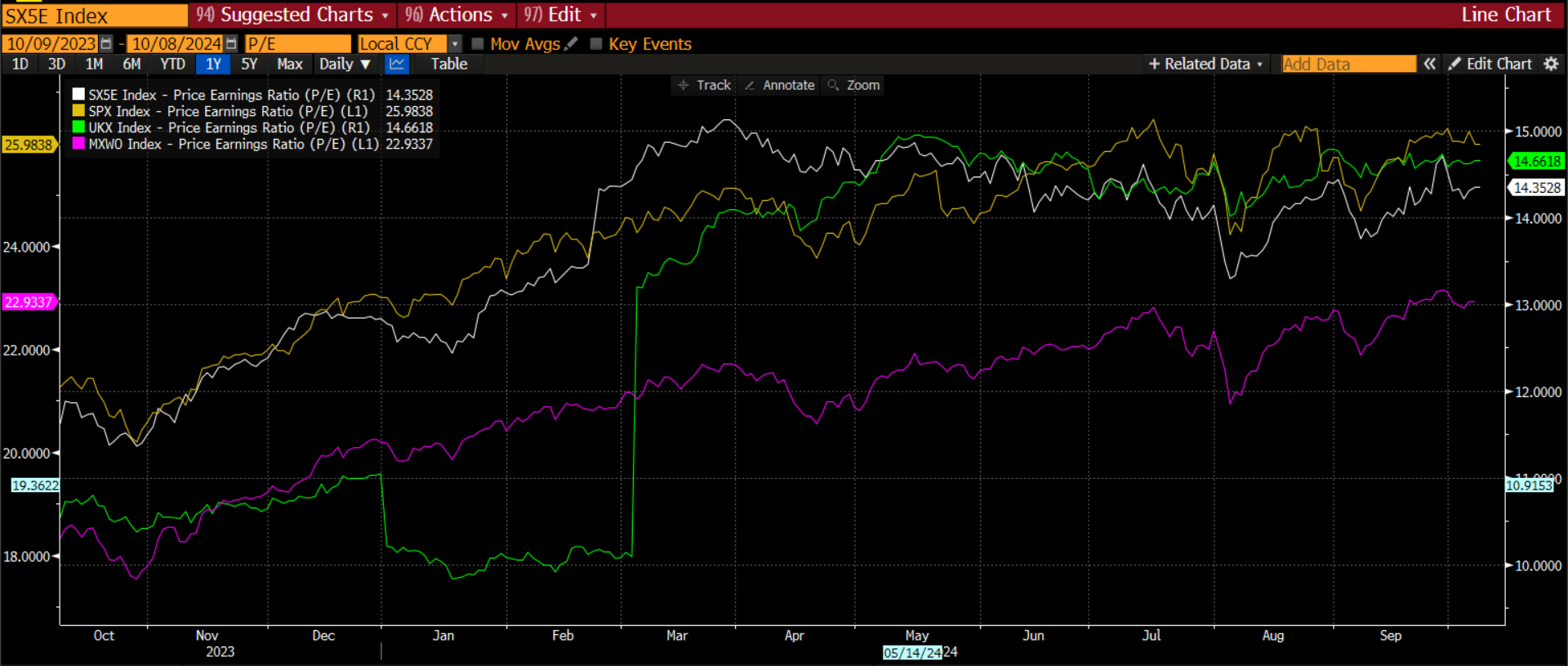
Source: XTB and Bloomberg
Mega cap stocks tempt investors once again
Investors are once again showing a preference for mega cap stocks as risk aversion bites. Since the start of Q4, the S&P 500 has outperformed medium-sized companies on the Russell 2000 and it has also outperformed the Dow Jones. Nvidia is higher by nearly 5% since the start of October, and futures markets are predicting a stronger open again on Tuesday. This is a trend that is worth watching. As interest rate expectations get recalibrated for the US and Fed rate cuts are priced out, this could hurt the broad stock market rally that we saw in Q3 as investors rush to the safety of mega cap stocks and their bullet proof balance sheets.
Author
Kathleen Brooks
XTB UK
Kathleen has nearly 15 years’ experience working with some of the leading retail trading and investment companies in the City of London.