Stocks: Chip restrictions pressure the market

Today's trading brings renewed concerns for the stock market -- is the downtrend resuming?
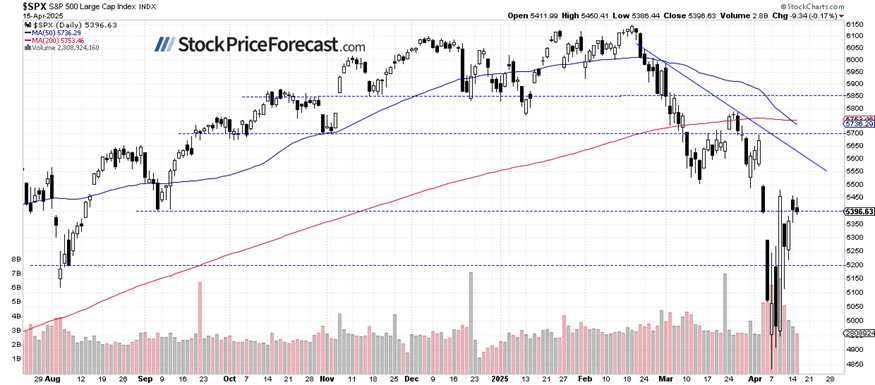
The S&P 500 closed 0.17% lower on Tuesday, fluctuating within Monday's trading range. The market is much less volatile following last week's wild swings, but this morning futures indicate it will open 0.7% lower due to news from the Trump administration about a ban on selling some types of chips from Nvidia to China.
Investor sentiment remained bearish, as shown in the last Wednesday’s AAII Investor Sentiment Survey, which reported that 28.5% of individual investors are bullish, while 58.9% of them are bearish.
The S&P 500 continues to trade below key 5,500 resistance, as we can see on the daily chart.
Nasdaq 100 - Tech under pressure
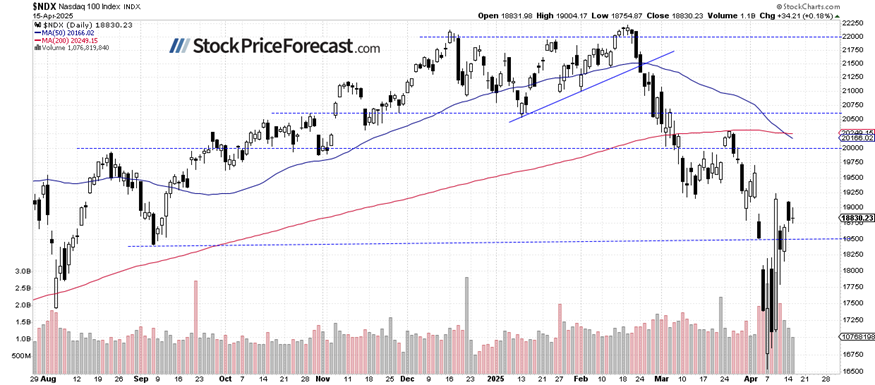
The Nasdaq 100 is facing pressure this morning due to chip restrictions. Futures suggest a 1.4% lower open, with semiconductor stocks like Nvidia seeing the most significant impact. The decision to limit exports of Nvidia's crucial H20 AI chip to China is weighing on the tech sector.
Resistance remains around 19,000-19,200, while support is around 18,200-18.500.
VIX pulling back
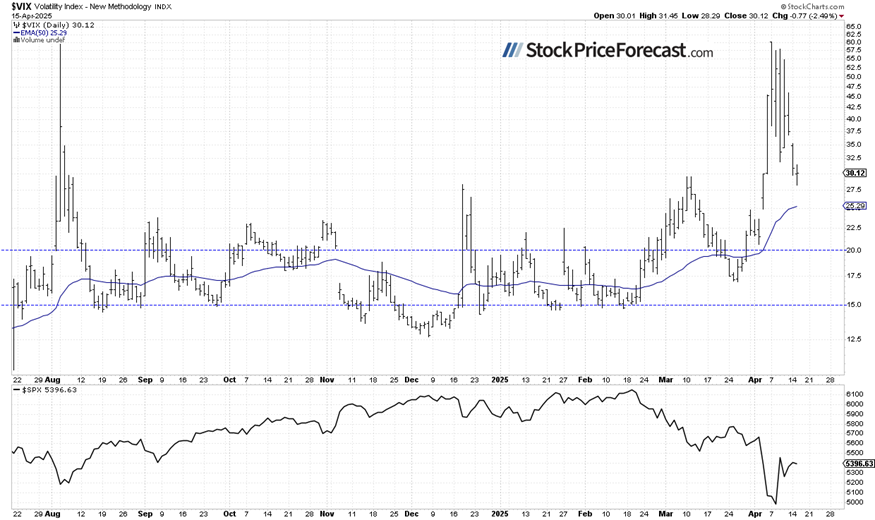
The VIX retreated to a local low of 28.29 yesterday while remaining elevated. It may see an uptick today as investors react to the new export limitations on the tech sector.
Historically, a dropping VIX indicates less fear in the market, and rising VIX accompanies stock market downturns. However, the lower the VIX, the higher the probability of the market’s downward reversal. Conversely, the higher the VIX, the higher the probability of the market’s upward reversal.
S&P 500 futures contract: Moving sideways
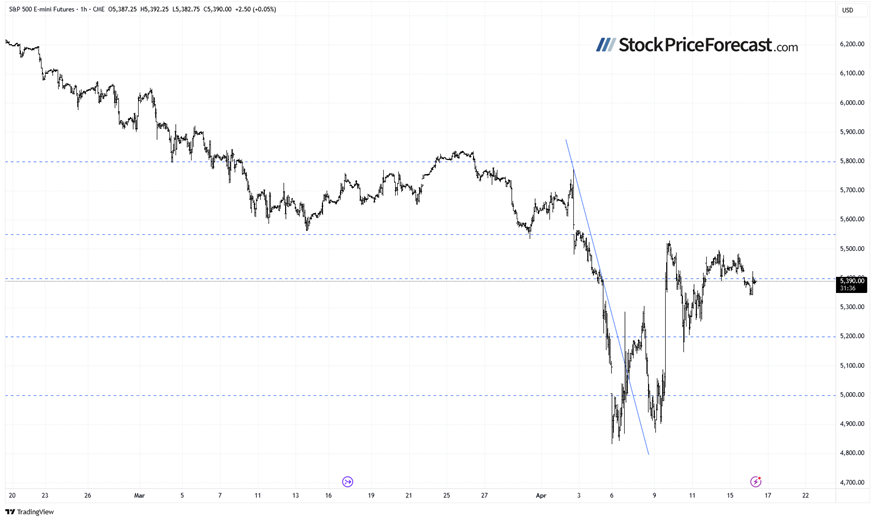
This morning, the S&P 500 futures contract is trading lower, pressured by the chip export restrictions news. The market appears to be losing the stability it showed earlier this week, but a large move lower seems less likely from here.
Key support remains around 5,300-5,350, marked by the recent fluctuations. Resistance remains around 5,500.
Last Wednesday, I noted that “The contract may be forming a double-bottom pattern, though it's too early to confirm.” This proved correct.
Conclusion
The stock market is facing renewed pressure this morning, primarily due to the Trump administration's decision to restrict chip exports to China. This development particularly impacts Nvidia and other semiconductor companies. The S&P 500 is set to open 0.7% lower, adding to its short-term uncertainty.
Earnings season kicked into high gear this week, with ASML reporting earlier today, Alcoa reporting after today's session closes, and TSMC and Netflix reporting tomorrow.
The market continues to be highly sensitive to trade policy developments, and volatility is likely to persist.
Here’s the breakdown:
-
S&P 500 futures point to a lower open, pulling back from their Monday-Tuesday stability.
-
Semiconductor stocks, particularly Nvidia, are facing downward pressure due to export restrictions.
-
Fed Chair Powell's speech later today could introduce additional volatility.
-
It is still a news-driven market, with tariff developments in focus.
Want free follow-ups to the above article and details not available to 99%+ investors? Sign up to our free newsletter today!
Want free follow-ups to the above article and details not available to 99%+ investors? Sign up to our free newsletter today!
Author

Paul Rejczak
Gold Price Forecast
Paul Rejczak is a stock market strategist who has been known for the quality of his technical and fundamental analysis since the late nineties.

















