AI-scare trade and tariff uncertainty takes hold


It was quite a day, with AI-disruption fears and tariff uncertainty triggering a risk-off session.
US Stock benchmarks underperformed across the board on Monday, with the S&P 500 shedding 71 points (1.0%) to 6,837 and most names posting losses; the Nasdaq 100 lost 303 points (1.2%) to 24,708, and the Dow Jones slid 821 points (1.7%) to 48,804.
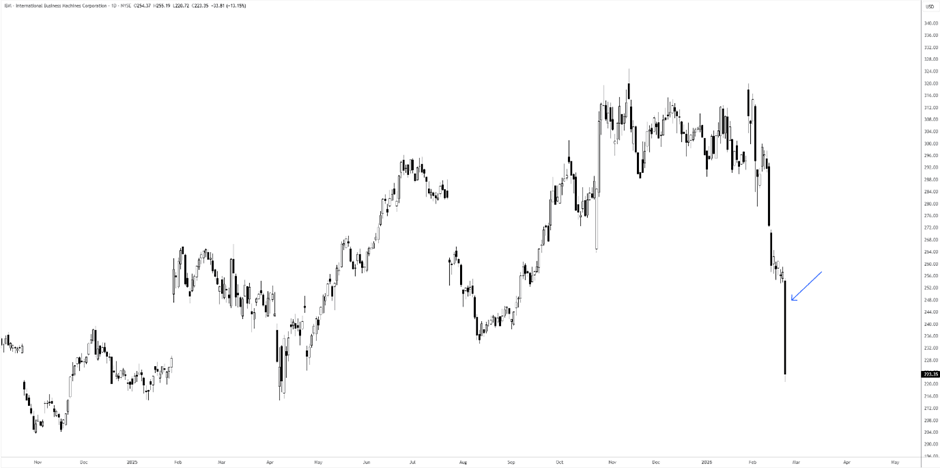
At the individual level, International Business Machines Corp. (IBM) took an absolute beating yesterday, erasing 13.0% – the largest single-day loss in over 25 years. In short, the sell-off was triggered on the back of investor fears following AI startup Anthropic’s announcement of Claude Code, a tool designed to modernise COBOL – the programming language that anchors IBM’s dominant mainframe business. They say a picture is worth 1000 words; just take a look at the chart below.
Under the hood, GICS sector performance showed financials led losses in recent trading, taking a sizeable hit, down 3.3%, followed by consumer discretionary and technology. Believe it or not, some sectors settled in the green, led by consumer staples and health care.
Of interest, the iShares Expanded Tech-Software Sector ETF (IGV) continued to lose ground on Monday, down nearly 5.0% and on track for its largest one-month loss since October 2008. Daily price, however, is now on the doorstep of a support area between US$76.07 and US$77.18. A breakout south of here could be bad news for the sector.
Elsewhere, both Spot Gold and Silver extended their recovery, with the former attracting bids above the widely watched US$5,000 level amid growing uncertainty. However, with Asian markets catching a bid overnight, improved risk appetite has weighed on Gold, down 0.9% and on track to snap a four-day winning streak.
Trump’s 10% tariff enforced
By now, it's nearly impossible to have missed the Supreme Court's 6-3 decision that struck down US President Donald Trump's reciprocal tariffs last Friday. The ruling determined that the 1977 International Emergency Economic Powers Act (IEEPA), which the President had cited as the legal basis for the import taxes, did not actually grant him the authority to impose them.
Shortly after the ruling, Trump announced a 10% blanket tariff across all countries under Section 122, which allows the levies to remain in place for 150 days. Following this, it will require Congressional approval to extend them. You will also have seen that Trump then announced that the tariff would be increased to 15%, the maximum allowed under Section 122. That said, according to the reports I have read, this has yet to be finalised.
As you would expect, the ruling and Trump’s tariff announcements injected a fresh wave of uncertainty across the markets, effectively replacing the previously negotiated tariff deals with many countries.
The day ahead
Following a rather quiet macro calendar yesterday, today’s drivers include the Conference Board's February US consumer confidence numbers and the Fed Bank of Richmond's regional manufacturing survey.
The Conference Board is expected to show that consumer confidence rose to 87.0 from 84.5 in January (estimate range is between 90.5 and 83.5). Per the forecast distribution, anything above (below) the maximum (minimum) estimates could prove market-moving for the USD. For example, a beat indicates increased confidence, which could lead to higher spending, thereby increasing the chances that the Fed remains on the sidelines for now.
Beyond the headline number, I will also be watching the jobs section of the report. In a previous post, I noted a marked deterioration in consumers’ perceptions of job availability in the January release, dropping to 23.9% from 27.5%, combined with an uptick in those reporting that jobs were ‘hard to get’. If we see a marked deterioration here, this could weigh on yields and the USD.
We have several Fed speakers also hitting the wires today. These include Governor Christopher Waller, Chicago Fed President Austan Goolsbee, Governor Lisa Cook, Atlanta Fed President Raphael Bostic, and Boston Fed President Susan Collins. Market pricing continues to imply a hold decision in March, with April also pretty much off the table at this point. June’s meeting is still a coin toss, with July now fully priced in for a 25-bp rate cut.
Speaking at the National Association for Business Economics yesterday, Waller stated that should the February jobs report reveal continued stabilisation, he may opt to hold rates steady at the March meeting. Conversely, a disappointing print would likely prompt him to vote to cut rates. According to Waller, it is now a coin toss.
Author
Aaron Hill
FP Markets
After completing his Bachelor’s degree in English and Creative Writing in the UK, and subsequently spending a handful of years teaching English as a foreign language teacher around Asia, Aaron was introduced to financial trading,