Silver Price Forecast: XAG/USD bulls remain focused on the $54.40 level

Silver remains steady near $54.00 after rejection at $54.40 area.
XAG/USD metal is on track for a nearly 8% rally this week.
Investors' hopes of Fed monetary policy easing are supporting speculative demand for precious metals.
Silver (XAG/USD) has failed to break November’s peak, at $54.40 area on Friday, weighed by a somewhat firmer US Dollar. The precious metal, however, remains close to $54.00, trading at $53,85 at the time of writing, after rallying nearly 8% this week.
The US Dollar Index (DXY), which measures the value of the USD against a basket of peers, is picking up from weekly lows amid a frail rebound in US Treasury yields on Friday's thinned Thanksgiving trading.
Nevertheless, the market is pricing a quarter-point rate cut by the Federal Reserve in December, and a few more next year, which is likely to keep speculative demand for the Greenback subdued and fuel the precious metal's rally.
Technical Analysis: The next upside targets are $54.40 and $54.85
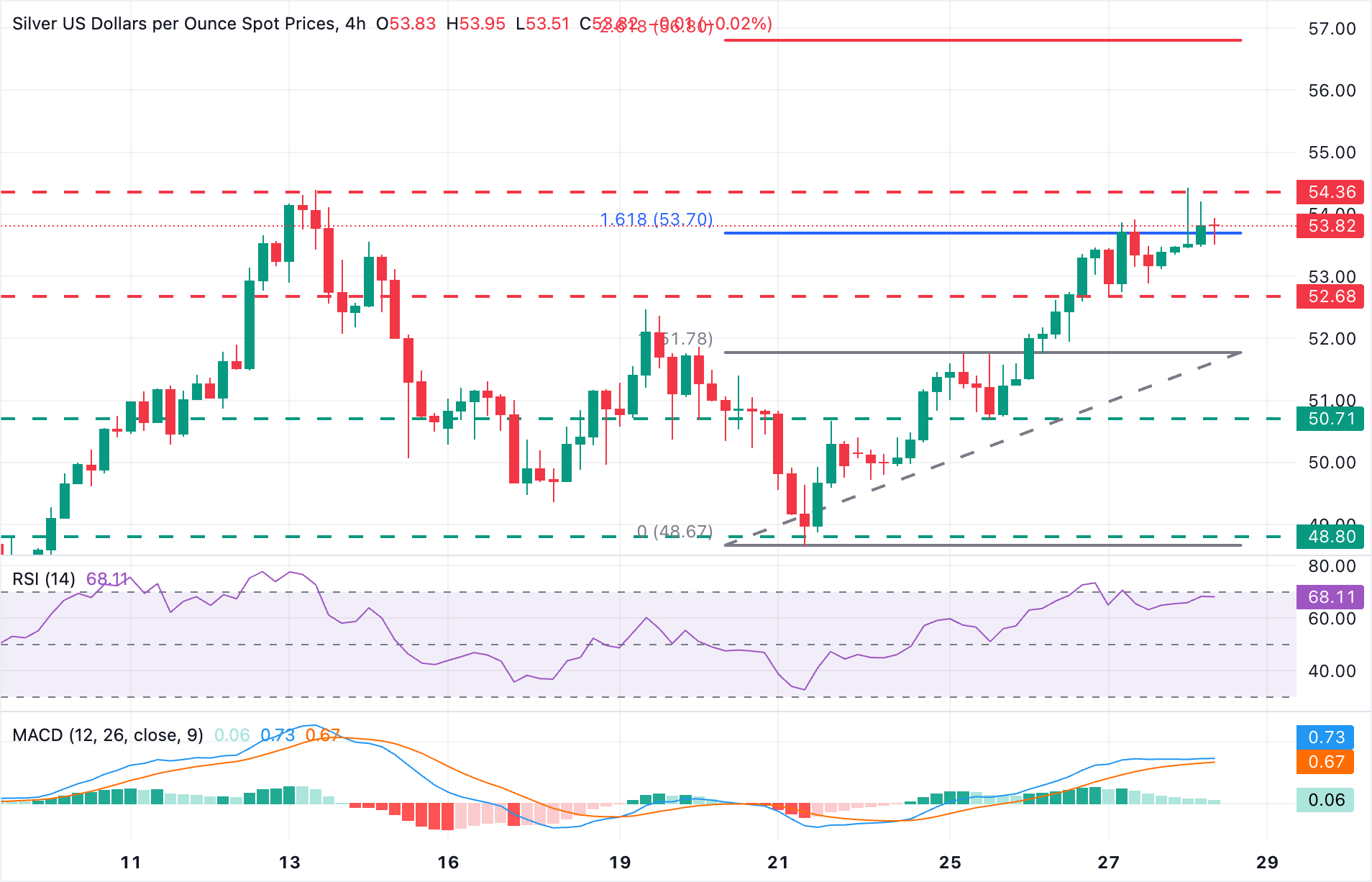
The technical picture remains positive. The rejection at $54.40 earlier on Friday has been contained above $53.50. Oscillators are at positive levels. The 4-Hour RSI is right below oversold territory while the MACD is turning flat at high levels, suggesting the possibility of some consolidation.
On the downside, the intra-day low at the mentioned $53.50 level is the prime support area ahead of Thursday’s low at the $52.70 area and the November 25 low, near $50.70.
Bulls remain focused on the November 13 highs, at the $54.40 area, which is the last hurdle ahead of the multi-year high of $54.85 reached in mid-October. Further up, the 261% Fibonacci extension of the November 21-25 rally, a common exhaustion level, is at the $56.60 area.
Silver FAQs
Silver is a precious metal highly traded among investors. It has been historically used as a store of value and a medium of exchange. Although less popular than Gold, traders may turn to Silver to diversify their investment portfolio, for its intrinsic value or as a potential hedge during high-inflation periods. Investors can buy physical Silver, in coins or in bars, or trade it through vehicles such as Exchange Traded Funds, which track its price on international markets.
Silver prices can move due to a wide range of factors. Geopolitical instability or fears of a deep recession can make Silver price escalate due to its safe-haven status, although to a lesser extent than Gold's. As a yieldless asset, Silver tends to rise with lower interest rates. Its moves also depend on how the US Dollar (USD) behaves as the asset is priced in dollars (XAG/USD). A strong Dollar tends to keep the price of Silver at bay, whereas a weaker Dollar is likely to propel prices up. Other factors such as investment demand, mining supply – Silver is much more abundant than Gold – and recycling rates can also affect prices.
Silver is widely used in industry, particularly in sectors such as electronics or solar energy, as it has one of the highest electric conductivity of all metals – more than Copper and Gold. A surge in demand can increase prices, while a decline tends to lower them. Dynamics in the US, Chinese and Indian economies can also contribute to price swings: for the US and particularly China, their big industrial sectors use Silver in various processes; in India, consumers’ demand for the precious metal for jewellery also plays a key role in setting prices.
Silver prices tend to follow Gold's moves. When Gold prices rise, Silver typically follows suit, as their status as safe-haven assets is similar. The Gold/Silver ratio, which shows the number of ounces of Silver needed to equal the value of one ounce of Gold, may help to determine the relative valuation between both metals. Some investors may consider a high ratio as an indicator that Silver is undervalued, or Gold is overvalued. On the contrary, a low ratio might suggest that Gold is undervalued relative to Silver.
Author

Guillermo Alcala
FXStreet
Graduated in Communication Sciences at the Universidad del Pais Vasco and Universiteit van Amsterdam, Guillermo has been working as financial news editor and copywriter in diverse Forex-related firms, like FXStreet and Kantox.

















