Seasonality indicates an important peak in March for the NASDAQ 100
As the NASDAQ100’s price action over the last three to four months has been more discombobulated than desired, i.e., the index has made little progress over that period, it is now trading at an early October 2025 level. The Elliott Wave Principle (EW) always presents us with possibilities, e.g., preferred vs. alternate, and sideways price action is therefore its worst nightmare, as it allows for many paths.
Thus, since no tool should be used in a vacuum, assessing other methods, indicators, and related factors alongside the EW is essential. We call that the “weight of the evidence" approach. Here, we look at the NASDAQ100’s seasonal trend during mid-term election years only. See Figure 1 below.
Figure 1. Average midterm election-year path for the NDX
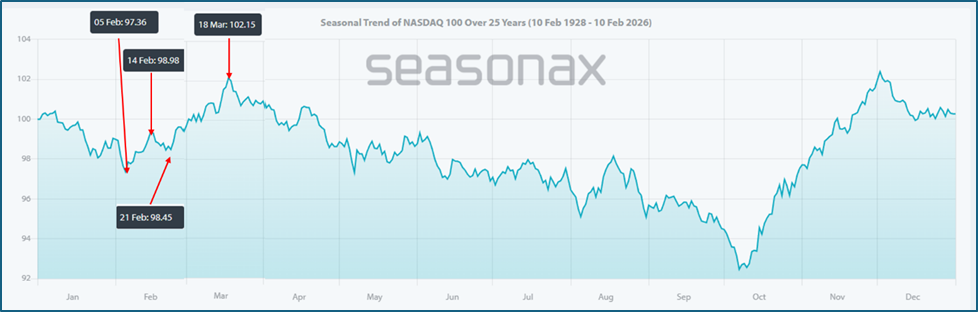
What we find is that, on average, the index bottoms on February 5, peaks around February 15, drops slightly to around February 21, and ultimately rallies to a March 18 high, after which it is all downhill until October.
As we can see, the NASDAQ 100 bottomed on February 6 and is now staging a rally. See Figure 2 below. Meanwhile, as we have stated often in our articles about the S&P500, “Make no mistake, once the pattern completes, we expect a multi-month correction to 5800 +/- 300 before the next rally to ideally 8100+ can begin.” The latter matches the March-October decline. As such, given the stagnant price action of late and seasonality, we’ve adjusted our EW count, which still points higher to around $26608.
Figure 2 Short-term EW count for the NASDAQ100
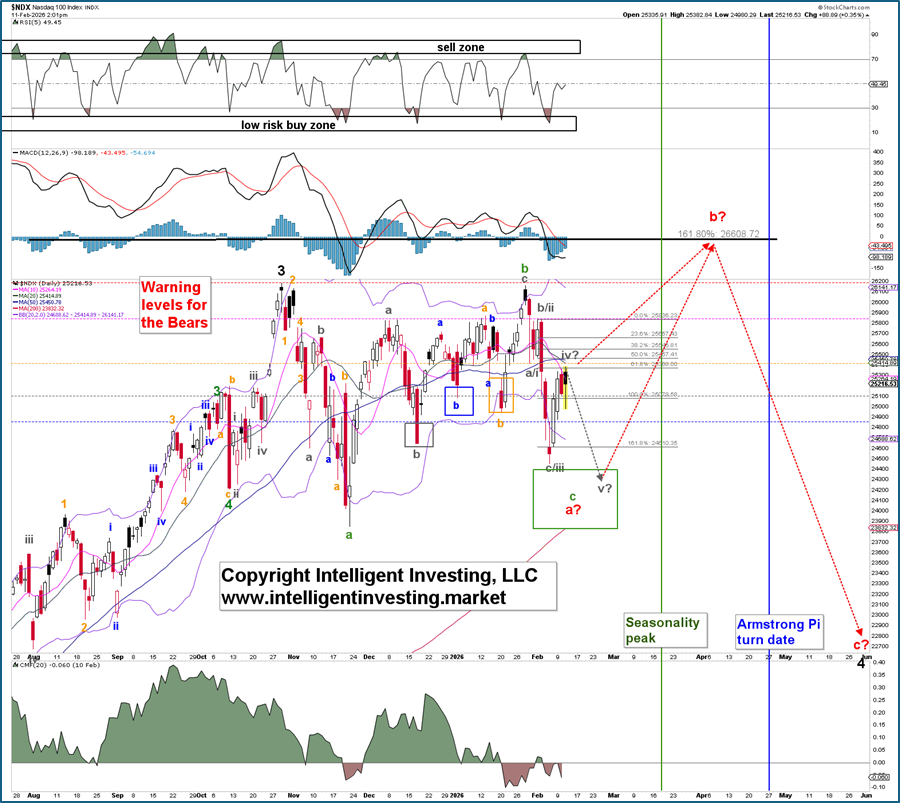
This level is 161.8% of the 2020-2021 rally (Wave-1), measured from the 2020 low (W-2). The index peaked on October 29 for W-3 but was 500 points short of the ideal 1.618x extension target.
· W-1 rallied from 6772 to 16765 (9993p).
· W-2 bottomed out on October 13, 2022, at 10440.
· W-3 targets: 10440+9992x1.618=26608
When the 3rd wave misses its target, the B-wave of the 4th wave often does the trick. Think July 2011, November 2015, October 2018, and February 2020. All these occasions featured new highs or new ATHs, which we call irregular B-waves, and were followed by significant declines: C-waves.
Thus, in the short term, we can still allow a last gray W-v to ideally reach $24200 +/- 200; but it is not necessary at this stage, and overlap with the orange, 3rd, warning level for the bears* ($25418) tells us the more direct rally to around February 15, etc., is the most likely path going forward. And remember, focus on the time frame that suits you: the daily price action is noisy, i.e., less certain. Weekly movements provide structure, whereas the monthly price action sets the trend. Trade accordingly.
*Warning levels for the bears are: 24854, 25112, 25418, 25840, 26182.
Author

Dr. Arnout Ter Schure
Intelligent Investing, LLC
After having worked for over ten years within the field of energy and the environment, Dr.