|

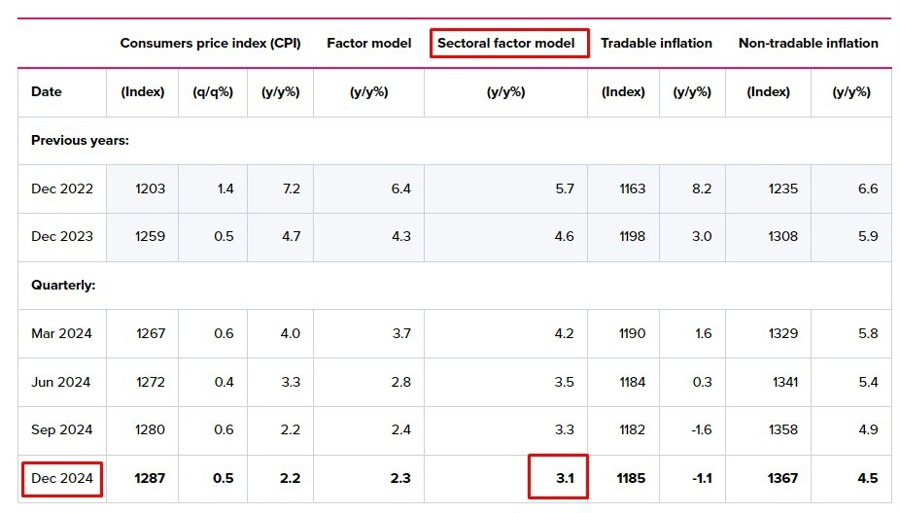
RBNZ Sectoral Factor Inflation Model arrives at 3.1% YoY in Q4 2024

The Reserve Bank of New Zealand (RBNZ) published its Sectoral Factor Model Inflation gauge for the fourth quarter of 2024, following the release of the official Consumer Price Index (CPI) by the NZ Stats early Wednesday.

The inflation measure extends its downtrend to 3.1% year-over-year (YoY) in Q4 2024 vs. 3.4% in Q3.

The inflation measures are closely watched by the RBNZ, which has a monetary policy goal of achieving 1% to 3% inflation.
FX implications

The Kiwi Dollar sees a fresh selling wave after the RBNZ’s inflation data. At the time of writing, NZD/USD is down 0.44% on the day to hit intraday lows near 0.5650.

About the RBNZ Sectoral Factor Model Inflation

The Reserve Bank of New Zealand has a set of models that produce core inflation estimates. The sectoral factor model estimates a measure of core inflation based on co-movements - the extent to which individual price series move together. It takes a sectoral approach, estimating core inflation based on two sets of prices: prices of tradable items, which are those either imported or exposed to international competition, and prices of non-tradable items, which are those produced domestically and not facing competition from imports.

Author

Dhwani Mehta

Dhwani Mehta

FXStreet

Residing in Mumbai (India), Dhwani is a Senior Analyst and Manager of the Asian session at FXStreet. She has over 10 years of experience in analyzing and covering the global financial markets, with specialization in Forex and commodities markets.


More from Dhwani Mehta
Share:

Editor's Picks

EUR/USD: US Dollar recovers ahead of ECB, more Trump in the docket

The EUR/USD pair soared in the last week of January, hitting a multi-year high of 1.2082 before finally retreating and trimming most of its weekly gains to settle around the 1.1900 level. The US Dollar gapped lower on Monday, on headlines suggesting the United States intended to intervene in the Japanese Yen.

GBP/USD retreats further, threatens 1.3700

Selling pressure remains on the rise, dragging GBP/USD back towards three-day lows around 1.3720-1.3710 at the end of the week. Cable’s retracement reflects a firmer rebound in the Greenback as investors digest Trump’s announcement of the next Fed chair.

Gold: Correction should be temporary

Gold kept winning this week, and on Thursday it briefly reached new all-time highs just beyond the $5,600 mark per troy ounce. Since then, the yellow metal has entered a correction phase, as some traders took profits at the right time and the US Dollar rose sharply.

Week ahead: Could strong US data shift focus from Trump’s rhetoric?

Significant market moves keep investors on their toes. Trump has been the primary source of volatility, mainly when targeting the Fed. Pivotal US data releases next week as markets adjust to potential Warsh Fed nomination. RBA, BoE and ECB meet next week; decent chances of surprises across the board. Dollar/Yen prepares for February 8 elections; gold experiences its first substantial correction.

Global central banks hold steady as EMs signal easing ahead

Central banks across both G10 and emerging markets met this week, with most opting to keep policy rates unchanged. Canada, Sweden, Brazil and Chile all held rates steady. Beyond central bank decisions, the Eurozone's solid Q4 GDP growth bolstered the case for the ECB to keep policy rates unchanged next week.

Top 3 Price Prediction: Bitcoin, Ethereum, Ripple deepen sell-off as bears take control of momentum

Bitcoin, Ethereum, and Ripple continued their corrections on Friday, posting weekly losses of nearly 6%, 3%, and 5%, respectively. BTC is nearing the November lows at $80,000, while ETH slips below $2,800 amid increasing downside pressure.