|

RBA hawkish-sounding quarterly Statement on Monetary Policy does little for AUD

The RBA Monetary Policy Statement released by the Reserve bank of Australia is out as follows:

The RBA has revised up its forecasts for core inflation and wages growth and warned further increases in inetrest rates would be needed to head off a damaging wage-price spiral.

Reuters reported that ''in a hawkish-sounding quarterly Statement on Monetary Policy, the Reserve Bank of Australia (RBA) said domestically-sourced cost pressures were still picking even if consumer price inflation was a whole may have finally peaked last quarter.

While growth in global goods prices had cooled this was yet to show clearly in Australia, while inflation in the service sector had climbed faster than expected.''

AUD/USD update
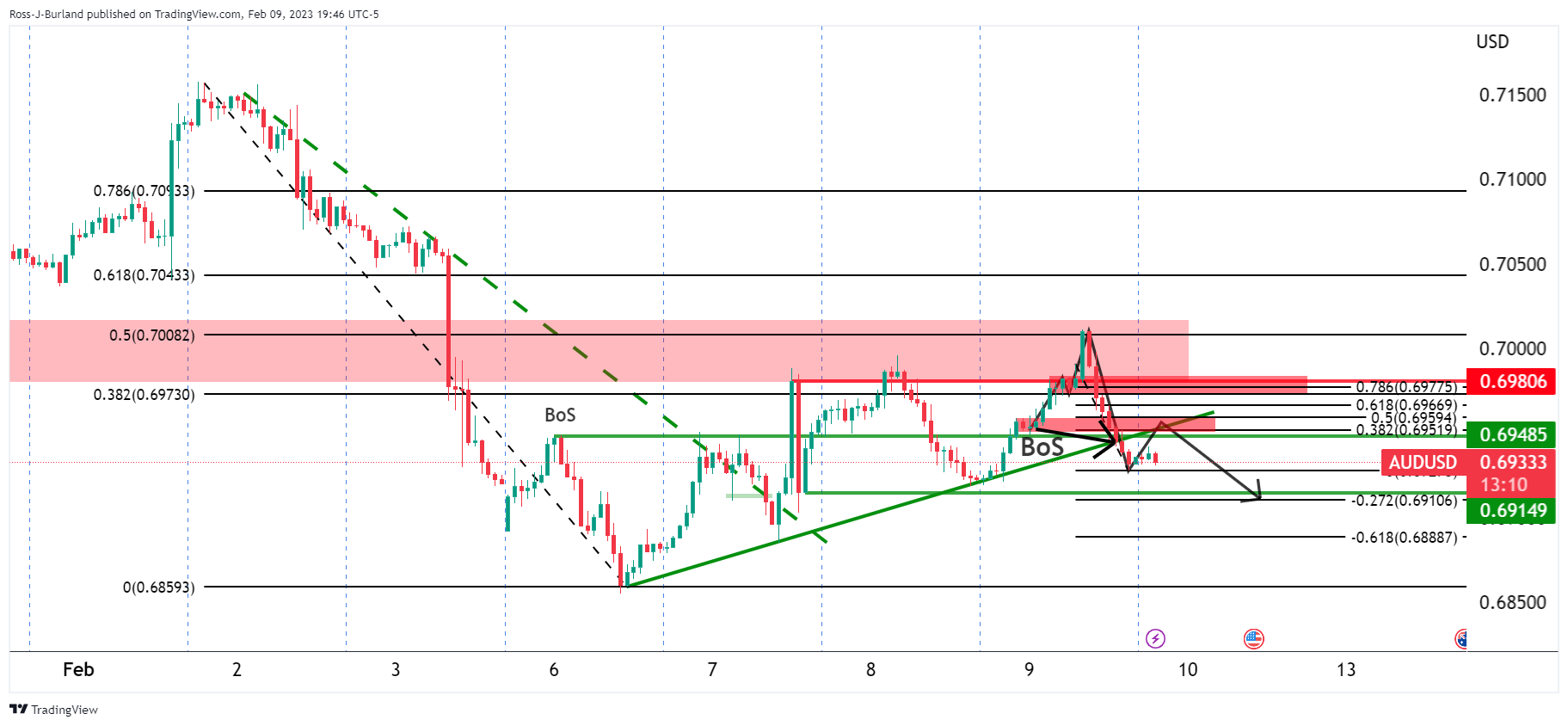
AUD/USD was unchanged in the release as the US dollar stays strong in Asia. However, the pair could be expected to make a move higher into re-test the break of the structure considering the bullish M-formation. The downside target is near 0.6920/10 which guards 0.69 the figure. 

Key notes

"The Board expects that further increases in interest rates will be needed to ensure that the current period of high inflation is only temporary," said the RBA, implying two or more hikes were waiting in the wings.

"The Board's priority is to return inflation to target. High inflation makes life difficult for people and damages the functioning of the economy. And if high inflation were to become entrenched in people's expectations, it would be very costly to reduce later."

About the RBA statement

The RBA Monetary Policy Statement released by the Reserve bank of Australia reviews economic and financial conditions, determines the appropriate stance of monetary policy and assesses the risks to its long-run goals of price stability and sustainable economic growth. It is considered as a clear guide to the future RBA interest rate policy. Any changes in this report affect the AUD volatility. If the RBA statement shows a hawkish outlook, that is seen as positive (or bullish) for the AUD, while a dovish outlook is seen as negatvie (or bearish).

Author

Ross J Burland

Ross J Burland, born in England, UK, is a sportsman at heart. He played Rugby and Judo for his county, Kent and the South East of England Rugby team.


More from Ross J Burland
Share:

Editor's Picks

AUD/USD holds the bounce near 0.7050 after China trade data

AUD/USD is holding the bounce from two-month lows, retesting 0.7050 in the Asian session on Tuesday. Easing tensions in the Middle East keep the US Dollar on the defensive, supporting the pair amid China's trade surplus expansion in May.

USD/JPY consolidates above 160.00 amid intervention fears, Israel-Iran ceasefire

USD/JPY holds steady above 160.00 during the Asian session on Tuesday as expectations that authorities will step in again to prop up the Japanese Yen hold back bulls from placing fresh bets. Moreover, a de-escalation of tensions between Israel and Iran undermines the safe-haven US Dollar, capping the currency pair. Traders also seem hesitant and opt to wait for the release of the latest US inflation figures on Wednesday and Thursday.

Gold rebounds but not out of the woods yet

Gold holds the rebound above $4,300 early Tuesday after hitting three-month lows at $4,269. The US Dollar eases amid doubts over the Mideast truce situation, traders cash in ahead of Wednesday’s US CPI. Downside risks remain intact for Gold whilst below the 200-day SMA and amid bearish daily RSI.

XRP and XLM outlook: Fragile recovery as traders favor downside

Ripple and Stellar remain under pressure on Tuesday after a mild recovery following a massive correction in the previous week. Weakening derivatives positioning, alongside mixed on-chain data for both XRP and XLM, suggests that any recovery rallies are likely viewed as corrective within a broader bearish context. Derivatives data shows a bearish tilt.

Upbeat NFP data sets the market up for CPI test

Investors sought safety toward the US dollar after the latest NFP report triggered risk-off trading across the markets. The US Dollar Index which tracks the dollar strength against a basket currencies recorded one of it’s best weeks in recent times.

The US economy defies the rules: 100 days into the Oil shock and the recession signal is still missing

More than three months after the start of the Iran war and the resulting disruption to global energy markets, the US economy continues to display remarkable resilience. The conflict has triggered a sharp rise in Oil prices, reignited inflationary pressures and fueled widespread concerns about a potential economic slowdown.













