Pound Sterling slumps against US Dollar as US and China slashes tariffs by 115%
- The Pound Sterling falls sharply below 1.3200 against the US Dollar after the US and China agree to reduce tariffs for 90 days by 115%.
- Lower US tariffs would pave the way for the Fed to cut interest rates.
- This week, investors will focus on the UK employment and the US CPI data on Tuesday.

The Pound Sterling (GBP) recovers some of its intraday losses after sliding to near 1.3140 against the US Dollar (USD) during North American trading hours on Monday. Still, the GBP/USD pair is down 0.8% at around 1.3200. The Cable falls sharply as the US Dollar strengthens after the United States (US) and China agreed on a reduction in tariffs imposed in the trade war in April, which will come into effect on Wednesday, for 90 days.
The US Dollar Index (DXY), which tracks the Greenback’s value against six major currencies, surges to near 101.80, the highest level since April 10.
US Treasury Secretary Scott Bessent has announced in a scheduled briefing during European trading hours that both Washington and China have agreed to lower import duties by 115%, Reuters reported. This indicates that current levies on the US and China are 10% and 30%, respectively. Bessent stated that fentanyl issues have not been resolved yet. Therefore, tariffs on China still stand at 30%.
The impact of the US-China trade resolution is favorable for the majority of asset classes across the globe, especially the US Dollar and US assets, which were dumped heavily when the trade war between the world's two largest economic countries stemmed after Beijing announced counter-tariffs. The Greenback came down by over 6% since US President Donald Trump announced reciprocal tariffs on the so-called Liberation Day.
Meanwhile, the resolution of the US-China trade war will also diminish elevated US consumer inflation expectations, a scenario that will pave the way for the Federal Reserve (Fed) to resume the monetary policy easing cycle, which it paused in January.
Daily digest market movers: Pound Sterling gains while BoE Lombardelli expects more interest rate cuts
- The Pound Sterling trades higher against its major peers, except the US Dollar, at the start of the week. The British currency demonstrates firmness as the Bank of England (BoE) retained its “gradual and cautious” monetary expansion guidance in the policy announcement on Thursday.
- The BoE lowered its interest rates by 25 basis points (bps) to 4.25%, as expected, but with a vote split in which Monetary Policy Committee (MPC) member Catherine Mann and Chief Economist Huw Pill voted for leaving interest rates unchanged. During European trading hours, BoE Deputy Governor Clare Lombardelli stated that the 25-bps interest rate reduction was appropriate due to "gradual disinflation progress and trade developments". Lombardelli signaled that more interest rate cuts are in the pipeline. "Evidence suggests that policy is still restrictive, Lombardelli said.
- On Friday, Pill clarified that his decision was based on expectations that longer-term domestic pressures might push up inflation, Reuters reported. Pill also downplayed the impact of global trade risk on the United Kingdom (UK) economy. “Not seeing a dramatic shift in the UK economy after tariff announcements,” Pill said.
- This week, the GBP/USD pair will be influenced by the UK employment data for the three months ending March and the US Consumer Price Index (CPI) data for April, which will be published on Tuesday. The UK labor market data is expected to show that the jobless rate accelerated and the wage growth grew at a slower pace. The US core inflation is estimated to have grown at a faster pace on a monthly basis.
- Ahead of the temporary US-China trade truce announcement, comments from Bessent, US Trade Representative Jamieson Greer, and China’s Vice Commerce Minister Li Chenggang have signaled that both nations have made “substantial progress” in high-stakes trade talks in Geneva over the weekend. The two-day meeting between the US and its Chinese counterparts over the weekend in Switzerland has managed to defuse the ongoing Sino-US trade war. "I'm happy to report that we've made substantial progress between the US and China in the very important trade talks,” Bessent said, Yahoo Finance reported.
- "We’re confident that the deal we struck with our Chinese partners will help us to work toward resolving the trade deficit,” US Trade Representative Greer said. On the other hand, China’s Vice Commerce Minister Li Chenggang said it would contain "good news for the world."
Technical Analysis: Pound Sterling slides to near 200-period EMA
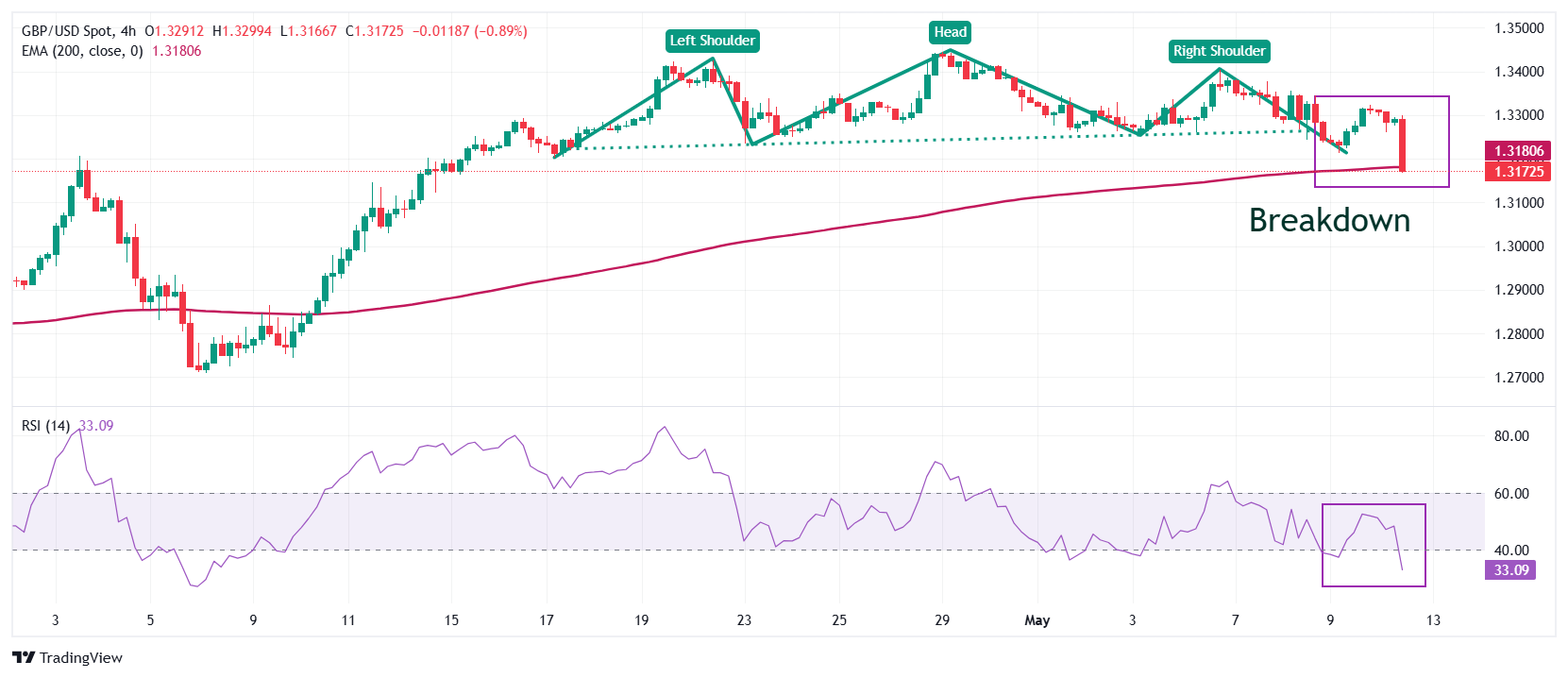
The Pound Sterling slips below 1.3200 against the US Dollar at the start of the week. The pair's outlook has turned bearish on a breakdown of the Head and Shoulders (H&S) formation on a four-hour timeframe. A breakdown of the H&S chart pattern leads to a bearish reversal, and its formation near a critical resistance increases its credibility.
The Cable slides to near the 200-period Exponential Moving Average (EMA), which is around 1.3190, suggesting a bearish trend.
The 14-period Relative Strength Index (RSI) declines below 40.00. Fresh bearish momentum would trigger if the RSI sustains below that level.
On the upside, the three-year high of 1.3445 will be a key hurdle for the pair. Looking down, the psychological level of 1.3000 will act as a major support area.
Tariffs FAQs
Tariffs are customs duties levied on certain merchandise imports or a category of products. Tariffs are designed to help local producers and manufacturers be more competitive in the market by providing a price advantage over similar goods that can be imported. Tariffs are widely used as tools of protectionism, along with trade barriers and import quotas.
Although tariffs and taxes both generate government revenue to fund public goods and services, they have several distinctions. Tariffs are prepaid at the port of entry, while taxes are paid at the time of purchase. Taxes are imposed on individual taxpayers and businesses, while tariffs are paid by importers.
There are two schools of thought among economists regarding the usage of tariffs. While some argue that tariffs are necessary to protect domestic industries and address trade imbalances, others see them as a harmful tool that could potentially drive prices higher over the long term and lead to a damaging trade war by encouraging tit-for-tat tariffs.
During the run-up to the presidential election in November 2024, Donald Trump made it clear that he intends to use tariffs to support the US economy and American producers. In 2024, Mexico, China and Canada accounted for 42% of total US imports. In this period, Mexico stood out as the top exporter with $466.6 billion, according to the US Census Bureau. Hence, Trump wants to focus on these three nations when imposing tariffs. He also plans to use the revenue generated through tariffs to lower personal income taxes.
Author

Sagar Dua
FXStreet
Sagar Dua is associated with the financial markets from his college days. Along with pursuing post-graduation in Commerce in 2014, he started his markets training with chart analysis.

















