Pound Sterling edges lower against US Dollar in final stretch to 2025
on
- The Pound Sterling remains broadly firm against its peers on the last trading day of 2025.
- The BoE is expected to follow a gradual monetary easing path next year.
- FOMC Minutes show that Fed officials support the need for additional interest rate cuts.
The Pound Sterling (GBP) trades broadly higher against its major peers in European trading hours on the last day of 2025. The British currency remains upbeat on market expectations that it will continue to outperform in 2026 amid hopes that there will be fewer interest rate cuts by the Bank of England (BoE) compared to other central banks.
In the monetary policy announced this month, the BoE reduced interest rates by 25 basis points (bps) to 3.75%, and guided that the monetary policy will remain on a gradual downward path.
“We still think rates are on a gradual downward path, but with every cut, how much further we go becomes a closer call,” the BoE said in the monetary policy statement. The bank also stated that inflation is expected to “ease in Q1 2026 to around 3%, closer to 2% in Q2".
Given that the BoE is confident about inflation returning to the 2% target in the mid-term, the major focus area for officials will be the United Kingdom (UK) labor market. In 2025, UK job market conditions remained weak as employers limited hiring following the increase in their contribution to social security schemes. In the three months ending October, the UK Unemployment Rate jumped to 5.1%, the highest level seen since March 2021.
Pound Sterling Price Today
The table below shows the percentage change of British Pound (GBP) against listed major currencies today. British Pound was the strongest against the New Zealand Dollar.
| USD | EUR | GBP | JPY | CAD | AUD | NZD | CHF | |
|---|---|---|---|---|---|---|---|---|
| USD | 0.15% | 0.16% | 0.05% | 0.07% | 0.15% | 0.37% | 0.15% | |
| EUR | -0.15% | 0.02% | -0.11% | -0.07% | 0.00% | 0.23% | 0.00% | |
| GBP | -0.16% | -0.02% | -0.13% | -0.09% | -0.01% | 0.21% | 0.00% | |
| JPY | -0.05% | 0.11% | 0.13% | 0.03% | 0.12% | 0.33% | 0.14% | |
| CAD | -0.07% | 0.07% | 0.09% | -0.03% | 0.08% | 0.26% | 0.09% | |
| AUD | -0.15% | -0.01% | 0.01% | -0.12% | -0.08% | 0.22% | 0.00% | |
| NZD | -0.37% | -0.23% | -0.21% | -0.33% | -0.26% | -0.22% | -0.21% | |
| CHF | -0.15% | -0.01% | -0.00% | -0.14% | -0.09% | -0.01% | 0.21% |
The heat map shows percentage changes of major currencies against each other. The base currency is picked from the left column, while the quote currency is picked from the top row. For example, if you pick the British Pound from the left column and move along the horizontal line to the US Dollar, the percentage change displayed in the box will represent GBP (base)/USD (quote).
Daily Digest Market Movers: Investors expect Fed to cut interest rates by at least 50 bps in 2026
- The Pound Sterling edges down to near 1.3455 against the US Dollar (USD) during the European trading session on Wednesday. The GBP/USD pair ticks lower as the US Dollar rises despite the release of dovish Federal Open Market Committee (FOMC) minutes of the December policy meeting.
- The US Dollar Index (DXY), which gauges the Greenback’s value against six major currencies, posts a fresh weekly high near 98.35.
- The FOMC minutes showed on Tuesday that officials argued in favor of reducing interest rates further, even after trimming them by 75 basis points (bps) in 2025, to support weakening labor market conditions. Most participants noted that "moving toward a more neutral policy stance would help forestall possible job market deterioration,” the FOMC minutes showed.
- According to the CME FedWatch tool, there is a 76.1% chance that the Fed will cut interest rates by at least 50 basis points (bps) in 2026.
- Going forward, the major trigger for the US Dollar will be the announcement of Fed Chair Jerome Powell’s successor. According to comments from US President Donald Trump, the name of the next Fed Chairman will be announced sometime in January.
Technical Analysis: GBP/USD continues to hold 20-day EMA
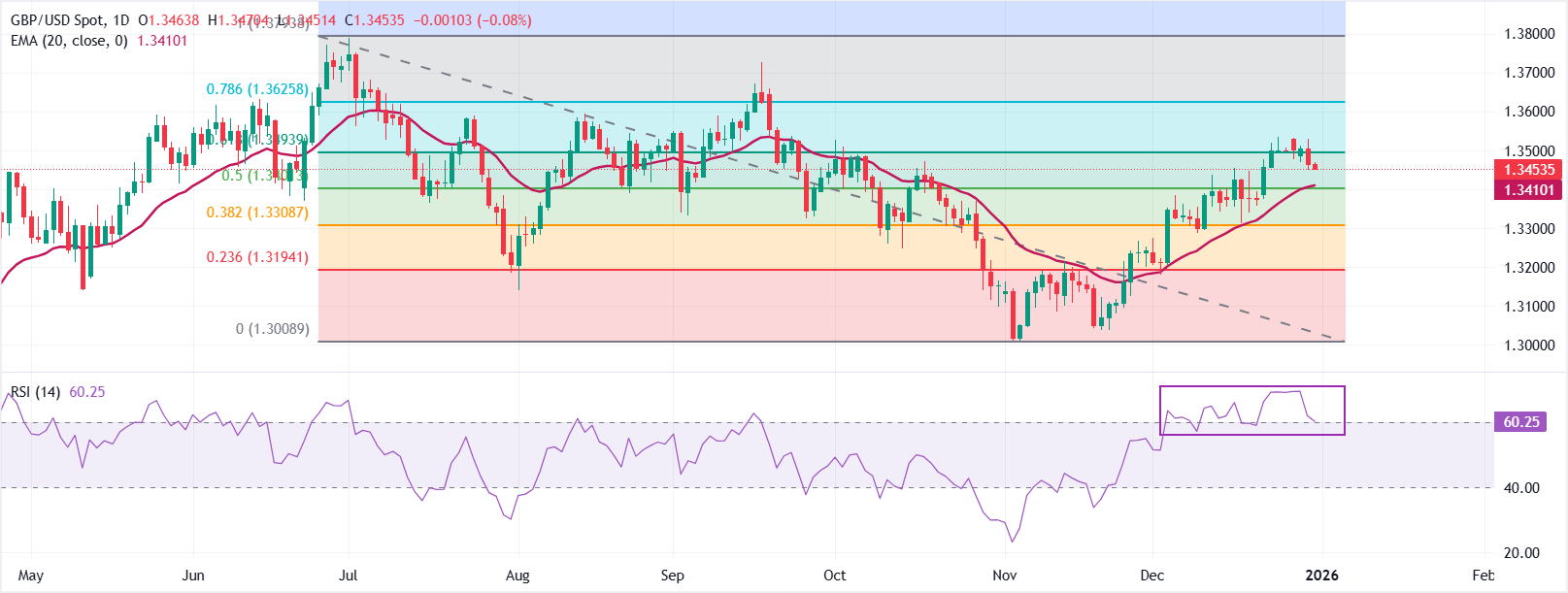
In the daily chart, GBP/USD trades at 1.3454, slightly down on the day. The 20-day EMA at 1.3410 trends higher, and the price holds above it, maintaining a near-term bullish bias. The average has advanced steadily in recent sessions and now offers immediate dynamic support. The RSI at 60 sits on the positive side of neutral and has eased from recent peaks, keeping momentum constructive without overextension.
Measured from the 1.3794 high to the 1.3009 low, the 61.8% retracement at 1.3494 acts as resistance as the pair presses into the upper half of the pullback map. A daily close above 1.3494 could extend gains, while failure to clear it would keep the rebound capped and leave price vulnerable toward the rising 20-day EMA.
(The technical analysis of this story was written with the help of an AI tool.)
BoE FAQs
The Bank of England (BoE) decides monetary policy for the United Kingdom. Its primary goal is to achieve ‘price stability’, or a steady inflation rate of 2%. Its tool for achieving this is via the adjustment of base lending rates. The BoE sets the rate at which it lends to commercial banks and banks lend to each other, determining the level of interest rates in the economy overall. This also impacts the value of the Pound Sterling (GBP).
When inflation is above the Bank of England’s target it responds by raising interest rates, making it more expensive for people and businesses to access credit. This is positive for the Pound Sterling because higher interest rates make the UK a more attractive place for global investors to park their money. When inflation falls below target, it is a sign economic growth is slowing, and the BoE will consider lowering interest rates to cheapen credit in the hope businesses will borrow to invest in growth-generating projects – a negative for the Pound Sterling.
In extreme situations, the Bank of England can enact a policy called Quantitative Easing (QE). QE is the process by which the BoE substantially increases the flow of credit in a stuck financial system. QE is a last resort policy when lowering interest rates will not achieve the necessary result. The process of QE involves the BoE printing money to buy assets – usually government or AAA-rated corporate bonds – from banks and other financial institutions. QE usually results in a weaker Pound Sterling.
Quantitative tightening (QT) is the reverse of QE, enacted when the economy is strengthening and inflation starts rising. Whilst in QE the Bank of England (BoE) purchases government and corporate bonds from financial institutions to encourage them to lend; in QT, the BoE stops buying more bonds, and stops reinvesting the principal maturing on the bonds it already holds. It is usually positive for the Pound Sterling.
Author

Sagar Dua
FXStreet
Sagar Dua is associated with the financial markets from his college days. Along with pursuing post-graduation in Commerce in 2014, he started his markets training with chart analysis.