Pound Sterling underperforms as UK Reeves warns of higher UK borrowing costs
- The Pound Sterling slides further to near 1.3070 against the US Dollar.
- Traders turn doubtful over whether the Fed will cut interest rates again this year.
- UK Chancellor Reeves might raise taxes to cover the fiscal shortfall.

The Pound Sterling (GBP) underperforms its major currency peers, except antipodeans, on Tuesday. The GBP faces selling pressure as investors turn cautious on expectations that the United Kingdom (UK) Chancellor of the Exchequer, Rachel Reeves, will raise taxes in the upcoming Autumn Budget later this month to plug a £22bn shortfall in the government's finances.
The Sunday Times has reported that Reeves was looking at more than 100 possible tax and spending options, with a focus on the top third of earners.
This week, investors will pay close attention to the Bank of England’s (BoE) monetary policy announcement on Thursday. Financial market participants are divided over whether the BoE will cut interest rates in the next meeting. In the September policy, the BoE kept interest rates steady at 4% as inflationary pressures remained higher. However, the BoE expressed confidence that price pressures would peak around 4% in September.
During the day, UK Chancellor Reeves warned that "inflation has been too slow to come down", which has exposed the economy to "rising cost of borrowing". Reeves added that her budget decisions in the upcoming Autumn Statement, scheduled later this month, will be focused on lowering inflation.
Daily digest market movers: Pound Sterling slides below 1.3100 against US Dollar
- The Pound Sterling slumps to near 1.3070 against the US Dollar (USD) during the European trading session on Tuesday. The GBP/USD pair weakens as the US Dollar trades firmly amid receding speculation that the Federal Reserve (Fed) could cut interest rates again this year.
- At the press time, the US Dollar Index (DXY), which tracks the Greenback’s value against six major currencies, ticks down to near 99.85. During the day, the DXY has posted a fresh three-month high around 100.00.
- The CME FedWatch tool shows that the probability of the Fed cutting interest rates by 25 basis points (bps) to 3.50%-3.75% at the December meeting has eased to 67.3% from 94.4% seen a week ago.
- Traders adjusted Fed dovish bets after Chairman Jerome Powell commented in the press conference last week that the December rate cut is “far from a foregone conclusion” as officials had “strongly different views” in the monetary policy meeting, adding that they “haven't made a decision about December”.
- Meanwhile, San Francisco Fed President Mary Daly stated in a moderated discussion at the Forum Club of the Palm Beaches in Florida on Monday that the December monetary policy decision will be guided by the incoming data. Daly added that the monetary policy needs to be modestly restrictive as inflation is well above the Fed’s 2% target.
- Going forward, the GBP/USD pair will be influenced by the US ADP Employment Change data for October, which will be released on Wednesday. Investors will pay close attention to the US ADP payrolls data, as the Nonfarm Payrolls (NFP) data remains unavailable due to the US federal shutdown.
- Economists expect the US ADP report to show that private employers added 24K fresh workers against laying off 32K employees in September. Signs of improving US job market conditions would further weigh on market expectations for more interest rate cuts by the Fed this year.
Technical Analysis: Pound Sterling sees more downside towards 1.3000
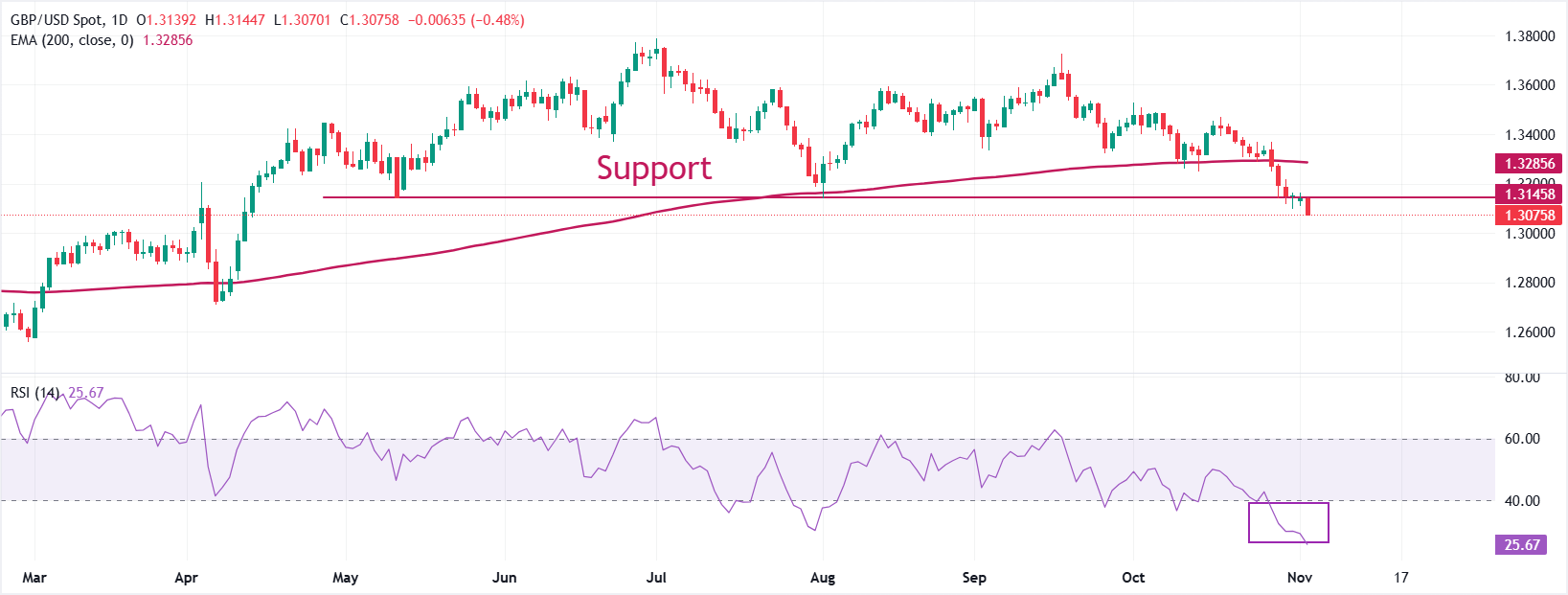
The Pound Sterling extends its downside below 1.3100 against the US Dollar during Tuesday’s European session. The outlook of the cable remains bearish as it trades below the 200-day Exponential Moving Average (EMA), which is around 1.3279.
The 14-day Relative Strength Index (RSI) slumps below 30.00, indicating that the overall momentum is bearish.
Looking down, the psychological level of 1.3000 will act as a key support zone. On the upside, the October 28 high around 1.3370 will act as a key barrier.
Economic Indicator
ADP Employment Change
The ADP Employment Change is a gauge of employment in the private sector released by the largest payroll processor in the US, Automatic Data Processing Inc. It measures the change in the number of people privately employed in the US. Generally speaking, a rise in the indicator has positive implications for consumer spending and is stimulative of economic growth. So a high reading is traditionally seen as bullish for the US Dollar (USD), while a low reading is seen as bearish.
Read more.Next release: Wed Nov 05, 2025 13:15
Frequency: Monthly
Consensus: 24K
Previous: -32K
Source: ADP Research Institute
Traders often consider employment figures from ADP, America’s largest payrolls provider, report as the harbinger of the Bureau of Labor Statistics release on Nonfarm Payrolls (usually published two days later), because of the correlation between the two. The overlaying of both series is quite high, but on individual months, the discrepancy can be substantial. Another reason FX traders follow this report is the same as with the NFP – a persistent vigorous growth in employment figures increases inflationary pressures, and with it, the likelihood that the Fed will raise interest rates. Actual figures beating consensus tend to be USD bullish.
Author

Sagar Dua
FXStreet
Sagar Dua is associated with the financial markets from his college days. Along with pursuing post-graduation in Commerce in 2014, he started his markets training with chart analysis.