Pound Sterling outperforms USD as US consumer sentiment deteriorates
- The Pound Sterling rises to near 1.3200 against the US Dollar as US consumers are concerned over the economic outlook due to Trump’s tariff policies.
- China increased counter-tariffs on imports of US goods to 125% on Saturday.
- Investors keenly await the UK employment and inflation data.

The Pound Sterling (GBP) extends its winning streak for the fifth trading day against the US Dollar (USD) at the start of the week. The GBP/USD pair jumps to near 1.3200 in Monday’s North American session as investors have dumped the US Dollar on the tit-for-tat tariff announcement between the United States (US) and China.
The US Dollar Index (DXY), which tracks the Greenback’s value against six major currencies, declines to near 99.00, the lowest level seen in three years.
US President Donald Trump's announcement of a 90-day pause on reciprocal tariffs last week has significantly diminished the risk of a US recession. However, an exception for China has still kept the US Dollar on its toes. China raised counter-tariffs on US goods imports to 125% effective on Saturday.
The motive behind Trump’s economic policies is to support domestic companies to onshore manufacturing facilities. However, business owners appear reluctant as they worry that Trump could reduce import duties again after securing a better deal from its trading allies, including China.
Meanwhile, deteriorating consumer sentiment due to Trump’s protectionist policies has resulted in a sharp decline in the US Dollar. The University of Michigan (UoM) reported on Friday that the preliminary Consumer Sentiment Index came in significantly lower at 50.8 in April, compared to estimates of 54.5 and the former reading of 57.0.
On the monetary policy front, investors expect the Federal Reserve (Fed) to reduce interest rates in the June meeting. However, Fed officials are reluctant to ascertain the economic outlook under Trump’s leadership. "It’s hard to know with any precision how the economy will evolve," New York Fed Bank President John Williams said on Friday.
Daily digest market movers: Pound Sterling gains at the start of UK data-packed week
- The Pound Sterling strengthens against its major peers at the start of the week. The British currency gains on upbeat United Kingdom (UK) monthly Gross Domestic Product (GDP) and the factory data for February. The Office for National Statistics (ONS) reported on Friday that the economy grew at a robust pace of 0.5% after remaining flat in January. Economists expected a moderate growth of 0.1%. Meanwhile, month-on-month Industrial and Manufacturing Production rose at a stronger pace.
- This week, investors will focus on the release of the UK employment data for three months ending February and the Consumer Price Index (CPI) data for March, which will be published on Tuesday and Wednesday, respectively.
- The UK labor market data is expected to show that the ILO Unemployment Rate remained steady at 4.4%. Average Earnings Including bonuses, a key measure of wage growth, is expected to have grown at a slower pace of 5.7%, compared to the 5.8% increase seen in the three months ending January. The core CPI – which excludes volatile items such as energy, food, alcohol, and tobacco – is estimated to have risen by 3.4% year-over-year in March, slower than February’s reading of 3.5%. Slower wage and core CPI growth would boost market expectations that the Bank of England (BoE) would reduce interest rates in the May meeting.
- BoE former deputy governor Charlie Bean warned in an interview with The Guardian last week that investment decisions by businesses would be delayed amid the fallout of tariff policies by US President Donald Trump. Bean supported an aggressive monetary policy easing and commented that the central bank should cut interest rates to 4%.
- UK Chancellor of the Exchequer Rachel Reeves has also signaled a difficult time for the nation in the face of Trump’s tariffs. In her column in Observer published over the weekend, Reeves said that Trump’s policies will have a “profound” effect on the UK. She signaled to work along the brewing trade war and strengthen the UK’s presence in the global market. “Now is not the time to turn our backs on the world,” Reeves said. She is ambitious about having a new trade relationship with the European Union (EU) along with constructive trade talks with the US.
Technical Analysis: Pound Sterling reclaims 1.3200
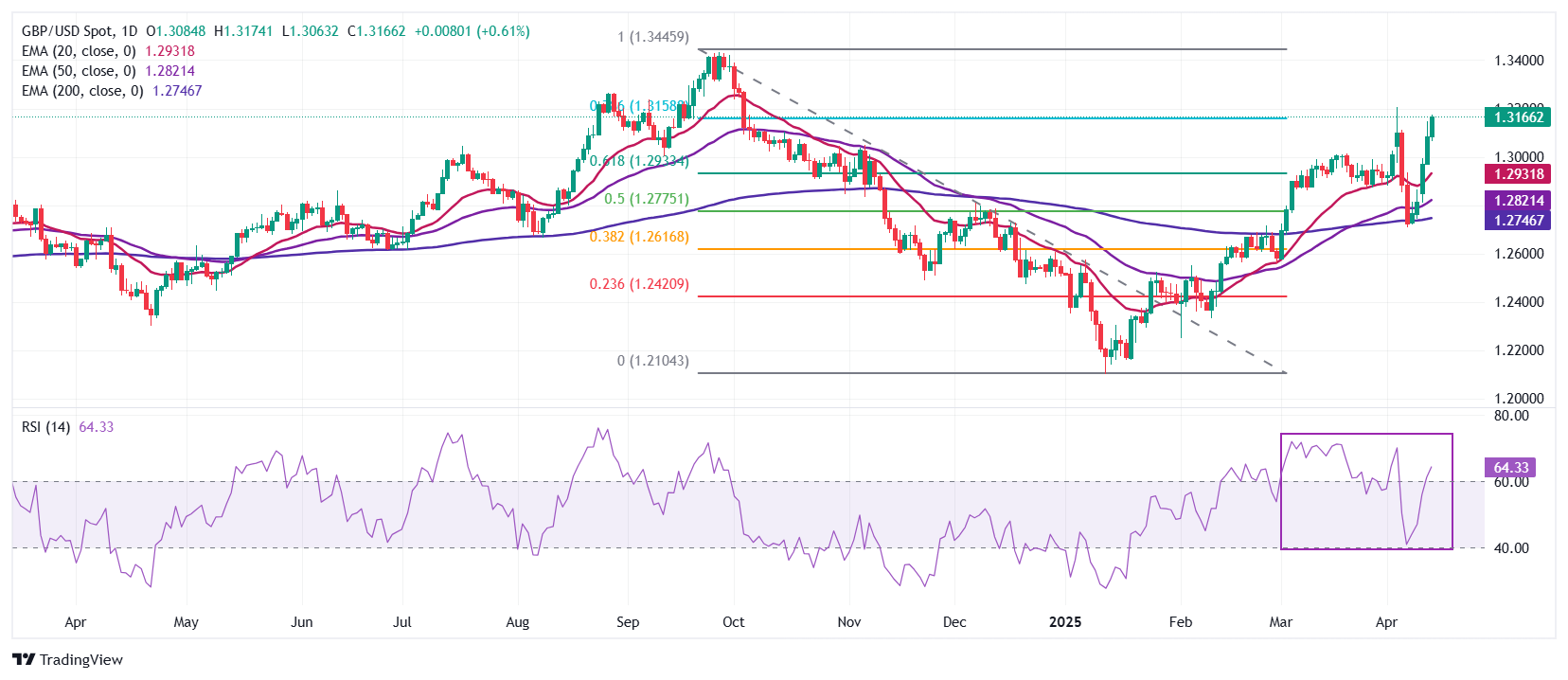
The Pound Sterling jumps to near 1.3200 against the US Dollar during European trading hours on Monday. The near-term outlook of the pair is upbeat as all short-to-long Exponential Moving Averages (EMAs) are sloping higher.
The 14-day Relative Strength Index (RSI) climbs above 60.00. A bullish momentum would emerge if the RSI holds above this level.
Looking down, the 61.8% Fibonacci retracement plotted from late September high to mid-January low, near 1.2927, will act as a key support zone for the pair. On the upside, the three-year high of 1.3430 will act as a key resistance zone.
US-China Trade War FAQs
Generally speaking, a trade war is an economic conflict between two or more countries due to extreme protectionism on one end. It implies the creation of trade barriers, such as tariffs, which result in counter-barriers, escalating import costs, and hence the cost of living.
An economic conflict between the United States (US) and China began early in 2018, when President Donald Trump set trade barriers on China, claiming unfair commercial practices and intellectual property theft from the Asian giant. China took retaliatory action, imposing tariffs on multiple US goods, such as automobiles and soybeans. Tensions escalated until the two countries signed the US-China Phase One trade deal in January 2020. The agreement required structural reforms and other changes to China’s economic and trade regime and pretended to restore stability and trust between the two nations. However, the Coronavirus pandemic took the focus out of the conflict. Yet, it is worth mentioning that President Joe Biden, who took office after Trump, kept tariffs in place and even added some additional levies.
The return of Donald Trump to the White House as the 47th US President has sparked a fresh wave of tensions between the two countries. During the 2024 election campaign, Trump pledged to impose 60% tariffs on China once he returned to office, which he did on January 20, 2025. With Trump back, the US-China trade war is meant to resume where it was left, with tit-for-tat policies affecting the global economic landscape amid disruptions in global supply chains, resulting in a reduction in spending, particularly investment, and directly feeding into the Consumer Price Index inflation.
BRANDED CONTENT
Finding a broker with low spreads can make a big difference in your trading success. Discover our top picks for low-spread brokers, each offering unique benefits to fit your strategy.
Author

Sagar Dua
FXStreet
Sagar Dua is associated with the financial markets from his college days. Along with pursuing post-graduation in Commerce in 2014, he started his markets training with chart analysis.