Pound Sterling falls back below 1.3200 on fewer-than-estimated US NFP growth
- The Pound Sterling fails to hold a weekly high of 1.3225 against the US Dollar as the Greenback bounces back strongly.
- The US Dollar rebounds sharply despite fewer-than-projected US NFP.
- Investors see the BoE cutting interest rates only once in the remainder of the year.

The Pound Sterling (GBP) falls sharply after posting a fresh weekly high above the round-level resistance of 1.3200 against the US Dollar (USD) in Friday’s North American session. The GBP/USD pair drops as the US Dollar bounces back strongly in the aftermath of the United States (US) Nonfarm Payrolls (NFP) data for August. The US Dollar Index (DXY), which tracks the Greenback’s value against six major currencies, bounces back strongly to near 101.40 after declining to near 100.60.
The NFP report showed that US employers hired 142K new workers in August, lower than estimates of 160K but higher than the 89K increase seen in July, downwardly revised from 114K. In the same period, the Unemployment Rate declined to 4.2%, as expected, from the former release of 4.3%. Slower-than-expected job growth shows clear signals that the Federal Reserve (Fed) will start reducing interest rates this month.
The Fed is widely anticipated to start reducing interest rates from the September meeting. However, traders remain split over the likely interest rate cut size. The possibility of the Fed opting for a large interest rate cut has increased this week after the publication of poor US JOLTS Job Openings data for July and ADP Employment Change and NFP data for August, which added to evidence of significant cracks in the labor market.
Meanwhile, the Average Hourly Earnings data, a key measure of wage growth that fuels consumer spending and price pressures, has increased to 3.8% from the estimates of 3.7% and the prior reading of 3.6% on a year-on-year basis. On the month, Average Hourly Earnings data rose at a faster pace of 0.4% from expectations of 0.3% and the 0.2% advance in July.
Daily digest market movers: Pound Sterling surrenders gains against US Dollar
- The Pound Sterling weakens against its other major peers on Friday. The British currency drops slightly as investors turn cautious amid the absence of United Kingdom (UK) top-tier economic data. Therefore, market sentiment and speculation for the Bank of England (BoE) interest rate path are guiding the value of the currency.
- The near-term outlook of the British currency has remained upbeat recently as investors expect that the BoE’s policy-easing cycle will be shallower than that of other central banks. For example, the European Central Bank (ECB) and the Fed are expected to cut their borrowing rates by 50 basis points (bps) and 100 bps in the remainder of the year, respectively, while the BoE is expected to reduce them by just 25 bps.
- The major reason behind firm speculation for BoE’s more gradual easing cycle is that the economy is doing better than previously expected and the fact that inflation in the services sector remains high.
- In next week’s UK calendar, investors will focus on the Employment data for the quarter ending July and the monthly Gross Domestic Product (GDP) data for July. Both indicators could be key in determining what will the BoE decide to do with interest rates when it meets later this month.
Technical Analysis: Pound Sterling declines below 1.3200
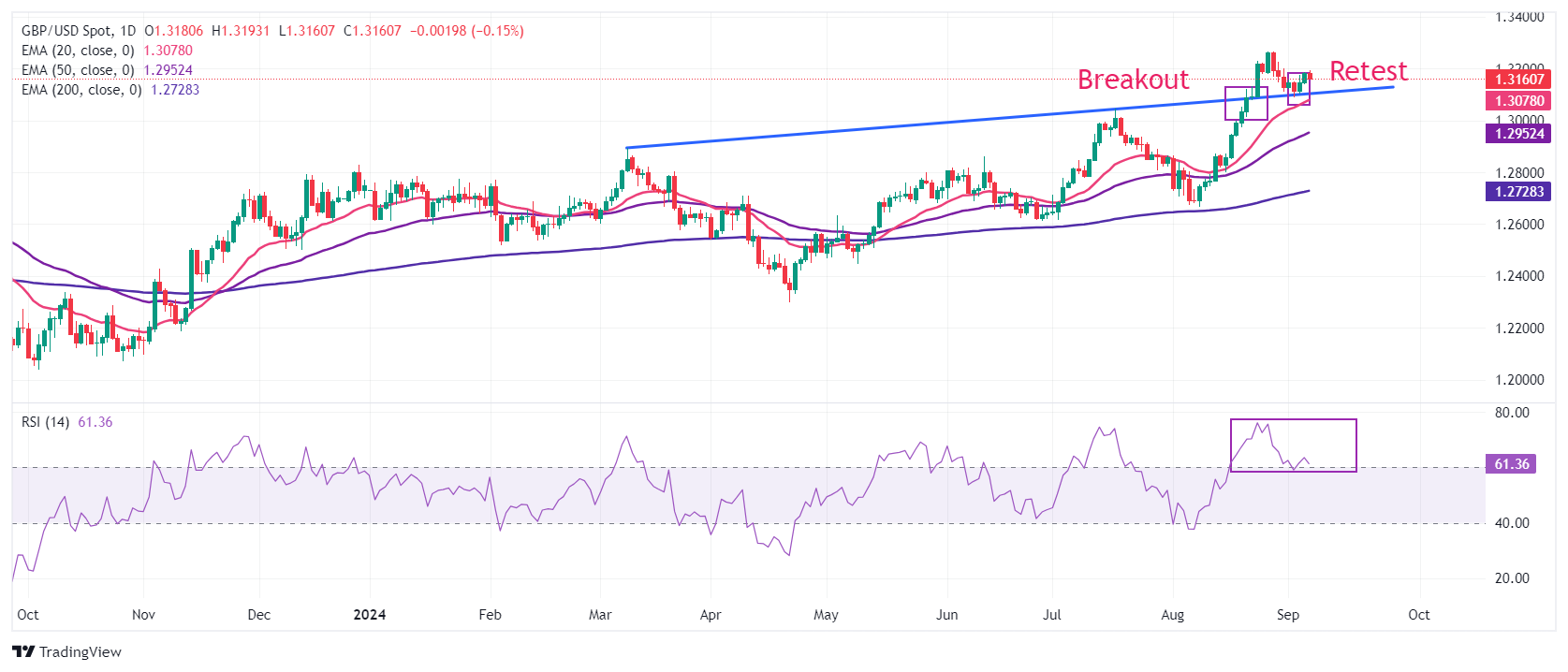
The Pound Sterling falls after failing to sustain above 1.3200 against the US Dollar. The outlook of the GBP/USD pair remains firm as it holds the breakout of an upward-sloping trendline plotted from the December 28, 2023, high of 1.2828 on the daily time frame.
Upward-sloping short-to-long-term Exponential Moving Averages (EMAs) suggest a strong bullish trend.
The 14-day Relative Strength Index (RSI) remains nearby 60.00, suggesting a resumption in the bullish momentum.
Looking up, the Cable will face resistance near the psychological level of 1.3500 and at the February 4, 2022, high of 1.3640 if it breaks above a fresh two-and-a-half-year high of 1.3266. On the downside, the psychological level of 1.3000 emerges as key support.
Author

Sagar Dua
FXStreet
Sagar Dua is associated with the financial markets from his college days. Along with pursuing post-graduation in Commerce in 2014, he started his markets training with chart analysis.