Pound Sterling plunges as UK inflation cools down, boosts BoE dovish bets
- The Pound Sterling falls sharply against its major peers after the release of soft UK CPI data for November.
- Soft UK inflation data and employment concerns pave the way for a BoE interest rate cut on Thursday.
- The US Dollar bounces back despite weakening job market conditions.

The Pound Sterling (GBP) faces intense selling pressure against its major currency peers on Wednesday and slides over 0.7% to near 1.3310 against the US Dollar (USD), following the release of the United Kingdom (UK) Consumer Price Index (CPI) data for November.
The Office for National Statistics (ONS) reports that the headline CPI inflation grew at an annualized pace of 3.2%, slower than estimates of 3.5% and the October reading of 3.6%. This is the second straight month in which headline inflation has grown at a slower pace after remaining stable at 3.8% in the July-September period, bolstering hopes that price pressures are on track to return to the desired rate of 2%.
In the same period, the core CPI – which excludes volatile components of food, energy, alcohol, and tobacco – rose at a moderate pace of 3.2%, compared to expectations and the previous release of 3.4%.
Month-on-month headline inflation deflated by 0.2%, while it was expected to remain flat after rising 0.4% in October. Inflation in the services sector, which is closely tracked by Bank of England (BoE) officials, decelerated to 4.4% from the prior reading of 4.5%.
This week, the UK’s employment data for the three months ending in October came in weaker than projected. In the period, the ILO Unemployment Rate rose to 5.1%, the highest reading in almost five years.
The overall data showing cooling inflationary pressures and rising labor market concerns strengthen hopes of an interest rate cut by the BoE at its monetary policy meeting on Thursday.
Pound Sterling Price Today
The table below shows the percentage change of British Pound (GBP) against listed major currencies today. British Pound was the weakest against the US Dollar.
| USD | EUR | GBP | JPY | CAD | AUD | NZD | CHF | |
|---|---|---|---|---|---|---|---|---|
| USD | 0.26% | 0.72% | 0.47% | 0.12% | 0.20% | 0.18% | 0.38% | |
| EUR | -0.26% | 0.46% | 0.18% | -0.13% | -0.06% | -0.08% | 0.12% | |
| GBP | -0.72% | -0.46% | -0.25% | -0.59% | -0.52% | -0.53% | -0.34% | |
| JPY | -0.47% | -0.18% | 0.25% | -0.33% | -0.26% | -0.29% | -0.08% | |
| CAD | -0.12% | 0.13% | 0.59% | 0.33% | 0.08% | 0.05% | 0.25% | |
| AUD | -0.20% | 0.06% | 0.52% | 0.26% | -0.08% | -0.02% | 0.18% | |
| NZD | -0.18% | 0.08% | 0.53% | 0.29% | -0.05% | 0.02% | 0.20% | |
| CHF | -0.38% | -0.12% | 0.34% | 0.08% | -0.25% | -0.18% | -0.20% |
The heat map shows percentage changes of major currencies against each other. The base currency is picked from the left column, while the quote currency is picked from the top row. For example, if you pick the British Pound from the left column and move along the horizontal line to the US Dollar, the percentage change displayed in the box will represent GBP (base)/USD (quote).
Daily digest market movers: Investors shift focus to the US CPI data
- The Pound Sterling corrects sharply to near 1.3320 against the US Dollar (USD) during Wednesday’s European session after revisiting the two-month high above 1.3450 the previous day. The GBP/USD pair has come under pressure due to a higher-than-projected slowdown in the UK inflation data and a decent recovery move in the US Dollar.
- At the time of writing, the US Dollar Index (DXY), which tracks the Greenback’s value against six major currencies, trades 0.4% higher to near 98.60. The DXY recovered sharply on Tuesday after posting a fresh 10-week low near 98.00, following the release of the United States (US) Nonfarm Payrolls (NFP) combined report for October and November.
- The US Dollar attracted significant bids even as the US NFP report showed that the Unemployment Rate rose to 4.6% in November, the highest figure seen since September 2021. The report also showed that the economy added 64K fresh workers in November after shedding 105K jobs in October.
- Theoretically, rising US labor market concerns lead to a surge in market expectations for interest rate cuts by the Federal Reserve (Fed). However, there has not been a notable change in the Fed’s dovish expectations, as market experts believe that the overall data was distorted by the historically longest US government shutdown in that period.
- Currently, the CME FedWatch tool shows that the Fed will hold interest rates steady in the 3.50%-3.75% range in its monetary policy meeting in January.
- Going forward, investors will focus on the US Consumer Price Index (CPI) data for November, which will be released on Thursday. The inflation data will significantly influence market expectations for the Fed’s monetary policy outlook, as officials have expressed that further interest rate cuts could prompt price pressures, which have remained well above the 2% target for a long period.
- "Moving monetary policy near or into accommodative territory, which further Federal Funds Rate cuts will do, risks exacerbating already elevated inflation and untethering the inflation expectations of businesses and consumers," Atlanta Fed Bank President Raphael Bostic wrote in an essay published by the Atlanta Fed, adding that "That is not a risk I would choose to take right now," Reuters reported.
Technical Analysis: GBP/USD falls from 1.3400
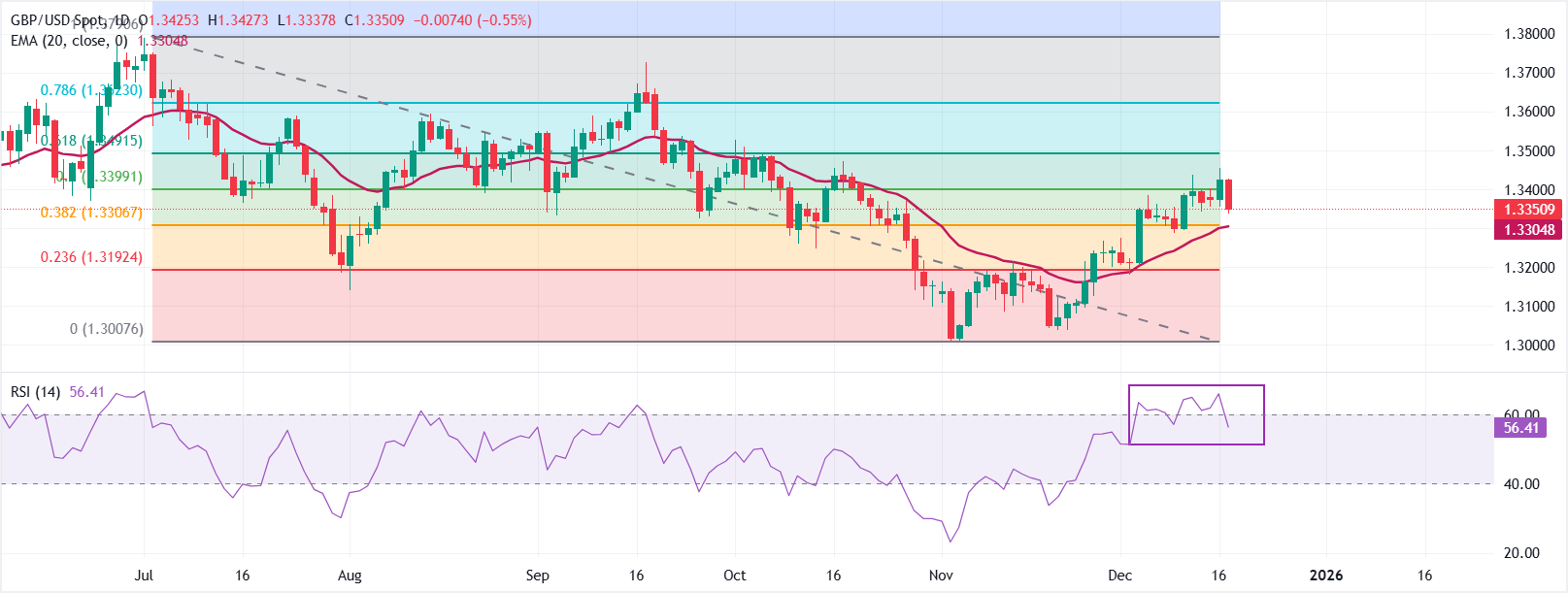
GBP/USD declines to near 1.3340 on Wednesday. Still, the short-term bias of the pair remains upward as the price holds above an ascending 20-day Exponential Moving Average (EMA) at 1.3305.
The 14-day Relative Strength Index (RSI) falls to 56 after failing to reach overbought conditions, suggesting signs of a bearish reversal.
Measured from the 1.3791 high to the 1.3008 low, the 50% Fibonacci retracement at 1.3399 acts as immediate resistance. A daily closing below the 38.2% retracement at 1.3307 could weaken the overall tone and pave the way for further downside towards the 23.6% Fibonacci retracement around 1.3200.
Looking up, a sustained closing above Tuesday's high at 1.3456 would open the door towards the psychological level of 1.3500.
(The technical analysis of this story was written with the help of an AI tool.)
Author

Sagar Dua
FXStreet
Sagar Dua is associated with the financial markets from his college days. Along with pursuing post-graduation in Commerce in 2014, he started his markets training with chart analysis.