Pound Sterling declines amid growing concerns over UK labor market
- The Pound Sterling trades lower against its risky peers as the UK labor market cools.
- UK employers have adjusted their HR policies following an increase in contribution to social security schemes.
- Fed's Governor Waller reiterates support for an interest rate cut in the policy meeting later this month.

The Pound Sterling (GBP) trades lower against its peers, except safe-haven currencies, on Friday due to growing concerns about the United Kingdom (UK) labor market.
The Office for National Statistics (ONS) reported on Thursday that the ILO Unemployment Rate accelerated to 4.7% in the three months ending May, the highest level seen since the quarter ending July 2021. The jobless rate has risen since April, when the increase in employers’ contributions to social security schemes announced by Chancellor of the Exchequer Rachel Reeves in the Autumn Statement came into effect.
Meanwhile, a less-than-expected drop in payrolls in the three months ending May suggests that labor market conditions are not as weak as they appeared. According to the employment report, the number of workers laid off was revised lower to 25K from prior estimates of 109K.
Average Earnings, a key measure of wage growth, grew almost in line with estimates. Rising jobless rate and easing wage growth suggest that employers are adjusting their labor policies to offset the impact of the increase in their social security cost.
Cooling labor market conditions should allow Bank of England (BoE) officials to argue in favor of reducing interest rates. However, this could be difficult at a time when inflationary pressures have accelerated significantly. The UK Consumer Price Index (CPI) report for June showed on Wednesday that price pressures grew at a faster-than-projected pace.
British Pound PRICE Today
The table below shows the percentage change of British Pound (GBP) against listed major currencies today. British Pound was the strongest against the Japanese Yen.
| USD | EUR | GBP | JPY | CAD | AUD | NZD | CHF | |
|---|---|---|---|---|---|---|---|---|
| USD | -0.31% | -0.17% | 0.07% | -0.19% | -0.47% | -0.49% | -0.29% | |
| EUR | 0.31% | 0.16% | 0.40% | 0.12% | -0.15% | -0.29% | 0.02% | |
| GBP | 0.17% | -0.16% | 0.22% | -0.02% | -0.29% | -0.40% | -0.11% | |
| JPY | -0.07% | -0.40% | -0.22% | -0.26% | -0.55% | -0.67% | -0.26% | |
| CAD | 0.19% | -0.12% | 0.02% | 0.26% | -0.30% | -0.38% | -0.10% | |
| AUD | 0.47% | 0.15% | 0.29% | 0.55% | 0.30% | -0.10% | 0.19% | |
| NZD | 0.49% | 0.29% | 0.40% | 0.67% | 0.38% | 0.10% | 0.29% | |
| CHF | 0.29% | -0.02% | 0.11% | 0.26% | 0.10% | -0.19% | -0.29% |
The heat map shows percentage changes of major currencies against each other. The base currency is picked from the left column, while the quote currency is picked from the top row. For example, if you pick the British Pound from the left column and move along the horizontal line to the US Dollar, the percentage change displayed in the box will represent GBP (base)/USD (quote).
Daily digest market movers: Pound Sterling finds a temporary cushion against US Dollar
- The Pound Sterling moves higher to near 1.3440 against the US Dollar (USD) during the European trading session on Friday. The Cable gains as the US Dollar retraces after rallying in last two weeks. The US Dollar Index (DXY), which tracks the Greenback’s value against six major currencies, ticks down to near 98.35, but is still close to an over three-week high slightly below 99.00.
- However, the outlook of GBP/USD pair, which is set to close in the red for a third consecutive week, remains bearish on expecations that the US Dollar could resume its upside journey. The demand for the Greenback is expected to remain buoyant as traders have pared Federal Reserve (Fed) dovish bets after the latest CPI data showed that tariffs are starting to show up in consumer prices.
- According to the CME FedWatch tool, the probability that the Fed will cut interest rates in the September meeting has fallen to 58% from the 70.4% seen a week ago. For July, the tool shows that the Fed is almost certain to leave interest rates steady in the range of 4.25%-4.50%.
- Market experts believe that inflation has started accelerating due to sectoral levies announced by US President Trump and that the effect could be even larger from August 1, when higher tariffs on several nations will become effective.
- The US CPI report for June also showed earlier this week that prices of goods that are largely imported have increased sharply. On Wednesday, New York Fed Bank President John Williams warned that tariffs could boost inflation by “one percentage point rest of 2025 into 2026”.
- Contrary to market expectations, Fed Governor Christopher Waller continued to argue in favor of reducing interest rates in the policy meeting later this month, citing concerns over the economy and job market, while assuring that the tariff impact will be limited and will fade next year. “The Fed should cut interest rates 25 basis points at the July meeting as rising risks to the economy and employment favour easing policy rate,” Waller said on Thursday.
Technical Analysis: Pound Sterling stays below 20-day and 50-day EMAs
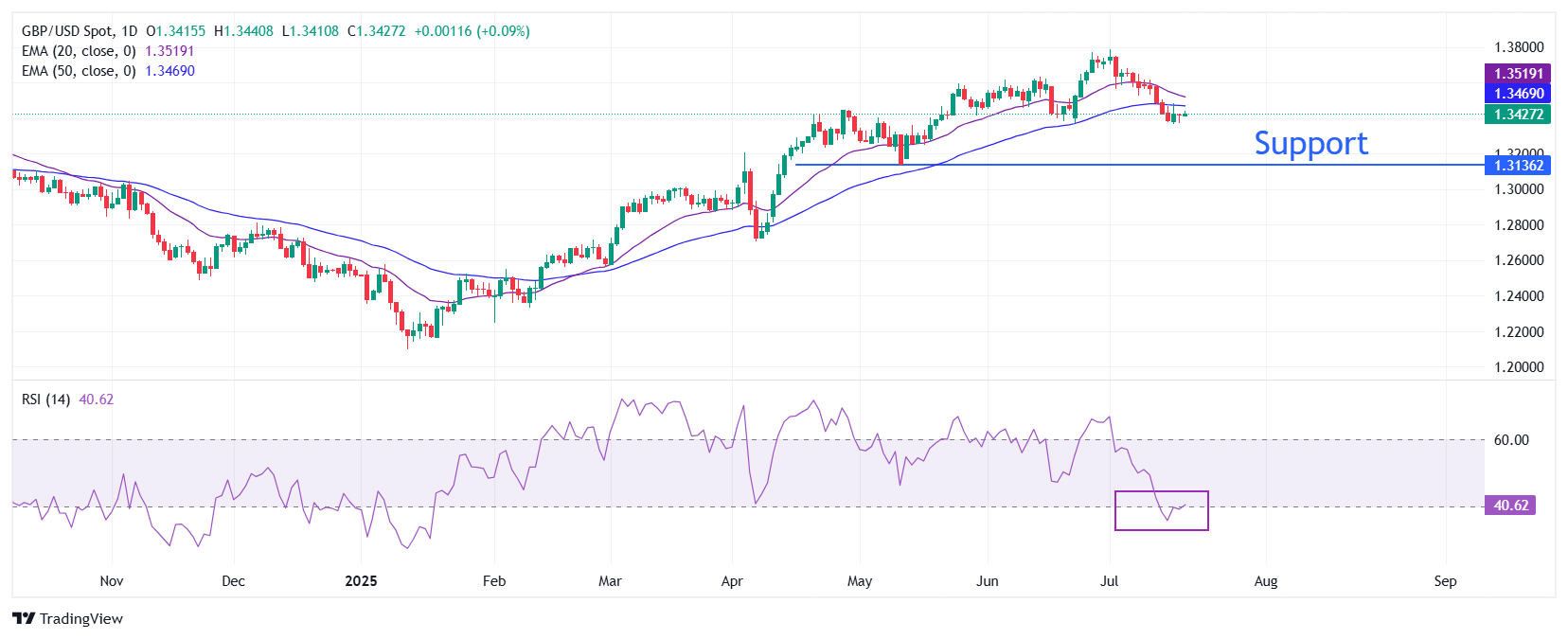
The Pound Sterling wobbles near the two-month low around 1.3370 against the US Dollar on Friday. The near-term trend of the GBP/USD pair is bearish as it trades below the 20-day and 50-day Exponential Moving Averages (EMAs), which trade around 1.3540 and 1.3470, respectively.
The 14-day Relative Strength Index (RSI) oscillates around 40.00, indicating a strong bearish momentum.
Looking down, the May 12 low of 1.3140 will act as a key support zone. On the upside, the July 11 high around 1.3585 will act as a key barrier.
Employment FAQs
Labor market conditions are a key element to assess the health of an economy and thus a key driver for currency valuation. High employment, or low unemployment, has positive implications for consumer spending and thus economic growth, boosting the value of the local currency. Moreover, a very tight labor market – a situation in which there is a shortage of workers to fill open positions – can also have implications on inflation levels and thus monetary policy as low labor supply and high demand leads to higher wages.
The pace at which salaries are growing in an economy is key for policymakers. High wage growth means that households have more money to spend, usually leading to price increases in consumer goods. In contrast to more volatile sources of inflation such as energy prices, wage growth is seen as a key component of underlying and persisting inflation as salary increases are unlikely to be undone. Central banks around the world pay close attention to wage growth data when deciding on monetary policy.
The weight that each central bank assigns to labor market conditions depends on its objectives. Some central banks explicitly have mandates related to the labor market beyond controlling inflation levels. The US Federal Reserve (Fed), for example, has the dual mandate of promoting maximum employment and stable prices. Meanwhile, the European Central Bank’s (ECB) sole mandate is to keep inflation under control. Still, and despite whatever mandates they have, labor market conditions are an important factor for policymakers given its significance as a gauge of the health of the economy and their direct relationship to inflation.
Author

Sagar Dua
FXStreet
Sagar Dua is associated with the financial markets from his college days. Along with pursuing post-graduation in Commerce in 2014, he started his markets training with chart analysis.

















