Pound Sterling outperforms US Dollar amid firm Fed dovish bets for 2026
- The Pound Sterling extends its upside to near 1.3535 against the US Dollar, the highest level seen in three months.
- Preliminary US GDP annualized expanded at a strong pace of 4.3% in the third quarter this year.
- Investors expect the BoE to deliver at least one interest rate cut by the first half of 2026.

The Pound Sterling (GBP) revisits the three-month high around 1.3535 against the US Dollar (USD) during the European trading session on Wednesday. The GBP/USD pair trades firmly as the Greenback underperforms, with unexpectedly stronger flash United States (US) Q3 Gross Domestic Product (GDP) data failing to diminish Federal Reserve (Fed) dovish expectations.
During the press time, the US Dollar Index (DXY), which tracks the Greenback’s value against six major currencies, posts a fresh 11-week low near 97.75.
The US Bureau of Economic Analysis (BEA) reported on Tuesday that the economy grew by 4.3% compared to the same quarter of the previous year, faster than 3.8% in the second quarter this year.
Meanwhile, the CME FedWatch tool shows that traders see a 70.6% that the Fed will reduce interest rates by at least 50 bps in 2026. The expected scope of interest rate cuts is higher than the single cut projected for next year by officials in the monetary policy announcement last week.
Federal Reserve (Fed) dovish expectations for 2026 remain upbeat as the US GDP report released on Tuesday lacks evidence of strong job creation despite robust growth. The report showed that businesses invested heavily in equipment and Artificial Intelligence (AI).
Economists have stated that the strong GDP growth appears to be more of a K-shaped recovery, with household spending remaining heavy in recreational activities. The demand by low and middle-income households remains weak due to high inflation and a sluggish job market.
US Dollar Price Today
The table below shows the percentage change of US Dollar (USD) against listed major currencies today. US Dollar was the weakest against the Japanese Yen.
| USD | EUR | GBP | JPY | CAD | AUD | NZD | CHF | |
|---|---|---|---|---|---|---|---|---|
| USD | -0.09% | -0.15% | -0.30% | -0.13% | -0.20% | -0.13% | -0.22% | |
| EUR | 0.09% | -0.06% | -0.22% | -0.04% | -0.11% | -0.04% | -0.14% | |
| GBP | 0.15% | 0.06% | -0.15% | 0.02% | -0.04% | 0.02% | -0.07% | |
| JPY | 0.30% | 0.22% | 0.15% | 0.20% | 0.11% | 0.17% | 0.09% | |
| CAD | 0.13% | 0.04% | -0.02% | -0.20% | -0.09% | -0.03% | -0.10% | |
| AUD | 0.20% | 0.11% | 0.04% | -0.11% | 0.09% | 0.06% | -0.07% | |
| NZD | 0.13% | 0.04% | -0.02% | -0.17% | 0.03% | -0.06% | -0.09% | |
| CHF | 0.22% | 0.14% | 0.07% | -0.09% | 0.10% | 0.07% | 0.09% |
The heat map shows percentage changes of major currencies against each other. The base currency is picked from the left column, while the quote currency is picked from the top row. For example, if you pick the US Dollar from the left column and move along the horizontal line to the Japanese Yen, the percentage change displayed in the box will represent USD (base)/JPY (quote).
Pound Sterling trades higher ahead of US Initial Jobless Claims data
- The Pound Sterling trades broadly higher against its major currency peers ahead of Christmas Eve on Wednesday. The British currency has remained firm since the monetary policy announcement by the Bank of England (BoE) last Thursday, as it maintained the gradual monetary easing stance.
- At the meeting, the BoE reduced interest rates by 25 bps to 3.75% with a tight 5:4 vote, and guided that monetary policy will remain on a gradual downward path. The BoE refrained from supporting aggressive easing as inflation is still well higher than the 2% target despite cooling down in the last two months.
- The United Kingdom (UK) headline inflation has decelerated to 3.2% YoY in November after peaking at 3.8% in the July-September period.
- The BoE kept the door open for further interest rate cuts as UK labor market conditions have remained weak.
- Meanwhile, investors seek fresh cues about how much the BoE will cut interest rates in 2026. According to a report from Reuters, traders expect the central bank to deliver at least one 25-bps interest rate cut in the first half of next year.
- In Wednesday’s session, the GBP/USD pair will be influenced by the US Initial Jobless Claims data, which will be published at 13:30 GMT.
Technical Analysis: GBP/USD aims to stabilize above 61.8% Fibonacci retracement level at 1.3496
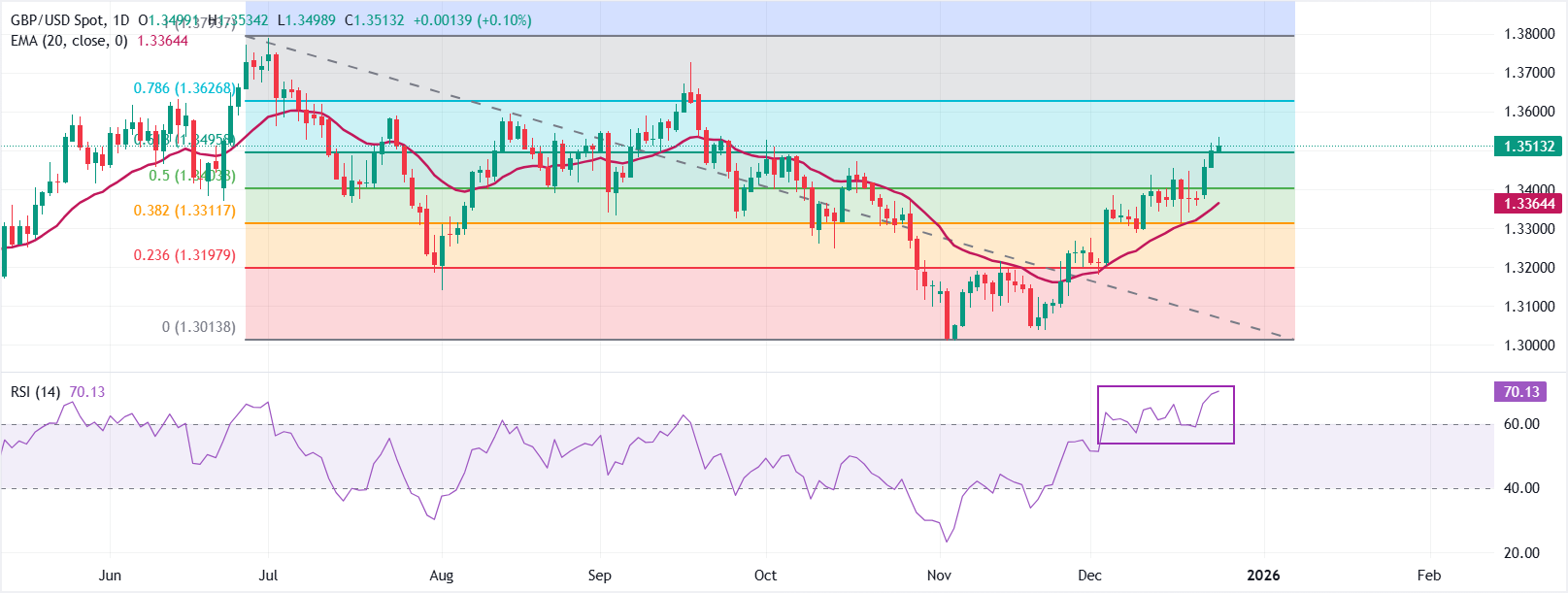
On the daily chart, GBP/USD trades at 1.3513. The pair holds above the rising 20-day EMA at 1.3364, keeping the short-term bias pointing higher.
The 14-day Relative Strength Index (RSI) at 70.12 is overbought and warns of stretched momentum. Measured from the 1.3794 high to the 1.3014 low, the 61.8% Fibonacci retracement level at 1.3496 has been reclaimed, while the 78.6% retracement at 1.3627 is the next resistance.
Trend support remains defined by the ascending 20-day EMA, with dips expected to test that area. The previously mentioned RSI would need to cool to ease upside pressure and allow consolidation. A close below the 50% Fibonacci retracement level at 1.3404 would dent the bullish tone and expose the 38.2% retracement at 1.3312. If the latter is breached, it would open the room to a further extension of the recovery.
(The technical analysis of this story was written with the help of an AI tool.)
Economic Indicator
BoE Interest Rate Decision
The Bank of England (BoE) announces its interest rate decision at the end of its eight scheduled meetings per year. If the BoE is hawkish about the inflationary outlook of the economy and raises interest rates it is usually bullish for the Pound Sterling (GBP). Likewise, if the BoE adopts a dovish view on the UK economy and keeps interest rates unchanged, or cuts them, it is seen as bearish for GBP.
Read more.Last release: Thu Dec 18, 2025 12:00
Frequency: Irregular
Actual: 3.75%
Consensus: 3.75%
Previous: 4%
Source: Bank of England
Author

Sagar Dua
FXStreet
Sagar Dua is associated with the financial markets from his college days. Along with pursuing post-graduation in Commerce in 2014, he started his markets training with chart analysis.

















