Pound Sterling gives back majority gains against US Dollar on upbeat US NFP
- The Pound Sterling surrenders its intraday gains against the US Dollar after the release of the US NFP data for April.
- Hopes of a de-escalation in the trade war between the US and China have improved investors’ risk appetite.
- The Fed is expected to keep interest rates steady, while the BoE is almost certain to cut them next week.

The Pound Sterling (GBP) is off from the day's high of 1.3320 against the US Dollar (USD) in Friday's North American session. The GBP/USD pair pares some of its intraday gains as the US Dollar bounces back after the release of the upbeat United States (US) Nonfarm Payrolls (NFP) data for April. The US Dollar Index (DXY), which tracks the Greenback’s value against six major currencies, rebounds from the intraday low of 99.60.
The US NFP data showed that the employers hired 177K fresh workers, beating estimates of 130K but remaining short of the March reading of 185K, revised lower from 228K. The Unemployment Rate remained steady at 4.2%, as expected. Average Hourly Earnings, a key measure of wage growth, grew steadily by 3.8% on year, slower than expectations of 3.9%. On a monthly basis, the wage growth measure rose at a slower pace of 0.2% against estimates and the prior release of 0.3%.
The Federal Reserve (Fed) is unlikely to make monetary policy adjustments as the US labor market has shown steady hiring despite the fallout of the tariff policy by US President Donald Trump, and will mainly focus on curbing elevated consumer inflation expectations.
The ISM Manufacturing Prices Paid index showed on Thursday that input costs continued to grow at a faster pace. Business owners will eventually pass on higher costs to consumers, which will feed into inflation and limit the scope of monetary policy easing by the Fed. On the contrary, signs of slowing job growth would force the Fed to prioritize employment over inflation.
Going forward, the next trigger for the US Dollar will be the Fed’s monetary policy decision, which will be announced on May 7. According to the CME FedWatch tool, traders are almost fully pricing in that the central bank will keep interest rates unchanged in the range of 4.25%-4.50%.
Daily digest market movers: Pound Sterling struggles against its peers
- The Pound Sterling underperforms its peers in Friday’s North American session. The British currency trades lower on firm expectations that the Bank of England (BoE) will reduce interest rates by 25 basis points (bps) to 4.25% in its policy meeting on Thursday.
- The reasons behind firm BoE dovish bets are global economic uncertainty in the face of tariffs announced by US President Donald Trump, a weak labor market outlook due to the increase in employers’ contribution to social security schemes, and softer-than-expected United Kingdom (UK) inflation data for March.
- Meanwhile, the market sentiment has turned favorable for risky assets after comments from the Chinese Commerce Ministry increased hopes of a de-escalation in the trade war between the US and China.
- On Thursday, the Chinese ministry signaled that the country is ready to discuss trade terms with Washington but emphasized that talks should be based on “sincerity”. “China says the door is open to trade talks with the US and urged the US to demonstrate sincerity if it wants trade talks,” Bloomberg reported.
- Investors have taken these comments from Beijing as a constructive step towards resolving trade disputes between the world’s two largest nations. The optimism on Sino-US trade resolution has resulted in an increase in demand for risk-perceived currencies.
- Market participants believe that Beijing won’t need to sell its products into other markets if the US continues to buy them. Investors were worried about fears that China would dump its products into European and Asian economies if its tariff war with the US continues. Given China’s low-cost competitive advantage, the competitiveness of products from other nations would have diminished in the global market. Such a scenario would have been unfavorable for their economic growth.
British Pound PRICE Today
The table below shows the percentage change of British Pound (GBP) against listed major currencies today. British Pound was the strongest against the US Dollar.
| USD | EUR | GBP | JPY | CAD | AUD | NZD | CHF | |
|---|---|---|---|---|---|---|---|---|
| USD | -0.27% | -0.12% | -0.55% | -0.25% | -0.99% | -0.79% | -0.26% | |
| EUR | 0.27% | 0.16% | -0.26% | 0.03% | -0.70% | -0.50% | 0.02% | |
| GBP | 0.12% | -0.16% | -0.42% | -0.13% | -0.86% | -0.65% | -0.14% | |
| JPY | 0.55% | 0.26% | 0.42% | 0.29% | -0.43% | -0.24% | 0.31% | |
| CAD | 0.25% | -0.03% | 0.13% | -0.29% | -0.75% | -0.52% | -0.02% | |
| AUD | 0.99% | 0.70% | 0.86% | 0.43% | 0.75% | 0.21% | 0.74% | |
| NZD | 0.79% | 0.50% | 0.65% | 0.24% | 0.52% | -0.21% | 0.52% | |
| CHF | 0.26% | -0.02% | 0.14% | -0.31% | 0.02% | -0.74% | -0.52% |
The heat map shows percentage changes of major currencies against each other. The base currency is picked from the left column, while the quote currency is picked from the top row. For example, if you pick the British Pound from the left column and move along the horizontal line to the US Dollar, the percentage change displayed in the box will represent GBP (base)/USD (quote).
Technical Analysis: Pound Sterling strives to hold 20-day EMA
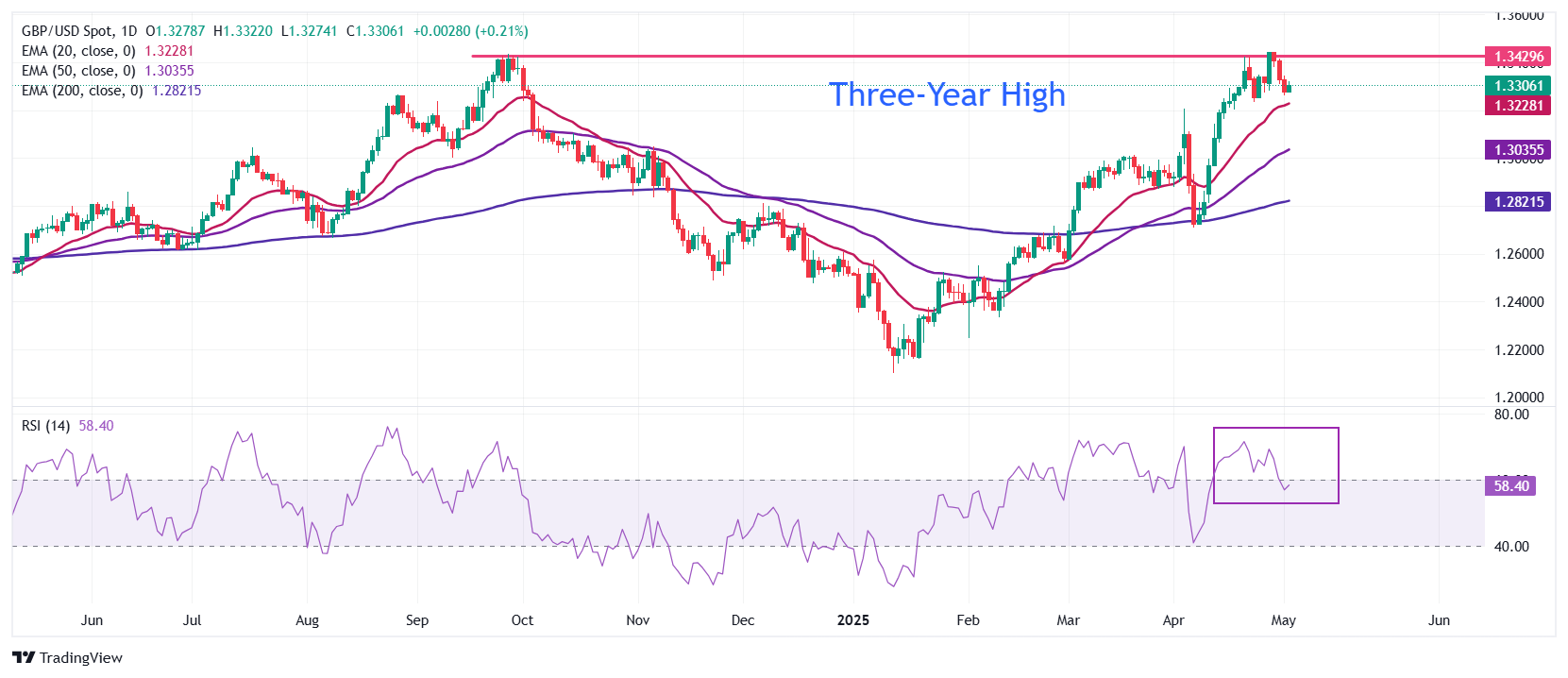
The Pound Sterling recovers from the weekly low of 1.3260 against the US Dollar on Friday. The pair corrected in the last three trading days from the three-year high of 1.3445. The overall outlook of the pair remains bullish as all short-to-long Exponential Moving Averages (EMAs) are sloping higher.
The 14-day Relative Strength Index (RSI) strives to return above 60.00. A fresh bullish momentum would trigger if the RSI manages to do so.
On the upside, the three-year high of 1.3445 will be a key hurdle for the pair. Looking down, the April 3 high around 1.3200 will act as a major support area.
Author

Sagar Dua
FXStreet
Sagar Dua is associated with the financial markets from his college days. Along with pursuing post-graduation in Commerce in 2014, he started his markets training with chart analysis.