US Dollar gives up weekly gains and turns flat after Nonfarm Payrolls release
- The US Dollar trades lower despite as rate cut hopes are being dialed back.
- China said to consider starting tariff negotiations with the Trump administration.
- The US Dollar Index capped below 100.00 ahead of key US data.
The US Dollar Index (DXY), which tracks the performance of the US Dollar (USD) against six major currencies, remains capped and falls to 99.50 at the time of writing on Friday after a false break and firm rejection 100-marker. The Greenback is softening a touch on the back of headlines that China is considering to start tariff negotiations with the Trump administration. As markets navigate news of trade negotiations, they are still eagerly awaiting the real first official trade deal.
Regarding the Ukraine-Russia war, the mineral deal between the US and Ukraine was signed, a much smaller one in terms of capital potential for the United States and not military guarantees for Ukraine whatsoever, Bloomberg reported.
On the economic calendar front, the Nonfarm Payrolls (NFP) release for April came in at 177,000, not far above the highest estimate of 171,000. Some initial US Dollar strength materialized on the back of the release, but nothing substantial for now. Markets are reading this number as the very last upbeat reading with the next Nonfarm Payrolls reading in June as a possible bearish one. .
Daily digest market movers: Not what was hoped for
- Japanese Finance Minister Katsunobu Kato said this Friday that the Japanese holdings of US debt are a tool for negotiating with the Trump administration, explicitly raising for the first time its leverage as a massive creditor to the United States in its negotiations, Reuters reported.
- In a Friday statement, China’s Commerce Ministry said that it had noted senior US officials repeatedly expressing their willingness to talk to Beijing about tariffs, and urged officials in Washington to show “sincerity” toward China. The ministry added “the US has recently sent messages to China through relevant parties, hoping to start talks with China,” and “China is currently evaluating this”, Bloomberg reports.
- The Nonfarm Payrolls report has been published:
- The Payrolls was an upbeat 177,000, beating the 130,000 consensus. The previous 228,000 reading got revised down to 185,000.
- The Unemployment rate remained stable at 4.2%.
- Monthly Average Hour Earnings fell to 0.2% against 0.3% previously.
- Equities are popping higher on the number with US futures shooting higher and European equities surging over 2% on the day.
- The CME FedWatch tool shows the chance of an interest rate cut by the Federal Reserve in May's meeting stands at 7.6% against a 92.4% probability of no change. The June meeting sees a 65.1% chance of a rate cut. Should Nonfarm Payrolls be a big beat on the estimated number, expect rate cut expectations to be unwound, while a miss might see rate cut expectations for June and even May soar.
- The US 10-year yields trade around 4.27%, erasing past weeks’ softening as traders reduce potential rate cut bets from the Federal Reserve.
US Dollar Index Technical Analysis: Back to square one in final hours
The US Dollar Index (DXY) is at a key technical level this Friday, brought there after a three-day winning streak. The Nonfarm Payrolls release could be the key here for this Friday, with a continuation from the past three days and a firm break above the 100-handle. Still, and even in that favorable scenario, a technical rejection could push back the DXY to new three-year lows.
On the upside, the DXY’s first resistance comes in at 100.22, which supported the DXY back in September 2024, with a break back above the 100.00 round level as a bullish signal. A firm recovery would be a return to 101.90, which acted as a pivotal level throughout December 2023 and again as a base for the inverted head-and-shoulders (H&S) formation during the summer of 2024.
On the other hand, the 97.73 support could quickly be tested on any substantial bearish headline. Further below, a relatively thin technical support comes in at 96.94 before looking at the lower levels of this new price range. These would be at 95.25 and 94.56, meaning fresh lows not seen since 2022.
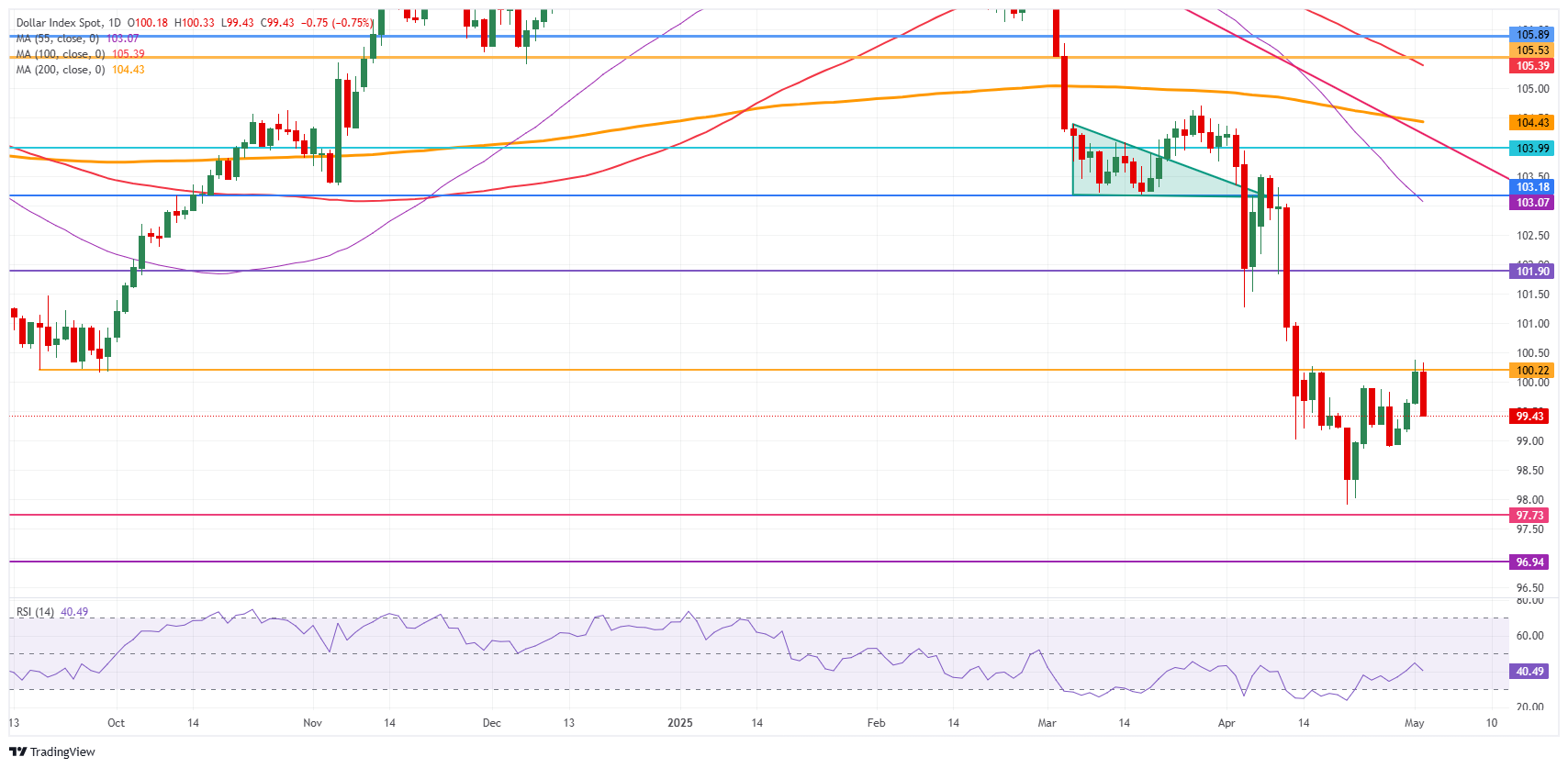
US Dollar Index: Daily Chart
Central banks FAQs
Central Banks have a key mandate which is making sure that there is price stability in a country or region. Economies are constantly facing inflation or deflation when prices for certain goods and services are fluctuating. Constant rising prices for the same goods means inflation, constant lowered prices for the same goods means deflation. It is the task of the central bank to keep the demand in line by tweaking its policy rate. For the biggest central banks like the US Federal Reserve (Fed), the European Central Bank (ECB) or the Bank of England (BoE), the mandate is to keep inflation close to 2%.
A central bank has one important tool at its disposal to get inflation higher or lower, and that is by tweaking its benchmark policy rate, commonly known as interest rate. On pre-communicated moments, the central bank will issue a statement with its policy rate and provide additional reasoning on why it is either remaining or changing (cutting or hiking) it. Local banks will adjust their savings and lending rates accordingly, which in turn will make it either harder or easier for people to earn on their savings or for companies to take out loans and make investments in their businesses. When the central bank hikes interest rates substantially, this is called monetary tightening. When it is cutting its benchmark rate, it is called monetary easing.
A central bank is often politically independent. Members of the central bank policy board are passing through a series of panels and hearings before being appointed to a policy board seat. Each member in that board often has a certain conviction on how the central bank should control inflation and the subsequent monetary policy. Members that want a very loose monetary policy, with low rates and cheap lending, to boost the economy substantially while being content to see inflation slightly above 2%, are called ‘doves’. Members that rather want to see higher rates to reward savings and want to keep a lit on inflation at all time are called ‘hawks’ and will not rest until inflation is at or just below 2%.
Normally, there is a chairman or president who leads each meeting, needs to create a consensus between the hawks or doves and has his or her final say when it would come down to a vote split to avoid a 50-50 tie on whether the current policy should be adjusted. The chairman will deliver speeches which often can be followed live, where the current monetary stance and outlook is being communicated. A central bank will try to push forward its monetary policy without triggering violent swings in rates, equities, or its currency. All members of the central bank will channel their stance toward the markets in advance of a policy meeting event. A few days before a policy meeting takes place until the new policy has been communicated, members are forbidden to talk publicly. This is called the blackout period.
Author

Filip Lagaart
FXStreet
Filip Lagaart is a former sales/trader with over 15 years of financial markets expertise under its belt.