|

Pound Sterling Price News and Forecast: GBP/USD trades higher due to downbeat US economic data

GBP/USD looks to approach 1.2750, focus on US PCE

GBP/USD treads waters to continue the winning streak for the fourth consecutive day, trading higher around 1.2720 during the Asian session on Thursday. The pair is experiencing upward pressure due to the disappointing United States (US) macroeconomic data released on Wednesday.

After the recent release of the soft Job Openings report from the previous Tuesday, the August ADP National Employment Report showed weaker hiring than the projected 195K, contributing 177K jobs to the economy. This contrasts with the 371K jobs added in July. Preliminary Gross Domestic Product (GDP) reported at 2.1%, below the previous reading of 2.4%. The index was expected to remain consistent. Read more...

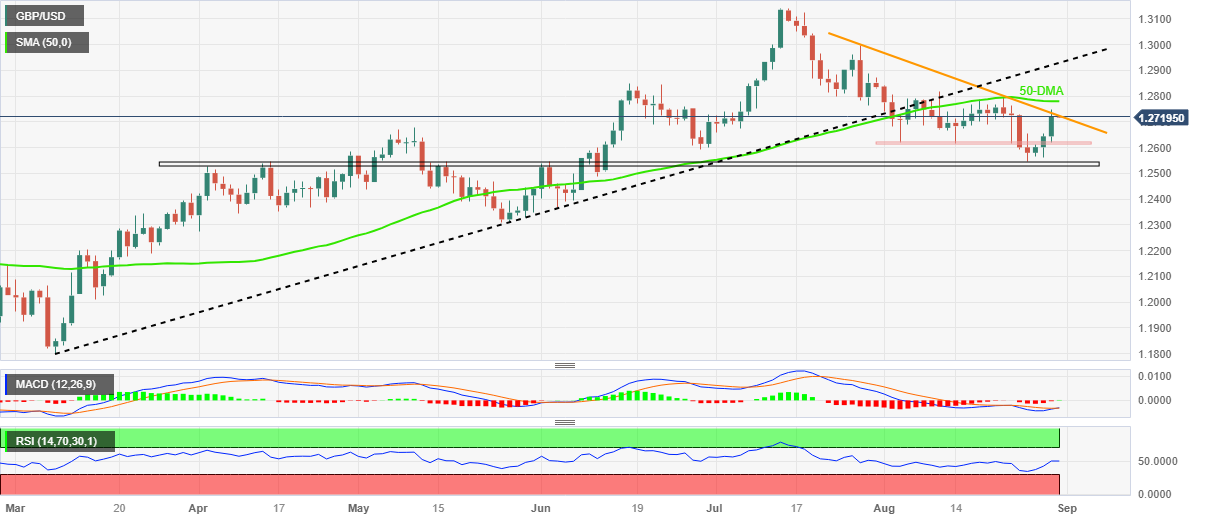
GBP/USD Price Analysis: Cable buyers prod key resistance near 1.2720, Fed inflation eyed

GBP/USD buyers attack a downward-sloping resistance line from late July as they await the key US inflation gauge while pausing the three-day uptrend amid early Thursday morning in Asia. In doing so, the Cable pair seesaws around the 1.2720 level while defending the previous week’s rebound from a five-month-old horizontal support zone.

Not only a clear rebound from the key horizontal support but the impending bull cross on the MACD and the steady RSI (14) line also keep the GBP/USD buyers hopeful. Read more...
Author

FXStreet Team

Composed of a group of economic journalists and FX experts, the FXStreet content team produces and oversees all content published on FXStreet. It provides a purely journalistic approach to the Forex market.


More from FXStreet Team
Share:

Editor's Picks

AUD/USD drops to two-week low, further below 0.7000 after RBA's less hawkish rate hike

AUD/USD drifts lower for the second straight day on Tuesday, hitting a fresh two-week low during the Asian session after the Reserve Bank of Australia's (RBA) widely expected 25 bps rate hike. The decision was far from unanimous, with three members preferring to hold rates at 4.60%. This tempers expectations of further tightening, which, along with modest US Dollar strength, weighs on the currency pair.


USD/JPY fails near 159.00 amid weak USD, intervention risks

USD/JPY edges lower during Tuesday’s Asian session, reversing part of the previous day's gains to 158.00 as the US Dollar remains depressed amid hopes for Iran diplomacy and ahead of US midterm elections. Meanwhile, intervention risks support the Japanese Yen, though the uncertainty over the timing of the next BoJ rate hike caps gains. This keeps the pair confined within a familiar range and warrants caution before placing directional bets.


Gold consolidates near $3,950 as Fed hike bets counter weak USD ahead of US elections

Gold holds steady around $3,950 through Tuesday’s Asian session, consolidating the previous day's recovery gains from the lowest level since October 2025, touched last week. Hopes for Iran optimism keep the safe-haven US Dollar depressed, which, along with anxiety ahead of US midterm elections, supports the bullion. However, Fed rate-hike bets and a modest bounce in US bond yields cap gains for the non-yielding yellow metal.

North Korea rejects US allegations linking DPRK hackers to $6.3 billion Binance hack
North Korea has pushed back against US allegations that state-backed hackers were responsible for the $6.3 billion exploit targeting crypto exchange Binance, describing Washington's accusations as a political provocation.
What a split Congress means for the US Dollar

The United States is going to the polls on Tuesday, and much is at stake. The mid-term elections mean the renovation of roughly one-third of the Senate and all 435 of the House seats. Additionally, special elections in Florida and Ohio will be held to fill the seats vacated by US Secretary of State Marco Rubio and Vice President JD Vance.

The 2% inflation target came from a throwaway remark. It now moves trillions
The Federal Reserve's 2% inflation goal grew out of an off-the-cuff remark by a New Zealand politician in 1988. Bond investors still price long-term US debt as if 2% holds, so a change in how the Fed measures inflation would move markets.