Pound Sterling rallies as sluggish US wage data improves market mood
- Pound Sterling exhibits strength against the US Dollar as the US Unemployment Rate rises to 3.9%.
- BoE policymakers want inflation to come down sustainably to 2% before a shift to policy normalization.
- Fed Powell expects the central bank is closer to gaining confidence that inflation will decline to the desired target.

The Pound Sterling (GBP) strengthens in Friday’s early American session as the risk appetite of market participants improves. The appeal for risk-sensitive assets firms after the United States Bureau of Labor Statistics (BLS) reported that wage growth remains soft and the Unemployment Rate rises sharply in February.
The appeal of the GBP/USD pair remains upbeat as markets broadly expect the Federal Reserve (Fed) to cut interest rates before the Bank of England (BoE) does so, which might reduce the policy divergence between them for some time.
While market expectations for a Fed rate cut are for the June meeting, investors see the BoE reducing interest rates from August. Inflation in the UK is still higher than in other developed countries in the Group of Seven (G-7) nations due to sticky services inflation driven by robust wage growth.
Next week, the UK’s Average Earnings data for the three months ending in January will provide fresh guidance on the inflation outlook. Strong wage growth momentum would further dampen rate-cut expectations. BoE policymakers warned that wage growth remains almost double what is required to be consistent for inflation to return to the 2% target.
Daily digest market movers: Pound Sterling strengthens on higher US Unemployment data
- The Pound Sterling extends its upside to a seven-month high at 1.2840 amid a risk-on mood ahead of the crucial United States Employment data for February.
- Economists anticipate that US employers added 200K jobs, lower than the robust hiring of 353K in January. The Unemployment Rate is anticipated to remain unchanged at 3.7%. Investors will also focus on the Average Hourly Earnings data, which will provide more cues on the inflation outlook.
- Investors should be prepared for highly volatile action as a drastic change in US employment numbers would influence market expectations for the Federal Reserve rate cut in the June policy meeting. Expectations for a rate-cut decision in June remain firm as Fed Chair Jerome Powell sounded less hawkish in his two-day testimony before Congress.
- The GBP/USD pair is set for weekly gains, mainly due to the weak appeal for the US Dollar. Next week, the Pound Sterling will be guided by the UK’s labor market data for three months ending in January, which could provide some cues about when the Bank of England will start reducing interest rates. Currently, market expectations for a rate cut point to the August meeting.
- BoE policymakers have refrained from specifying any time frame for lowering borrowing costs, saying that cuts are not appropriate until they get confidence that inflation will return sustainably to the 2 % target.
- Meanwhile, UK house prices have risen for a fifth straight month due to a recent fall in mortgage rates and expectations that rate cuts are around the corner. The mortgage lender Halifax reported that house prices rose by 0.4% in February on a month-on-month basis.
- On the other side of Atlantic, the US Dollar comes under extreme pressure after the release of the Nonfarm Payrolls (NFP) report for February. The Unemployment Rate rose to 3.9% from expectations and January's reading of 3.7%. US employers hired 275K workers, lower than the prior reading of 353K, but remains higher than market expectations of 200K.
- The soft Average Hourly Earnings data that is expected to cool down the inflation outlook has built severe pressure on the US Dollar. The monthly wage growth was merely 0.1% against expectations of 0.3% and the former release of 0.6%. Annual wages rose at a slower pace of 4.3% from expectations and prior reading of 4.4%. For January, wage growth has been revised down from 4.5%.
Technical Analysis: Pound Sterling rallies to 1.2900
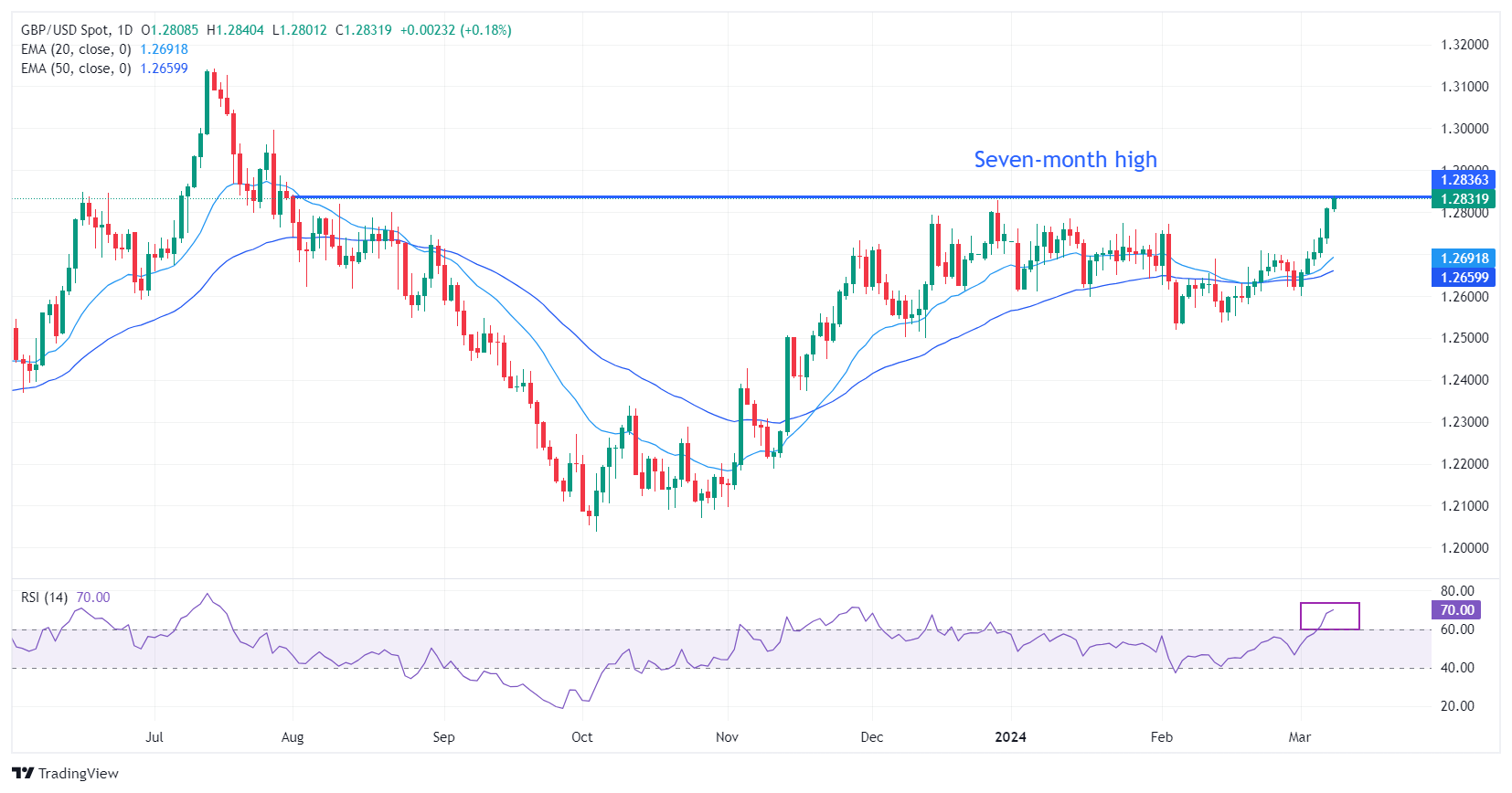
Pound Sterling refreshes a seven-month high around 1.29000. The GBP/USD pair strengthens after an upside break of the Descending Triangle formed on a daily time frame. A breakout of the aforementioned chart pattern results in wider-than-average ticks on the upside.
Upward-sloping 20-day and 50-day Exponential Moving Averages (EMAs) at 1.2690 and 1.2660 suggest more upside.
The 14-period Relative Strength Index (RSI) rises to 70.00, indicating that a bullish momentum is active now.
Employment FAQs
Labor market conditions are a key element to assess the health of an economy and thus a key driver for currency valuation. High employment, or low unemployment, has positive implications for consumer spending and thus economic growth, boosting the value of the local currency. Moreover, a very tight labor market – a situation in which there is a shortage of workers to fill open positions – can also have implications on inflation levels and thus monetary policy as low labor supply and high demand leads to higher wages.
The pace at which salaries are growing in an economy is key for policymakers. High wage growth means that households have more money to spend, usually leading to price increases in consumer goods. In contrast to more volatile sources of inflation such as energy prices, wage growth is seen as a key component of underlying and persisting inflation as salary increases are unlikely to be undone. Central banks around the world pay close attention to wage growth data when deciding on monetary policy.
The weight that each central bank assigns to labor market conditions depends on its objectives. Some central banks explicitly have mandates related to the labor market beyond controlling inflation levels. The US Federal Reserve (Fed), for example, has the dual mandate of promoting maximum employment and stable prices. Meanwhile, the European Central Bank’s (ECB) sole mandate is to keep inflation under control. Still, and despite whatever mandates they have, labor market conditions are an important factor for policymakers given its significance as a gauge of the health of the economy and their direct relationship to inflation.
Author

Sagar Dua
FXStreet
Sagar Dua is associated with the financial markets from his college days. Along with pursuing post-graduation in Commerce in 2014, he started his markets training with chart analysis.