Pound Sterling clings to gains against US Dollar while Fed monitors tariff-impact on inflation
- The Pound Sterling shows strength near 1.3650 against the US Dollar after the announcement of the Israel-Iran ceasefire.
- Fed’s Powell states that the central bank still needs time to assess the impact of tariffs on inflation.
- BoE’s Bailey expresses concerns over easing labor market strength.

The Pound Sterling (GBP) holds onto gains near a fresh three-year high around 1.3650 against the US Dollar (USD) during European trading hours on Wednesday. The GBP/USD pair strengthens as the US Dollar continues to underperform its peers, as its safe-haven demand has diminished significantly after the announcement of a ceasefire between Israel and Iran on Tuesday.
During the European trading session, the US Dollar Index (DXY), which tracks the Greenback’s value against six major currencies, struggles to hold the weekly low around 98.00.
On Tuesday, United States (US) President Donald Trump announced that a truce between Israel and Iran has become effective and urged them not to violate it. “The ceasefire is now in effect. Please do not violate it!" Trump wrote in a post on Truth Social.
Meanwhile, the support for maintaining interest rates at their current levels by Federal Reserve (Fed) Chair Jerome Powell in his semi-annual testimony before the US House Financial Services Committee on Tuesday has failed to uplift the US Dollar.
“I don’t think we need to be in any rush as long as economy is strong, and the uncertainty is high surrounding the still-unresolved tariff debate,” Powell said, Reuters reported. He guided that the central bank will closely monitor the “impact of tariffs on inflation during June and July” and expressed confidence that “interest rate cuts would come sooner if the central bank sees the tariff-driven inflation not as strong as expected."
Pound Sterling trades braodly stable while BoE's Bailey warns of labor market risks
- The Pound Sterling seems broadly stable against its major peers on Wednesday, even as Bank of England (BoE) Governor Andrew Bailey warned of downside risks to the United Kingdom’s (UK) labor market and reiterated a gradual downward interest rate path in his testimony before the Lords Economic Affairs Committee on Tuesday.
- “We [BoE] are starting to see labour market softening, and wage settlements are likely to come off," Bailey said. He added that the increase in employers’ contribution to social security schemes seems to be “affecting labour market”.
- Last week, Andrew Bailey also stated in the monetary policy announcement that the central bank will closely monitor upside inflation risks and downside labor market risks after leaving interest rates unchanged at 4.25%, with a 6-3 majority vote.
- Meanwhile, data from the latest employment surveys has also shown a slowdown in job vacancies. The recruitment platform Indeed showed that job vacancies were down 5% in mid-June compared to their level at the end of March, Reuters reported.
- This week, the US Dollar will be influenced by the US Personal Consumption Expenditures Price Index (PCE) data for May, which will be released on Friday. The Fed’s preferred inflation gauge is expected to show that price pressures grew at a fast pace year-over-year. The core PCE inflation data – which excludes volatile food and energy prices – is estimated to have accelerated to 2.6% YoY from 2.5% in April.
Technical Analysis: Pound Sterling holds onto gains above 1.3600
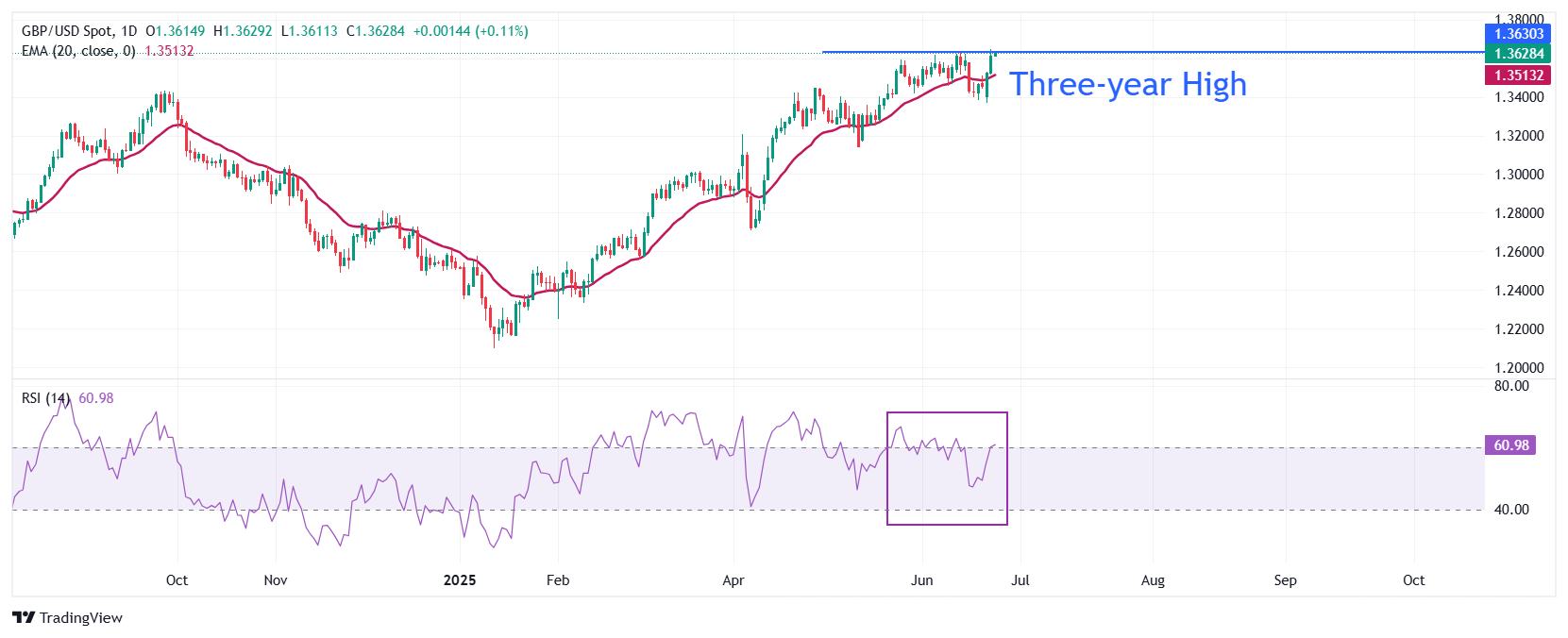
The Pound Sterling clings to gains near a fresh three-year high around 1.3650 against the US Dollar on Wednesday. The near-term trend of the GBP/USD pair remains bullish as the 20-day Exponential Moving Average (EMA) slopes higher around 1.3513.
The 14-day Relative Strength Index (RSI) rebounds above 60.00. A fresh bullish momentum would emerge if the RSI holds above that level.
Looking down, Monday's low at 1.3370 will act as a key support zone. On the upside, the January 13, 2022, high near 1.3750 will act as the key barrier.
Employment FAQs
Labor market conditions are a key element to assess the health of an economy and thus a key driver for currency valuation. High employment, or low unemployment, has positive implications for consumer spending and thus economic growth, boosting the value of the local currency. Moreover, a very tight labor market – a situation in which there is a shortage of workers to fill open positions – can also have implications on inflation levels and thus monetary policy as low labor supply and high demand leads to higher wages.
The pace at which salaries are growing in an economy is key for policymakers. High wage growth means that households have more money to spend, usually leading to price increases in consumer goods. In contrast to more volatile sources of inflation such as energy prices, wage growth is seen as a key component of underlying and persisting inflation as salary increases are unlikely to be undone. Central banks around the world pay close attention to wage growth data when deciding on monetary policy.
The weight that each central bank assigns to labor market conditions depends on its objectives. Some central banks explicitly have mandates related to the labor market beyond controlling inflation levels. The US Federal Reserve (Fed), for example, has the dual mandate of promoting maximum employment and stable prices. Meanwhile, the European Central Bank’s (ECB) sole mandate is to keep inflation under control. Still, and despite whatever mandates they have, labor market conditions are an important factor for policymakers given its significance as a gauge of the health of the economy and their direct relationship to inflation.
Author

Sagar Dua
FXStreet
Sagar Dua is associated with the financial markets from his college days. Along with pursuing post-graduation in Commerce in 2014, he started his markets training with chart analysis.