Pound Sterling clings to gains against US Dollar amid easing Trump tariff fears
- The Pound Sterling trades firmly near 1.2900 against the US Dollar as investors see US President Trump tariffs less fearful.
- Trump is poised to provide a one-month exemption for tariffs on automobiles from Canada and Mexico.
- BoE officials have guided a gradual policy-easing approach.

The Pound Sterling (GBP) clings to gains near 1.2900 against the US Dollar (USD) in North American trading hours on Thursday. The GBP/USD pair exhibits strength as the risk premium of the US Dollar has diminished significantly, with investors expecting the United States (US) President Donald Trump’s tariff agenda to be less fearful than what they had projected earlier.
Markets currently see Trump’s tariffs more as a tactic to have a dominant position while negotiating deals with US trading partners. On Wednesday, White House Press Secretary Karoline Leavitt said that the US President will exempt automobiles from 25% tariffs imported from Canada and Mexico for a month, which he imposed on Tuesday.
"We spoke with the big three auto dealers and are going to give a one-month exemption on any autos coming through USMCA,” Leavitt said and added, “Trump is open to hearing about additional tariff exemptions.” Also, the US President is considering providing the exemption on some agricultural products too, Agriculture Secretary Brooke Rollins told Bloomberg.
Going forward, the US Dollar will be influenced by the US Nonfarm Payrolls (NFP) data for February, which will be released this Friday. The labor market data will influence market speculation about the Federal Reserve’s (Fed) monetary policy outlook. Investors expect the economy to have added 160K jobs, higher than 143K in January. However, the US ADP reported on Wednesday that the private sector added 77K fresh workers in February, significantly lower than estimates of 140K and the former release of 186K.
During North American trading hours on Thursday, the US Department of Labor has reported lower-than-expected Initial Jobless Claims for the week ending February 28. Individuals claiming jobless benefits for the first time come in lower at 221K, fewer than estimates of 235K and the former release of 242K.
Daily digest market movers: Pound Sterling weakens while BoE guides moderate policy-easing approach
- The Pound Sterling trades lower against its peers on Thursday despite Bank of England (BoE) officials reiterating a “gradual and cautious” policy easing approach while testifying before Parliament’s treasury department on Wednesday.
- BoE Monetary Policy Committee (MPC) member Megan Greene advocated for a “gradual path” for “removing monetary policy restrictiveness” as the inflation persistence is less likely to fade on its own accord. BoE Chief Economist Huw Pill argued that there is more work to do to “squeeze out” underlying inflation.
- BoE Governor Andrew Bailey said more about the consequences of US President Donald Trump-led trade war on the global economy. However, he warned that the hike in employers’ contribution to National Insurance (NI) announced by Chancellor of the Exchequer Rachel Reeves in the Autumn Budget will increase job costs by 2%, lifting inflation by 0.1%-0.2%.
- Meanwhile, traders have fully priced in two more 25 basis points (bps) interest rate cuts by the BoE this year. The BoE also reduced its key borrowing rates by quarter-to-a-percent in the February policy meeting to 4.5%.
Technical Analysis: Pound Sterling gathers strength to break above 61.8% Fibo retracement
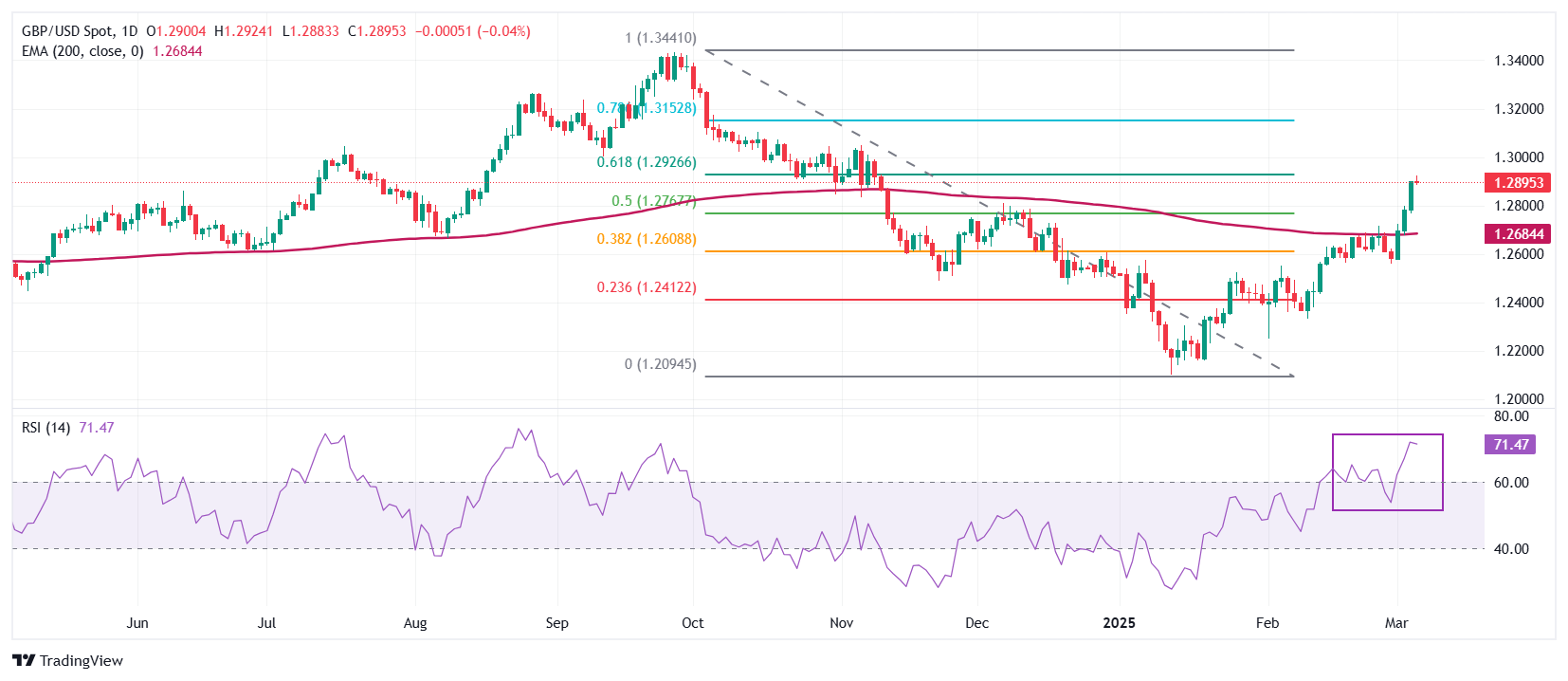
The Pound Sterling rises to the 61.8% Fibonacci retracement plotted from the late September high to mid-January low and tops near 1.2930 on Thursday. The long-term outlook of the GBP/USD pair has turned bullish as it holds above the 200-day Exponential Moving Average (EMA), which is around 1.2680.
The 14-day Relative Strength Index (RSI) climbs above 60.00, suggesting a strong bullish momentum.
Looking down, the 50% Fibo retracement at 1.2767 and the 38.2% Fibo retracement at 1.2608 will act as key support zones for the pair. On the upside, the psychological 1.3000 level will act as a key resistance zone.
US Dollar FAQs
The US Dollar (USD) is the official currency of the United States of America, and the ‘de facto’ currency of a significant number of other countries where it is found in circulation alongside local notes. It is the most heavily traded currency in the world, accounting for over 88% of all global foreign exchange turnover, or an average of $6.6 trillion in transactions per day, according to data from 2022. Following the second world war, the USD took over from the British Pound as the world’s reserve currency. For most of its history, the US Dollar was backed by Gold, until the Bretton Woods Agreement in 1971 when the Gold Standard went away.
The most important single factor impacting on the value of the US Dollar is monetary policy, which is shaped by the Federal Reserve (Fed). The Fed has two mandates: to achieve price stability (control inflation) and foster full employment. Its primary tool to achieve these two goals is by adjusting interest rates. When prices are rising too quickly and inflation is above the Fed’s 2% target, the Fed will raise rates, which helps the USD value. When inflation falls below 2% or the Unemployment Rate is too high, the Fed may lower interest rates, which weighs on the Greenback.
In extreme situations, the Federal Reserve can also print more Dollars and enact quantitative easing (QE). QE is the process by which the Fed substantially increases the flow of credit in a stuck financial system. It is a non-standard policy measure used when credit has dried up because banks will not lend to each other (out of the fear of counterparty default). It is a last resort when simply lowering interest rates is unlikely to achieve the necessary result. It was the Fed’s weapon of choice to combat the credit crunch that occurred during the Great Financial Crisis in 2008. It involves the Fed printing more Dollars and using them to buy US government bonds predominantly from financial institutions. QE usually leads to a weaker US Dollar.
Quantitative tightening (QT) is the reverse process whereby the Federal Reserve stops buying bonds from financial institutions and does not reinvest the principal from the bonds it holds maturing in new purchases. It is usually positive for the US Dollar.
Author

Sagar Dua
FXStreet
Sagar Dua is associated with the financial markets from his college days. Along with pursuing post-graduation in Commerce in 2014, he started his markets training with chart analysis.